Where to Buy a Sizzix Die Cutting Machine: A Procurement Checklist for Corporate Gifts
-
1. Write down every gift and promotional-product use before you buy
-
2. Choose the machine for your actual setup: start with the Big Shot manual
-
3. Plan your dies before you confirm the machine
-
4. Buy from an authorized Sizzix B2B channel, not a random marketplace
-
5. Test materials before you produce all 400
- 6. Make the gift reusable and teach people how to get old wax out of a candle holder
-
7. Budget for pads, labor, and the boring parts
-
Bottom line: treat it as a production decision
I manage purchasing for a roughly 300-person company. Corporate gifts sit in an uncomfortable spot between procurement and marketing: they aren't office supplies, and they aren't exactly advertising, but someone has to order them. That someone is me. I process somewhere around 60-80 orders a year, and in 2024 I had to deliver 400 personalized client thank-you gifts without blowing the budget or the timeline.
Here's how that project led me to a Sizzix die cutting machine. I priced custom die-cut tags with each recipient's name printed on them. The minimum order was too high, the lead time was close to a month, and the color proofs didn't match our brand. So I looked at producing the die-cut parts in-house. After a pilot test, I bought a Sizzix Big Shot manual die cutting machine. I would have saved three weeks of research if I'd had this checklist below.
1. Write down every gift and promotional-product use before you buy
Don't buy a machine for one project. That's how die cutters and electronic cutters end up in storage closets. Make a list first. Here's what ours looked like for a normal year:
- New client welcome kits: about 60 per year
- Employee anniversary gifts: one or two per month
- Holiday client gifts: one run of 400
- Trade show giveaways: two events per year
Once I put it on paper, the die cutter stopped looking like a craft purchase and started looking like a flexible production station. The upside was that we could personalize on our schedule: no volume minimum, no external proofing, no rush charges. The risk was that manual die cutting eats labor. I kept asking myself whether 400 gifts were worth creating a new process. It wasn't, for one order. It was, though, because a tag die and alphabet set could come back for employee anniversaries, onboarding kits, and event kits. The expected value worked only because the machine wasn't meant for a single run.
2. Choose the machine for your actual setup: start with the Big Shot manual
If you type "where to buy Sizzix die cutting machine" into a search bar, you'll see several models: Sidekick, Big Shot, Big Shot Plus, Big Shot Pro, and some electronic options. It's tempting to compare specs first. Don't. Compare the environment where the machine will run.
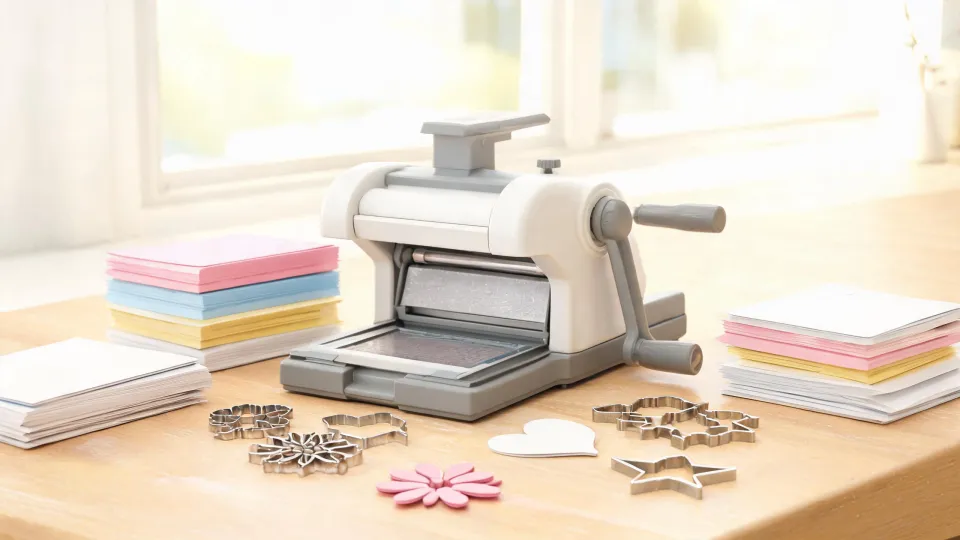
The Sizzix Big Shot manual die cutting machine was the right call for us. No software updates, no firmware, no driver conflicts with locked-down company laptops. It's quiet, runs on a crank, and any employee can learn the sandwich in about two minutes: platform, pad, die, material, pad. The standard Big Shot handles dies up to roughly 6 inches wide. That covers gift tags, greeting cards, ornaments, small box inserts, and most of what a corporate gift program needs. If you regularly need bigger pieces, Sizzix makes wider and larger machines; buy for your usual size, not the once-a-year project.
3. Plan your dies before you confirm the machine
The machine is only the platform. The dies do the actual work, and die selection determines what you can produce. This is also the step people skip. They buy a starter bundle of pretty shapes, then find out there's no font set for personalization and no tag die in the size they need.
For corporate gifts, the dies that earned their keep for us were:
- A standard gift tag die in a size that fits inside a small box or attaches to a candle holder
- A quality alphabet set for first names and short messages
- A basic circle or rounded square die for inserts, tabletop signs, and event place cards
- One custom Sizzix die with our logo
The custom logo die made the biggest difference. It follows the same process as ordering custom packaging: you supply vector artwork, approve a proof, then wait for tooling and shipping. That lead time can easily eat two weeks, so place the custom die order at the same time you order the machine, not after the first test run looks okay.
Also consider licensed dies. Sizzix works with designers like Tim Holtz, whose holiday die collections have fine detail. They're useful for annual client gifts and event themes, but buy a practical core of shapes first and add the decorative dies after you've run one full test.
4. Buy from an authorized Sizzix B2B channel, not a random marketplace
Where to buy a Sizzix die cutting machine depends on who's paying. A one-time retail buyer can order from the official Sizzix website or an authorized craft store. But a company needs more than a box at the front door: we need an itemized invoice, tax-exempt paperwork, consistent part numbers, and someone to contact if something is missing.
We made the mistake of ordering our first machines from an online marketplace. The order came from a third-party seller, the invoice wasn't itemized, and our finance team rejected it. The machines went back. Instead, I set up a proper account through Sizzix's wholesale or distributor route. It took an application and a resale certificate, but after that every order generated clean invoices and the discount structure made sense for repeat buying. That matters more than saving a few dollars on a cutting pad.
As of early 2025, the most direct way to verify an authorized channel is sizzix.com. If you're a promotional products company or a distributor, ask about trade pricing when you apply. If you're a regular corporate buyer, a B2B account with an authorized distributor still simplifies reordering pads and dies later.
5. Test materials before you produce all 400
Die cutting is not magic. You have to match the material, the die, and the cutting pad stack, and you can't do that by guessing. We wasted about 40 sheets of premium cardstock before we stopped treating it like a printer paper decision.
Here's what we learned about paper weights:
- Standard copy paper is 20 lb bond, about 75 gsm. It cuts, but it feels too flimsy for a gift tag.
- 80 lb text, about 120 gsm, cut cleanly but still felt thin.
- 100 lb cover, about 270 gsm, was our sweet spot. Tags felt substantial in the hand and still cut without excessive force.
If your tag carries a printed logo, treat printing as a color-managed job. A standard office printer won't reliably match a brand color. We ordered the printed sheets from a local print shop and asked them to hold the logo color to a Delta E of less than 2, which is the industry reference for brand-critical color matching. Then we cut those printed sheets in-house with the Sizzix Big Shot.
And run one sheet at a time. We tried stacking multiple sheets of 100 lb cover to save time. The top sheets looked fine, but the bottom sheet came out with torn edges. One sheet per pass was slower, but the waste rate dropped to almost zero.
6. Make the gift reusable and teach people how to get old wax out of a candle holder
Here is the part I didn't expect to matter: what happens after the gift is used. A branded candle holder is attractive on day one, but if the recipient doesn't know how to clean it, it goes in the trash once the candle burns down. We printed a small care card and put it in every gift box. That simple step made the branded holder useful long after the candle was gone.
How to Get Old Wax Out of a Candle Holder
Let the candle burn until about 1/4 inch of wax remains, then let the holder cool completely. Place it in the freezer for 1 to 2 hours. The wax will contract and usually pops out of the glass with a light tap. If a thin film remains, fill the holder with warm water and a few drops of dish soap, wait 15 minutes, and wipe it clean with a soft cloth. For stubborn marks, rub with a paste of baking soda and water. Do not scrape the inside with a metal knife, and don't pour boiling water into a cold glass holder. Those shortcuts cause scratches and thermal shock.
That card turned out to be one of the best parts of the whole project. Recipients kept the holder on their desk instead of throwing it away, which means our logo stayed visible for months. It also made the gift feel more thoughtful, and it gave our team a small but real story to tell about sustainability and reusability.
7. Budget for pads, labor, and the boring parts
The machine isn't the only cost. Cutting pads wear out unevenly, and worn pads cause partial cuts. We didn't factor this in at first and almost blamed the machine for what was really a worn-pad problem. Buy replacement pads at the same time as the machine and plan to replace them after heavy production runs. Write the replacement date on the pad itself if you have to.
Also count the labor honestly. For our run of 400 personalized tags, two manual Big Shot machines plus three people took about two full workdays. It wasn't hard work, but it was work, and it required table space, die storage, and someone to keep the line moving. If you have a hard deadline, schedule the people before you schedule the die.
I do not buy major production equipment for a single event. The machine only made sense because we had five gift-related touchpoints across the year. And remember that Sizzix pricing and authorized distributors can change, so verify current purchasing channels on the official website before you commit.
Bottom line: treat it as a production decision
Corporate gifts can be personalized, but personalization has to be produced somehow. A Sizzix die cutting machine is a reasonable option when you have recurring projects, short-run personalization needs, and a clear plan for materials, maintenance, and labor.
- List your actual gift calendar before buying anything.
- Start with a Sizzix Big Shot manual die cutting machine for basic runs.
- Choose dies around real projects, and order the custom logo die early.
- Buy through an authorized Sizzix wholesale or distributor route so finance gets clean invoices.
- Test cardstock at the weights you'll actually use, and print color-critical work separately.
- Add a care card for reusable gifts such as candle holders.
- Budget for cutting pad replacement and staff time, not just the machine price.
That wax cleanup tip alone changed how our recipients saw the gift. The Sizzix machine got the project made, but the small practical details are what made the brand feel worth keeping.

Elise Laurent is a crystal and decorative glass quality analyst covering crystal figurines, vases, ornaments, suncatchers, and gift glassware. She examines ISO 6486-1 where food-contact glass dinnerware applies, then uses polarized strain inspection, dimensional checks, surface-defect grading, and refractive clarity to compare decorative pieces outside that scope. Her work helps sourcing teams choose materials, finishing routes, and protective packaging without confusing visual brilliance with verified durability.