Custom Sizzix Dies and What Actually Makes a Good Corporate Gift: A Cost Controller's View
Most corporate-gifting advice starts with the wrong question. People ask, “What makes a good corporate gift?” I’ve spent six years as procurement manager for a 40-person promotional products company, managing an annual corporate-gift budget around $120,000. I now think the right question is different: “Can we promise exactly this gift, at exactly this quality, by exactly this date?” If the answer is “probably,” then you don’t have a gift problem. You have a risk problem.
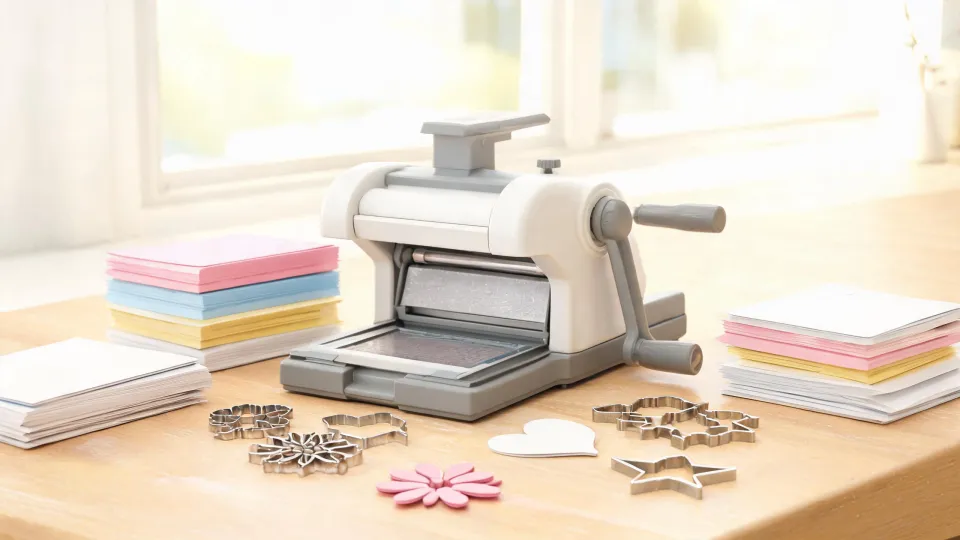
The item you choose matters less than the certainty you can offer. That’s why custom Sizzix dies and a reliable Sizzix electric die cutting machine show up in my budget discussions. They aren’t “craft supplies.” They are scheduling tools.
The object is less important than the repeatability
A good corporate gift should feel personal, but from a procurement perspective it has to be reproducible. Let’s use a candle holder as an example. Clients ask for candle holders all the time—hotels, real estate teams, even banks. The glass part is fairly generic. What makes the gift feel custom is the die-cut sleeve or wrap around it.
If you produce 800 candle holder wraps by hand, every piece will be a little different. Someone will cut too high. Someone will score the fold line crookedly. The gift will look fine at first, but when a few units arrive damaged, the whole order feels cheap. That is a risk you carry all the way to delivery day.
A custom Sizzix die cuts and scores the same shape over and over. The operator’s job changes from “measure carefully” to “place material and press.” That consistency is not a small thing in corporate gifts. It is the difference between showing a client a perfect sample and showing them a perfect run.
My TCO spreadsheet doesn’t lie
I know the word “spreadsheet” is not glamorous, but this is where cost control actually happens. I do not evaluate a gift by its unit price. I evaluate it using total cost of ownership—TCO (i.e., materials, tooling, labor, shipping, quality control, and the cost of missing the date). A low quote with an estimated delivery date is not a low TCO. It is a high-risk quote wearing a cost-saving costume.
In October 2023, we needed 500 die-cut cardstock ornaments for a bank’s December 1 client event. A supplier quoted $380 less than producing them in-house with a custom Sizzix die we already owned. When I asked whether they could commit to a November 27 delivery, the answer included the words “estimated delivery” and “probably.” I had been burned by “probably” before, so we ran the job ourselves and paid our team a small overtime shift. The order shipped on November 21. That $380 difference was not waste. It was a certainty premium.
I don’t have hard data on how many unexpected rush fees in our industry come from this pattern. But I can say this anecdotally: every late-night scramble in my own budget review was connected to a promise I couldn’t verify, not to a unit price that was too high.
Never expected a steel-rule die to become a schedule stabilizer. I expected custom Sizzix dies to solve a quality problem. It turned out they solved a timeline problem too.
What about expedite fees?
I have mixed feelings about rush fees. Part of me thinks they are a tax on someone else’s poor planning. Another part has watched what an actual rush order does to a production floor: jobs stop, dies change, quality control gets compressed. The fee is not only paying for speed. It is paying for priority.
For reference, public fee schedules from commercial printers and die-cut service companies in early 2025 show next-business-day expediting at roughly 50–100% above standard pricing. Basic steel-rule die setup often runs around $50–$200 depending on complexity. Those numbers are not universal, and I’m not defending every fee. But in a corporate-gift timeline, $180 of expediting is cheap compared to the cost of telling a client “we missed the date.”
The objection I keep hearing
A purchasing manager will say, “If my CEO tells me to cut the gift budget by 5%, I don’t have room for custom dies.” I used to make that same argument myself. But cutting unit cost by 5% and then paying overtime and expedite fees because the cheaper supplier can’t make a date is not cost control. It’s cost theater.
I built a TCO calculator after hidden fees and missed dates burned us twice. Now every new die decision goes through it. If a stock Sizzix die works for a one-off sample, we use the stock die. But if the same gift will be repeated—ornaments every December, candle holder sleeves for every new hotel opening—a custom die pays for itself by the second run.
The question should never be “how much does this custom Sizzix die cost?” The question should be “what does this custom die cost per reliable unit over the life of the corporate gift program?” That calculation makes the decision honest.
We still use manual Sizzix machines for short runs and samples. For quantities above a few hundred, we use a Sizzix electric die cutting machine. The electric machine doesn’t make the creative decisions, but it removes the bottleneck. One operator can stage materials while the machine runs. That is how a deadline stops being scary.
So what makes a good corporate gift?
After six years of purchase orders, vendor negotiations, and a few unpleasant “late order” phone calls, my answer is simple. A good corporate gift has four traits:
- It is appropriate enough to be used.
- It carries the brand without shouting.
- It can be reproduced consistently at the required quantity.
- It arrives when promised.
That last trait is where custom Sizzix dies, a Sizzix electric die cutting machine, and a procurement manager who thinks in TCO come in. The gift might be a candle holder, a die-cut greeting card, or an ornament. But the real product is a kept promise.
I’m not saying you should always pay more. I’m saying you should stop pretending that “probably on time” has no price. In the corporate gift business, uncertainty is a cost. Once you put it in the spreadsheet, you start making different choices—and your clients notice.

Elise Laurent is a crystal and decorative glass quality analyst covering crystal figurines, vases, ornaments, suncatchers, and gift glassware. She examines ISO 6486-1 where food-contact glass dinnerware applies, then uses polarized strain inspection, dimensional checks, surface-defect grading, and refractive clarity to compare decorative pieces outside that scope. Her work helps sourcing teams choose materials, finishing routes, and protective packaging without confusing visual brilliance with verified durability.