Your Corporate Gift Is Judged Before It’s Opened: Sizzix Die-Cut Quality and Personalized Wrap
I’m the person who spoils the fun in corporate gift projects. Quality and brand compliance manager at a promotional products company; I review every sample that goes to a B2B client before it ships. That’s roughly 200+ unique deliverables a year, and I still reject about 8% of first deliveries. Usually for details most people would call tiny.
So here’s my hot take: the gift itself is rarely the reason a corporate gift works. Recipients form an opinion about your company before they even know what’s inside the package.
From the outside, it looks like sending corporate gifts is about picking the right item—the ornament, the desk piece, the candle holder, the gift card. The reality is it’s about the moment the package lands on someone’s desk. Recipients audit your attention to detail in the three seconds it takes to register the heft of the box, the quality of the wrap, the edge of the die-cut tag. Miss that window, and the actual gift has to work twice as hard to recover.
Recipients audit your details, not your intentions
People assume that as long as the thing inside is nice, the outer stuff is just packaging. But I’ve sat in on debriefs after gifting campaigns and heard what recipients actually mention. They mention when the box felt flimsy. They mention when the Christmas die-cut on the tag had rough edges. They mention when the foil-stamped logo was slightly off-center. Those small things are how recipients decide what kind of company you run.
Color is the miss I see most often. Procurement knows their brand blue in RGB for the website, then forgets to specify a Pantone reference for tissue, wrap, and tags. Industry standard color tolerance is Delta E below 2 for brand-critical colors (according to Pantone’s color matching guidelines, pantone.com). A Delta E between 2 and 4 is noticeable to trained observers; anything above 4 is visible to basically everyone. A corporate Christmas red that drifts orange will quietly undermine a lot of expensive design work.
When I implemented our verification protocol in 2022, color checks were the first thing I added. Not because recipients would ever use the phrase “Delta E.” It’s because they’d use words like “cheap” or “off” instead. Same outcome, worse vocabulary.
We tested the forty-cent question
In Q3 2024, I ran a blind test with one client’s procurement team. Same exact gift in every box: a die-cut ornament, produced on a Sizzix cutting machine with a custom Christmas die. Half went into plain white mailers. Half went into branded tissue, a personalized gift wrap finish, and a die-cut insert cut from 100 lb cover stock (the same weight as a sturdy business card). What was inside was identical.
We asked which version felt more professional. About 7 out of 10 picked the wrapped one without knowing the difference. Several said it looked “worth more.” The extra cost was about $0.40 per unit. On a 1,000-piece corporate order, that’s $400 for measurably better brand perception. On a 200-piece run, it’s $80. It’s almost a no-brainer, if you actually stop to calculate it.
Before anyone calls me a packaging romantic: I have mixed feelings about presentation upgrades when they’re used to mask an average product. If the ornament inside is mediocre, no amount of branded tissue will save it. But if the product is good and the presentation is lazy, you’ve paid for quality and then hidden it. Most corporate gift programs fail in that second half, not the first.
I also know the cost of missing this stuff. In 2023, an 8,000-unit order hit a wall when the greeting-card insert came back 2mm too wide for its box after lamination. The redo cost our client about $22,000 and delayed their launch by two weeks. Nobody had checked the physical specs of the insert, because everyone was focused on the ornament. The most expensive mistakes in this industry are rarely about the hero product. They’re about the piece nobody thought of as part of the design.
Custom dies are a consistency tool, not a branding gimmick
Here’s something vendors won’t tell you: the “custom die” gets sold to clients as a way to put a logo in a new shape. The real value, for corporate gifting, is repeatability. Order the same Christmas tree shape from three outside suppliers and you’ll get three slightly different trees: different edge finish, different tolerances, different behavior on thick cardstock. Around a single craft table, nobody notices. In a corporate program where fifty recipients sit in the same office and compare gifts? You’ll hear about it.
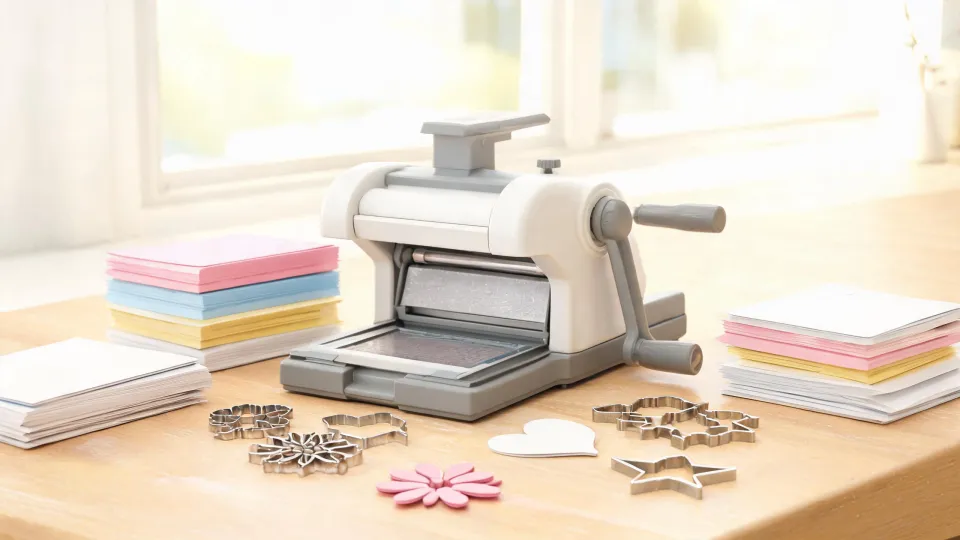
That’s why I’m a believer in controlling your cut quality. We run a Sizzix cutting machine in-house with custom Sizzix dies for seasonal work, and when a holiday program comes up I often point clients to the Sizzix Tim Holtz Christmas dies as a design benchmark. Not because the name looks better in a pitch. Because those dies are engineered to cut cleanly through layered cardstock without tearing fibers or snapping small bridges. When you scale to a few thousand ornaments, a die that leaves fuzzy edges can be the difference between a 2% scrap rate and a 15% one. You only find that out if you’re tracking quality by component, not by finished gift.
Where do you find personalized gift wrap services?
A question I hear often from corporate buyers is, “where can I find personalized gift wrap services?” I understand why they ask. It sounds like a hidden procurement category that doesn’t show up in normal search results. My honest answer: don’t start by searching for “personalized gift wrap services.” Start by looking for a print partner that handles branded wrap, tissue, and die-cut tags under one roof, then qualify them like any packaging supplier.
Here’s the short checklist I give clients:
- Ask about color control. If a supplier says they’ll “just match it on screen,” that’s a red flag. You want someone who works from Pantone references and can talk about color tolerance in production.
- Ask if foil, embossing, and die-cutting happen in their own shop. Coordinating three separate vendors for one gift presentation is how deadlines and quality get lost.
- Ask for a folded sample, not a flat mockup. Fold the wrap over a real box, check whether the ink cracks along the crease, and inspect the tag edge. Foil can look flawless flat and shatter around a corner.
- Be realistic about turnaround. Custom branded wrap is a production job. A supplier that promises instant delivery on color-matched, foil-stamped wrap is usually cutting a quality corner somewhere.
Paper weight is another lever. For die-cut tags, I prefer 100 lb cover or at least 80 lb cover (216 gsm) so the piece has enough stiffness to feel intentional. Flimsy tags bend in the first pocket they travel in, and a bent tag reads as a sloppy company. Those are details that get quoted back to you later, usually by a recipient who never told you they noticed.
What if your order is only 200 pieces?
By this point, someone usually says: “We’re not producing 50,000 units. Our sales team needs 200 corporate gifts for December. Do we really need custom dies and personalized wrap?”
Part of me wants to say that fancy presentation only pays off at scale. I used to believe that, and I’ve watched enough small orders suffer from it to change my mind. In 2024, a financial-services client ordered 200 beautifully die-cut ornaments with printed inserts. Gorgeous product. They skipped branded wrap and mailed them in plain boxes. The reaction from recipients was polite instead of impressed. The product investment was there; the perception investment wasn’t.
For 200 units, good wrap plus a die-cut tag can add roughly $0.40–$0.60 per gift (based on 2025 supplier quotes; verify current pricing). That’s $80 to $120 total. Compare that with what you already spent on product, printing, and shipping. It’s a rounding error—assuming you care what the gift makes people feel.
Custom dies are a separate conversation. If you order once and never again, the tooling cost can feel hard to justify. But holiday corporate gifts tend to repeat every year. Spread the setup cost over three December seasons and it becomes normal production equipment. And if your run is tiny, there are well-designed standard die lines, including the Sizzix Tim Holtz Christmas dies, that deliver a clean, craft-quality result without custom tooling. The point isn’t to spend for its own sake. It’s to make the presentation as deliberate as the product itself.
Bottom line
Corporate gifts aren’t objects you mail. They’re brand moments you produce, and recipients judge those moments by first sight, not by your internal design intent.
People assume the corporate gift is the part inside the box. After four years of reviewing 200+ unique deliverables annually, I’m convinced the moment around the box is the part that decides the feeling. A clean die-cut edge, an accurate brand color, a wrap that doesn’t crack at the seam—those are quiet benchmarks of professionalism. Get them right and the gift inside can do its job. Get them wrong, and you’ve just taught your best client how you really work.

Elise Laurent is a crystal and decorative glass quality analyst covering crystal figurines, vases, ornaments, suncatchers, and gift glassware. She examines ISO 6486-1 where food-contact glass dinnerware applies, then uses polarized strain inspection, dimensional checks, surface-defect grading, and refractive clarity to compare decorative pieces outside that scope. Her work helps sourcing teams choose materials, finishing routes, and protective packaging without confusing visual brilliance with verified durability.