Why Corporate Gift Projects Keep Cutting Out (and What Actually Fixes Them)
Last November, I placed an order for 180 die-cut felt ornaments as our end-of-year corporate gift. The concept was simple: a Christmas tree shape cut from felt, personalized with each client's name on a small matching tag. The supplier confirmed the design. Then the boxes arrived with the name die slightly off on more than half of the run.
The production manager's explanation was short: 'The machine cut out during the middle of the run. By the time we reset it, the die never lined up exactly again.'
So I did what any buyer would do. I started searching machine troubleshooting. 'Why does the machine keep cutting out?' 'Which die cutter is more reliable?' I compared specs and forum threads until I ran out of coffee.
I was asking the wrong question.
I'm an office administrator for a 180-person company. I manage our corporate gift buying—roughly 60 to 80 orders a year, about $90,000 in total spend, across eight vendors. I've been doing this since 2020. I have the scars and the spreadsheet history to spot a pattern.
The machine was not the problem.
The Surface Problem
On the surface, this was a reliability problem. If the machine hadn't stopped, every ornament would have lined up. That was the supplier's story, and honestly, it was the story I wanted to believe too.
But when I looked back at our last five years of custom gift orders, almost every miss followed the same pattern: a custom shape, a tight deadline, and a description that was too vague to turn into a production spec. We would explain a concept in words. The vendor would translate that concept into a die setup. Somewhere between the translation and the first cut, the order 'cut out.'
In other words, the real problem wasn't the machine stopping. It was that our entire process expected the machine to be perfect every time.
The Deeper Issue: We Treated Custom Gifts as One-Off Crafts
It took me three years and about 60 gift orders to understand that custom die-cut gifts fail before the machine even starts. The breakdown usually happens upstream.
The first problem was my own brief. When I asked for a 'felt Christmas ornament,' that didn't mean much. Which felt? What thickness? Which die? Did the tree shape need a loop at the top? Should the name be centered the same way regardless of how many letters it has? The supplier made reasonable assumptions. Some of those assumptions were wrong. We didn't have a formal spec sheet for custom dies or for standard motifs, so every order was a new conversation. It cost us when a 'minor adjustment' became a full re-run.
The second problem was that we treated repeatable and personalized as opposites. I used to think a personalized gift had to be fragile—each one different, so each one risky. That's not true. With die cutting, the base shape can be standard. The company name or employee name can be handled separately as a custom die. But our old process never captured that. We treated the die as a one-time cost buried in the purchase order, not as an asset we could reuse. So the next year, we paid for the same confusion all over again.
The third problem was the handoff. There were too many people between the design idea and the physical cut. Marketing described the concept. The vendor's salesperson translated it. A production person set up the die. Nobody had a physical sample to approve until it was too late. Every handoff added time and another chance for the process to cut out.
Here's the thing: none of that showed up on the supplier's quality checklist. It showed up on the production floor, after the machine had already started.
The Real Cost of Ignoring the Process
I track this stuff because I report spend to finance every month, and because I've learned that good supplier relationships don't survive sloppy specs.
The failed ornament run cost us about $1,900 in extra rework and rush delivery. That hurt. The bigger cost was time. I logged twelve hours chasing that single order, and finance spent another four untangling the invoice. It wasn't the first time we ate that kind of cost. I just got better at measuring it.
The least obvious cost was internal trust. My VP asked me two weeks later, 'Can we handle a 400-person corporate gift program for the new office?' I said yes, even though our internal workflow wasn't ready. I spent the next month building that workflow while trying not to look uncertain.
That uncertainty came from knowing we were one bad run away from the same failure again.
What Actually Solved It
We didn't replace our supplier. We changed our starting point.
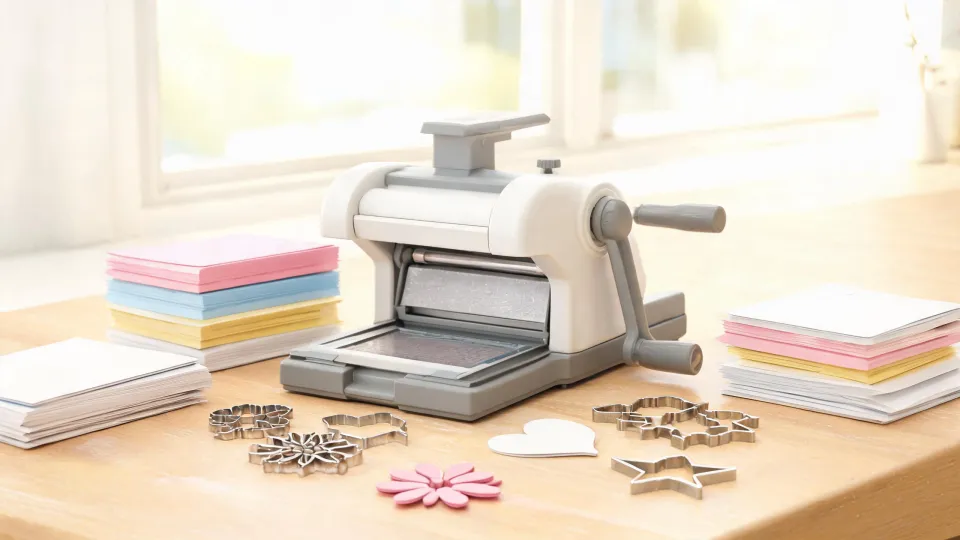
I bought two Sizzix die cutting machines and a starter set of dies for our office. One machine sits in a small supply room for prototypes. The other is used for low-volume personalized gift requests and seasonal samples. It was not a big capital expense, especially compared with the cost of one failed corporate gift run.
We also ordered a set of Sizzix Christmas dies in mid-summer. That felt strange at first. But we wanted the die shapes tested, approved, and ready before Q4 rush. When the holiday orders finally arrived, we weren't guessing. We were choosing from shapes we had already cut.
Here's what our new process looks like:
- Pick a base die. For Q4 corporate gifts, the base is usually a Sizzix Christmas tree, snowflake, or ornament die. It's a standard shape that we can source again.
- Decide personalization. A custom Sizzix die can cut a company name, event name, or employee initial. We order the custom die as a tool, not as a one-time mystery expense. It gets a label and a storage spot.
- Make one physical sample. We cut the exact felt or paper in-house using the same die, then send that sample to our production partner. No more email descriptions.
- Use one shared order template. It lists die names, material type, cut pressure, and packaging notes. It is boring. It saves us.
Switching to this workflow cut our sample approval time from about five days to two days. It also reduced the number of times we had to say 'sorry, that's not what we meant.' Sizzix die cutting machines & dies gave us a physical source of truth. A die doesn't interpret. It cuts a fixed shape. If the sample is right, the tool is right.
To be fair, this didn't make every problem disappear. A die cutter won't fix a missed delivery date. It won't correct bad design. But it fixed the root cause for us: the missing reference sample.
The Bottom Line
So why does the process keep cutting out?
Usually because we blame the nearest machine and ignore the system around it. A machine stops. A die shifts. A print moves. Those are real events, but they're easier to talk about than 'we don't have a repeatable, shared process.'
The cut-out happens long before the material goes into the machine. It happens when we rely on verbal descriptions instead of physical dies.
If you manage corporate gifts like I do, don't ask which machine is more reliable. Ask whether you can make one sample before you commit to a full run. Then build a small kit of Sizzix dies and let that kit be your standard. It took me three years and more rework than I want to admit to understand that. I'm writing this so you can get there faster.

Elise Laurent is a crystal and decorative glass quality analyst covering crystal figurines, vases, ornaments, suncatchers, and gift glassware. She examines ISO 6486-1 where food-contact glass dinnerware applies, then uses polarized strain inspection, dimensional checks, surface-defect grading, and refractive clarity to compare decorative pieces outside that scope. Her work helps sourcing teams choose materials, finishing routes, and protective packaging without confusing visual brilliance with verified durability.