Why I Check Twice Before Buying Custom Gifts (And You Should Too)
-
My $2,400 Lesson: Prevention Beats Cure in Custom Gift Procurement
-
Argument 1: Verify Invoicing Capability Before You Order
-
Argument 2: Color and Material Specs Are Not "Close Enough"
-
Argument 3: Check Die and Machine Compatibility (Yes, Even Sizzix)
-
But Isn't All This Checking Just Slowing Us Down?
-
Reaffirming the Point: Prevention Is the Best Deal
My $2,400 Lesson: Prevention Beats Cure in Custom Gift Procurement
I'm an office administrator for a 250-person company. I manage all gift and promotional ordering—roughly $180,000 annually across 12 vendors. I report to both operations and finance. After five years of managing these relationships, I've learned one thing the hard way: checking twice upfront is cheaper than fixing once later.
This isn't about bureaucracy. It's about not eating $2,400 out of your department budget because a vendor can't provide a proper invoice. It's about not missing a client deadline because the "red" on your personalized gift didn't match their brand. And it's about not scrapping 500 greeting cards because the paper weight was wrong.
Argument 1: Verify Invoicing Capability Before You Order
In 2022, I found a great price from a new vendor—30% cheaper than our regular supplier. I ordered 500 personalized gifts for a sales team event. They delivered on time. The product looked fine. But when I submitted the invoice, finance rejected it. The vendor had given me a handwritten receipt. No tax ID. No itemized breakdown. I ate $2,400 out of the department budget.
I still kick myself for not checking that upfront. If I'd asked one simple question—"Can you provide a proper invoice with your tax ID and itemized costs?"—I would've saved myself the headache. Now I verify invoicing capability before placing any order, no matter how good the price looks.
Why does this matter? Because in corporate procurement, your reputation is tied to your paperwork. A vendor who can't invoice properly makes you look bad to finance and operations. And that's a cost no discount can offset.
Argument 2: Color and Material Specs Are Not "Close Enough"
Everything I'd read about color matching said it was straightforward. In practice, it's the #1 source of rework for branded gifts and greeting cards. We learned this when a client rejected an entire batch of custom greeting cards because the red wasn't their corporate red.
Industry standard color tolerance is Delta E < 2 for brand-critical colors. Delta E of 2-4 is noticeable to trained observers; above 4 is visible to most people. Reference: Pantone Color Matching System guidelines.
We'd assumed "red is red." But the printed cards were visibly orange-red compared to their brand guidelines. We had to reprint 1,000 cards at our own cost—$1,800 and two weeks lost. Now I require a Pantone match or a physical proof before any full run. For print resolution, we also specify 300 DPI at final size, because a low-res logo on a personalized gift looks cheap.
When I compared our Q1 and Q2 results side by side—same vendor, different specifications—I finally understood why the details matter so much. The extra 20 minutes spent reviewing color chips and paper stocks saved us from a repeat.
Argument 3: Check Die and Machine Compatibility (Yes, Even Sizzix)
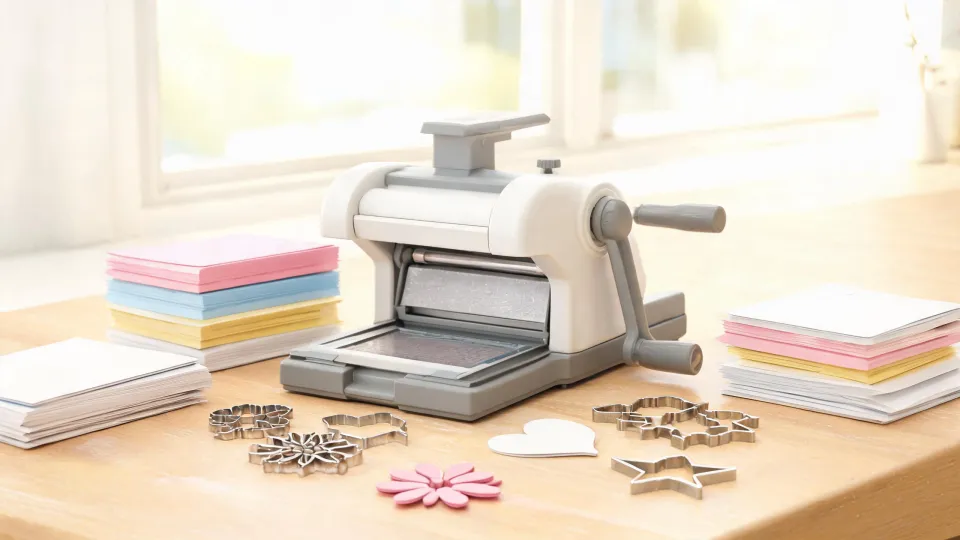
We use Sizzix products heavily for corporate gifts, ornaments, and greeting cards. The Sizzix Big Shot cutting machine is a workhorse. We also order custom Sizzix dies for specific shapes and logos. But here's what I learned the hard way: not every die works with every material, and not every machine can handle every thickness.
I once assumed our Big Shot could cut through anything. It can't. Thick chipboard jammed the machine. We wasted a whole afternoon and ruined a die. Sizzix machines are versatile, but they have limits—and the brand is clear about not claiming they can cut any material without limitations. So now we check material compatibility before every production run.
I have mixed feelings about custom die setup fees. On one hand, $50 to $200 per die feels like a lot. On the other, a failed die run costs 10x that in time and materials. The setup fee is cheap insurance.
But Isn't All This Checking Just Slowing Us Down?
I hear this from my team sometimes. We process 60-80 orders annually. Adding a 12-point checklist to each one feels like friction. But let's look at the numbers from our 2024 vendor consolidation project.
Before we standardized checks, we had a 15% rework rate on custom orders. After implementing a simple verification checklist (invoice capability, color proof, material compatibility, die specs), our rework rate dropped to 4%. That's an 11% reduction. On $180,000 in annual spend, that's roughly $19,800 in avoided rework and rush fees.
Checklists work. Period. The 15 minutes you spend upfront is nothing compared to the days you spend fixing a mistake. And rush fees? Next business day printing costs +50-100% over standard pricing. Why pay that when a little prevention could've kept you on standard timeline?
Reaffirming the Point: Prevention Is the Best Deal
In custom gifts, mistakes are expensive. Once a die is cut, you can't uncut it. Once a card is printed, you can't unprint it. Once a Hanukkah candle holder is engraved with the wrong number of branches—well, you've got a problem. Last year, a colleague asked me, "What do you call the Hanukkah candle holder?" I said, "It's a menorah, but more precisely a hanukkiah—it has nine branches." We almost ordered seven-branch menorahs for a Hanukkah gift because the supplier didn't know the difference. A quick check saved us from an embarrassing client moment.
So no, I don't think checking twice is overkill. I think it's the most efficient thing you can do. Five minutes of verification beats five days of correction. Every time.

Elise Laurent is a crystal and decorative glass quality analyst covering crystal figurines, vases, ornaments, suncatchers, and gift glassware. She examines ISO 6486-1 where food-contact glass dinnerware applies, then uses polarized strain inspection, dimensional checks, surface-defect grading, and refractive clarity to compare decorative pieces outside that scope. Her work helps sourcing teams choose materials, finishing routes, and protective packaging without confusing visual brilliance with verified durability.