Sizzix Die Cutting Machines & Dies for Promotional Products: A Procurement Checklist
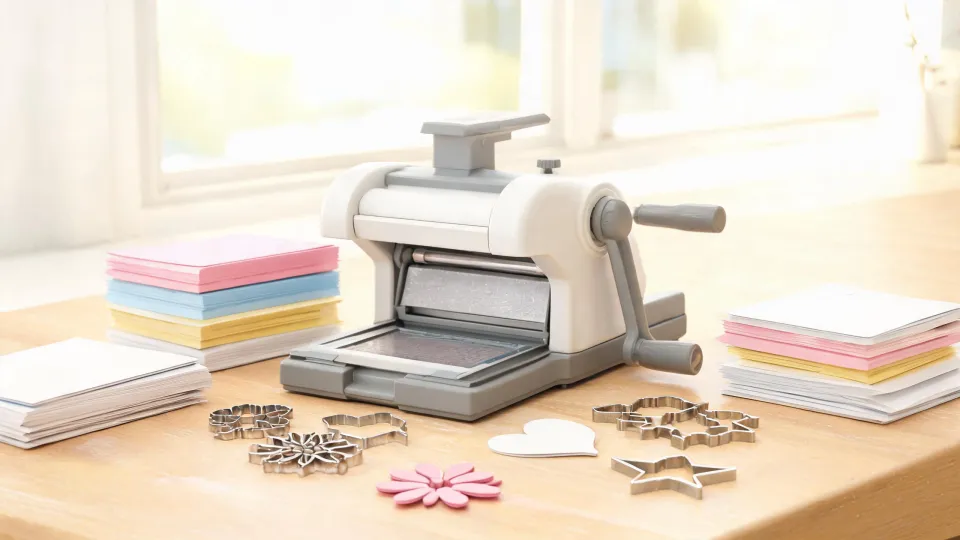
-
Who should use this checklist?
-
Step 1: Define the finished item before defining the machine
-
Step 2: Ask, what is a greeting card size?
-
Step 3: Add die setup to the total cost
-
Step 4: Look for the Sizzix logo on the die, not just on the selling page
-
Step 5: Require a sample on the exact material and a 300 DPI proof
-
Step 6: Put die ownership and reorder terms in writing
-
The honest limitation of custom Sizzix dies
Four years ago, I was the procurement person who said yes to a 'personalized gift' request without understanding how the item would get made. That order involved die-cut greeting cards, and I almost approved a machine quote before locking down the card size. My vendor caught the problem after the first prototype review. Since then, I have tracked over $180,000 in commercial spending on promotional products, and I use the same total-cost lens whenever Sizzix die cutting machines & dies appear in a vendor presentation.
If you are evaluating Sizzix die cutting machines & dies for a B2B promotional products program, this checklist is designed to prevent the hidden costs I have already paid for. It covers product definition, die sizes, setup fees, logo checks, material samples, and reorder terms.
Who should use this checklist?
Use this guide if you buy custom corporate gifts, personalized gift sets, greeting cards, ornaments, embroidery kits, candle holders, or similar items in quantities above a few hundred. Total cost of ownership matters more than the per-unit price sitting in your inbox.
If you are making ten items for a holiday party, skip the custom die conversation entirely. If the buyer only needs stock logo-printed merchandise on a fast deadline, custom Sizzix dies will not save time. Custom tooling makes sense for repeatable production runs where the design stays the same.
Step 1: Define the finished item before defining the machine
The biggest mistake I made was asking which Sizzix machine to buy before I could describe the finished product. Now I ask every supplier to repeat the product brief back to me in one sentence. For example: 'A 5 by 7 inch folded greeting card printed on 100 lb cover stock, with a standard envelope and a die-cut ornament shape in the front panel.' If the supplier cannot repeat that statement clearly, the quote means nothing.
Product definition drives die choice. A custom shape for an ornament has different cutting requirements than a greeting card blank. Sizzix die cutting machines & dies include manual and electric options, but no vendor should recommend a machine until I tell them what material and finished dimensions I need.
When I audited one year of procurement data, almost every budget overrun traceable to a craft category came from the same cause: the product changed after die design started. The material was agreed to verbally, and then the vendor switched the board stock to lower cost material. Lock the product definition before you ask about the machine.
Step 2: Ask, what is a greeting card size?
Here is the test question I ask any vendor who quotes greeting cards: 'What is a greeting card size?' If they answer 'standard,' I ask for decimal dimensions. Why? Because there is no single standard. Common folded card sizes include A2 at 4.25 x 5.5 inches, A6 at 4.5 x 6.25 inches, and A7 at 5 x 7 inches. Each one pairs with a different envelope, and envelope costs are not always included in the quoted card price.
You do not need to memorize every card size. You do need to ask the question. The answer tells you two things: whether the die is a custom die or a standard Sizzix die, and whether the envelope is a stocked commodity or a special order. Square cards often look great, but they can push the envelope from a stock sleeve into a custom item. That becomes a hidden cost before the first die-cut edge touches the press.
For die cutting machine selection, Sizzix machines have a recommended maximum cutting surface. A 5 x 7 die is not a problem on larger platforms, but a smaller machine may need multiple passes or a different die adapter. If I approve an oversized tool for the wrong machine, every production step gets slower. Knowing the card size is not a creative detail. It is a costing detail.
Step 3: Add die setup to the total cost
A unit price is only one part of the calculation. I use a simple rule: every custom die quote is a tooling investment plus a variable production cost. Suppose Supplier A quotes $0.75 per piece and a $300 setup charge. At 500 pieces, the total is $0.75 multiplied by 500 plus $300, which equals $675 or $1.35 per piece. Supplier B quotes $1.25 per piece with no setup. That total is $625. Supplier B wins even though the first quote had the lower unit price.
I also ask for setup fees, plate charges, shipping, and storage. Common setup fees for die cutting can run from $50 to $200 depending on complexity, based on pricing structures I have seen from commercial trade suppliers. Larger custom Sizzix dies and registered cutting jobs often cost more to set up. If a vendor says 'free die setup,' I ask where that setup cost is buried. More than once, the free setup appeared later inside a dangerous per-unit price.
Include storage in the total cost too. If the custom die sits in a supplier warehouse for two years, monthly storage can exceed the original tooling cost. When I compare quotes, my spreadsheet separates tooling from units so I can see the real amortized cost.
Step 4: Look for the Sizzix logo on the die, not just on the selling page
Promotional products usually carry your customer's logo, not the equipment maker's logo. Still, if you are promised Sizzix die cutting machines & dies, ask to see the actual product references. Official Sizzix packaging includes the Sizzix logo, and a supplier who is quoting genuine Sizzix tooling should be able to show you the product name and item number. A generic compatible die may cut the same first sample, but material behavior and alignment can differ on reorders. For a repeat personalized gift campaign, consistency matters.
Your own brand logo is a different check. If you are printing a customer logo onto a die-cut greeting card, the file should be a vector or a 300 DPI bitmap at final print size. A 72 DPI logo pulled from a website will look soft, and the die-cut edge will make the low resolution even more obvious. Print files for commercial products should meet the standard minimum of 300 DPI at final size.
If the project uses a custom color, I also ask for the Pantone reference. Pantone color matching is not about perfection; it is about consistency. A die-cut greeting card printed in the wrong blue creates the same customer complaint as a broken die.
Step 5: Require a sample on the exact material and a 300 DPI proof
I never approve a full production run from a digital mockup. Die cutting projects need physical samples. Ask for a sample cut on your intended stock. If you requested 100 lb cover stock, which is roughly 270 gsm, do not accept a sample made on 80 lb text. Paper weight numbers are not consistent across text and cover systems, and the thickness difference changes cutting pressure, folding, and envelope fit.
The same rule applies to the printed area. The proof should show the printed file and the die-cut line separately so there is no confusion about which part is ink and which part is the cut. For a personalized gift with names, verify spelling and text placement on the actual die-cut shape before you authorize the full order.
This is the step that catches the expensive surprises. After I once approved a sample made from the wrong cardstock, I kept second-guessing myself until the corrected sample arrived. That week of uncertainty was stressful, but it was cheaper than shipping 2,000 cards with the wrong fold depth.
Step 6: Put die ownership and reorder terms in writing
Custom dies are assets. If you paid for die setup, you should control the die and the die file. Write down who stores the die, who pays for storage, how long the die will be kept, and what happens if you change suppliers. A $200 custom die can become an $850 hassle if the vendor holds it hostage or if no one can find the original CAD file.
Ask for a copy of the die schematic and the cut file. This helps you reorder from another qualified manufacturer if needed. It also gives you documentation of the expected cutting line if a future order arrives with a shifted registration. For standard Sizzix dies, record the official die name or item number so reordering is simple. For custom dies made for your company, confirm who owns the steel rule tool itself.
I also put material specifications in the reorder document. The die is the same, but the cardstock, adhesive, coating, and envelope should be the same too. A change in paper thickness can turn a perfect die-cut ornament into a pile of damaged edges.
The honest limitation of custom Sizzix dies
Custom Sizzix dies are a good fit for stable, repeatable product lines. They are not a good fit for every promotional products order. If your quantity is too low to spread the setup cost, or if your creative team changes the shape every month, do not order a custom die. Use standard die lines or work with another production method.
To be fair, I have told my own stakeholders no on custom dies several times. It is not because the product was bad. It is because the volume did not justify tooling ownership. A company that wants one short run of 100 die-cut greeting cards with a unique shape will pay a high hidden premium. The same company ordering 1,000 decorative ornaments with the same shape can make custom Sizzix die cutting very cost-effective.
The most honest advice I can give is this: Sizzix die cutting machines & dies are an investment, not a coupon. I recommend them only when the product is defined, the card size is confirmed, the tooling cost is visible, the brand marks are approved, and the process includes a physical sample. If you skip one checklist item, the hidden cost usually finds you.

Elise Laurent is a crystal and decorative glass quality analyst covering crystal figurines, vases, ornaments, suncatchers, and gift glassware. She examines ISO 6486-1 where food-contact glass dinnerware applies, then uses polarized strain inspection, dimensional checks, surface-defect grading, and refractive clarity to compare decorative pieces outside that scope. Her work helps sourcing teams choose materials, finishing routes, and protective packaging without confusing visual brilliance with verified durability.