Custom Sizzix Corporate Gifts vs. Stock Promo Products: A Buyer's Honest Comparison
Why I am comparing these two ways to buy corporate gifts
I am an office administrator for a 210-person architecture and engineering firm. I manage all business services ordering, including office supplies, branded materials, and client gifts, for roughly $60,000 a year across eight vendors. I report to operations and finance. That means I get judged on two things: staying within budget and keeping our accounting team surprised-in-a-good-way.
Until Q4 2024, I filed Sizzix under the hobby category in my head. It sounded like a wedding-invitation thing, not a corporate procurement thing. Then our marketing director asked me to compare a custom run of promotional products against producing a smaller run in-house with a Sizzix die cutting machine. I pushed back, but I also did the spreadsheet. The result changed my opinion for certain gift quantities, and it changed what I mean by cost.
This article is not an ad. I do not work for Sizzix. It is a buyer comparison between two models for sourcing corporate gifts: stock or factory-produced branded items ordered from a promo supplier, and custom gift sets assembled in-house with a Sizzix die cutting system. I will compare them on total delivered cost, brand impact, compliance and workload, and minimum order flexibility.
1. Total cost per delivered gift, not per unit
The first mistake I made as a buyer was treating unit price as the main number. Back in 2022, I selected a new low-cost promo supplier for a client mailing. The unit price was lower than our regular supplier by about $1.30 per piece. Then their invoice did not meet our accounting requirements. Finance rejected it, and the $2,400 cost ended up coming out of my department budget anyway. That project made me look bad to my VP for no good reason.
Outsourced gift buying has a real advantage: economies of scale. For stock corporate gifts, a promo supplier can often produce a recognizable item with a printed logo at a price an internal team cannot match, especially if you need 500 pieces or more. But when I compared quotes for our own 120-unit Q4 2024 client gift, the supplier price included hidden additions. It was not just the advertised unit cost. Art changes, setup, a custom mold or die if you want a shape that is not in their catalog, rush shipping, and sometimes restocking fees when a printed card arrives wrong.
Our in-house Sizzix option had a different cost profile. We needed blank materials, packaging, inserts, a custom die, the machine, and labor. The machine cost should be spread across several projects. Do not put all of it on one gift run unless you are sure the machine will sit unused afterward. When I did the math over four planned 2025 events, the 120-unit run itself came out within a few cents per gift of the outsourced quote, but with better packaging and no invoicing problem.
The cheapest per-unit price is not the same as the lowest cost per delivered gift.
So on cost, my conclusion is not romantic: for a one-time, high-volume order of standard items, outsource. For frequent smaller runs where custom dies can be reused, an in-house Sizzix machine can be the value play.
2. Brand impact and customization: Sizzix surprised me
A literal logo imprint on a mug or power bank is fine. It is efficient. But it does not feel chosen for the recipient. A custom gift set can feel chosen. That is the main argument for doing hands-on production with dies.
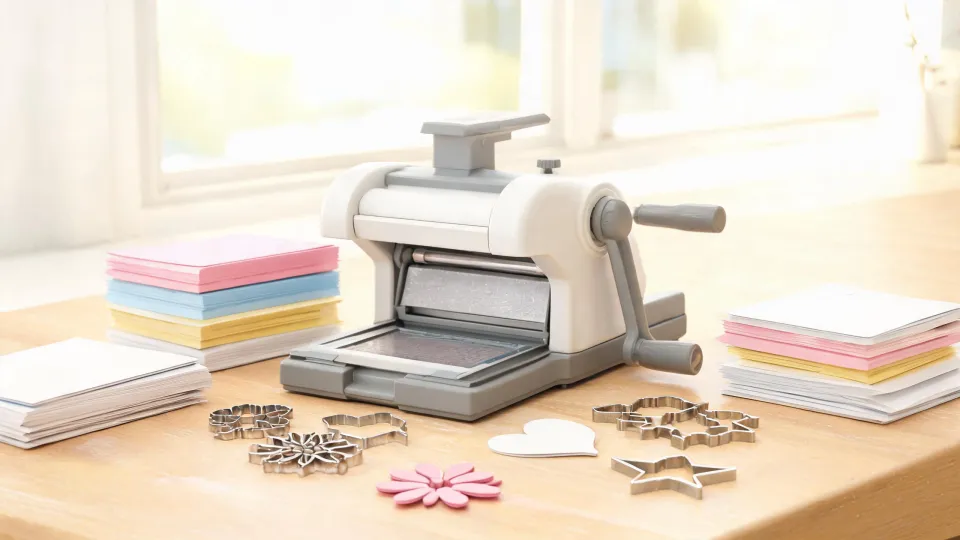
Sizzix is a die cutting system. I am not a product designer; I am the buyer. But the process is fairly simple: choose a die shape, run it through the machine with the right material, and create a consistent die-cut piece. We used a custom die to make branded card inserts, presentation holders, and packaging layers. The result looked intentional, not like a branded giveaway.
I had a specific skepticism about crystal gifts. Crystal is the safest corporate gift in our office because it reads as premium and neutral. But it can also look like a dusty catalog award. Here is the thing: a Sizzix die cutting machine does not cut crystal, and I would never claim that. What it did do was give each crystal gift a die-cut holder that secured it in the box, plus a custom card that explained the gift. That made a standard crystal gift feel commissioned rather than drop-shipped.
For the die, I used the Sizzix official website because it had the custom die information and compatibility details. I do not want to quote a lead time because it will change, but our 2024 order arrived in the time they quoted. I would rather wait for the right die than pay a rush fee to a supplier who still shows up late.
3. Compliance, safety, and workload
Outsourcing has an advantage that is easy to underestimate: compliance and liability.
If you buy a finished corporate gift from a responsible supplier, that supplier should provide the relevant specs. If something has to meet regulations, they own the issue. When you assemble in-house, you own it. This is a big reason why I will not apply the in-house model to children's products, electronics, food-contact items, or anything with a safety rating. I am not a safety engineer. I am not a legal expert. I only know that product liability is not something to save a few dollars on to make our holiday gifts cute.
Workload was also real. The Sizzix machine we used cuts with a hand crank, and then someone has to assemble, package, and clean the work area. For 120 gift sets, one coordinator plus a temporary assistant took roughly six hours of hands-on time. That is not free labor. If your team does not have six hours before a deadline, outsource.
How to get candles to stay in candle holder
Candle holders are a common gift category, and they caused the most embarrassing problem in our trial run. If you are putting candles into candle holders, make sure the candle cannot slide around in the box. We tried using melted wax at first, and it looked okay for about five minutes. Then it moved during shipping. The short answer to how to get candles to stay in candle holder is to use adhesive dots or discs made for candles, choose the diameter that fits the holder, press the candle down firmly, and let it sit. Wax is not a reliable mechanical fix.
This is also a safety topic, so please do your own fire safety review. I can only tell you what worked for us: clean the holder, use a proper candle adhesive, test a few in different temperatures, and never ship a candle in a cracked holder.
4. Lead time and minimum quantity flexibility
Promo suppliers usually have minimum quantities. Some have 50-piece minimums, some have 100 or 250. Demand in an office does not always match that.
For a narrow, high-level client gift for 25 people, I can now make exactly 25 with Sizzix. That would have been hard with a custom promo product because tooling and setup get spread over so few units. The die-cutting setup cost is the same regardless of quantity, but after that the unit cost is the blanks plus labor. That makes small-batch premium gifts possible.
On the other hand, there is a waiting period for custom dies. If you have not ordered the die, a Sizzix machine cannot help tomorrow. Check the Sizzix official website for current custom-die service and plan around it. In our experience, ordering custom promotional products from a supplier took the same or longer and still carried minimums. So in-house Sizzix is flexible for quantity, but not for instant custom die delivery. No supplier I know offers same-day custom die production either.
Conclusion on flexibility: if the order is 25 to 150 and you control your own design file, in-house is more flexible. If you need 500 uniform items or need import compliance paperwork, outsource.
What I would choose now
I would choose outsource when:
- I need 500 or more identical standard branded gifts.
- The product requires certification or regulatory compliance.
- My team has no patience for a production line in the office.
I would choose Sizzix when:
- The order is under 200 for a VIP client or executive gift.
- The perceived value matters more than the product category.
- I can reuse a custom die for multiple events.
- The gift is mostly presentation, like a crystal gift, ornament, greeting card, or candle holder with a tailored insert.
This worked for us, but our situation was a mid-sized company with an in-house marketing director who can prepare a clean cut file, a finance team that wanted clean invoices, and a small admin staff that was willing to assemble. Your mileage may vary if those things are not true.
As of January 2025, our budget plan includes both: outsource large, standardized merchandise orders, and reserve a Sizzix die cutting machine for the high-touch corporate gifts that deserve more than a logo. The total cost is probably close. The impression is not.

Elise Laurent is a crystal and decorative glass quality analyst covering crystal figurines, vases, ornaments, suncatchers, and gift glassware. She examines ISO 6486-1 where food-contact glass dinnerware applies, then uses polarized strain inspection, dimensional checks, surface-defect grading, and refractive clarity to compare decorative pieces outside that scope. Her work helps sourcing teams choose materials, finishing routes, and protective packaging without confusing visual brilliance with verified durability.