What Is the Best Promotional Products Company? A Die-Cutting Comparison (Sizzix Big Shot vs. Outsourcing)
-
What is the best promotional products company? It depends on the production model
-
Minimum order quantities are a silent budget leak
-
A personalized gift means more than a logo and a font
-
The timeline illusion, plus a postage mistake that cost about $1,540
-
When a traditional promotional products company is still the right call
-
Our current rule of thumb
What is the best promotional products company? It depends on the production model
I've typed what is the best promotional products company? into a search engine every fall since 2018. Clients ask us the same question even when they're already sitting in our office. It's a natural question. It's also incomplete, because the right answer depends more on the production model than on a company name.
I handle corporate gift orders for a 14-person promotional distribution studio in Ohio. For seven years, I've personally made—and documented—13 significant ordering mistakes totaling roughly $11,700 in wasted budget. After mistake number nine, my boss asked me to build our pre-order checklist. That checklist changed how we buy, and eventually it changed what we make.
Our turning point was a 2021 holiday order. We ran an internal comparison between sending the whole job to a traditional promotional products company and producing it in-house with die-cutting equipment. We repeated the comparison on nearly every gift order after that. The dimensions that mattered were minimum order quantities, personalization, turnaround time, and total cost including the costs that never appear on the invoice. The conclusions surprised me, and one of them cost us money to learn.
Minimum order quantities are a silent budget leak
Outside suppliers have production minimums for a legitimate reason. Setup and tooling cost real money, so unit prices drop as volume rises. That logic sounds reasonable until a client asks for 140 gifts.
In 2021, we quoted 140 crystal thank-you gifts for a financial client. A supplier offered $9.80 per unit at 140 pieces or $4.75 per unit at 500. My boss approved the 500-piece run. The total was $2,375; the smaller run would have been $1,372. We spent $1,003 extra for 360 products that sat in our storage room for 14 months and eventually went to a school auction. Those 360 pieces were not inventory. They were a receipt.
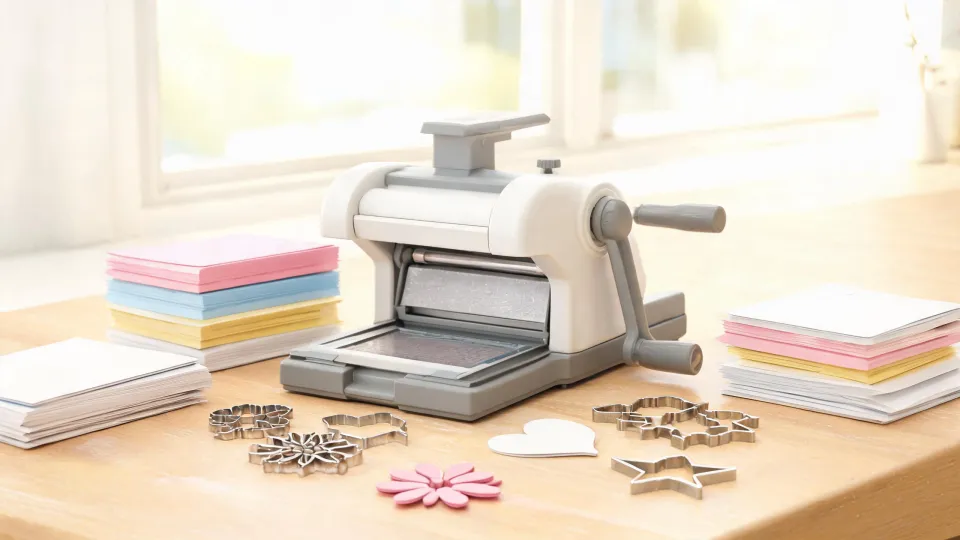
A custom steel-rule die for a die-cutting machine is a different kind of commitment. You buy the tool once. The die does not impose a production minimum, so if we need 50 custom Christmas ornaments this week and 120 next week, we cut 50, then 120. That flexibility matters when a client updates a recipient list in early December. It is the main reason we now own a Sizzix Big Shot Manual Die Cutting Machine.
A personalized gift means more than a logo and a font
Any promotional supplier can put a logo on a mug, a notebook, or a tote. What most people mean by a personalized gift is something that makes one specific recipient feel recognized. A first name printed in the same font as 2,000 other first names is not quite that.
Let me give you a concrete example. One of our 2024 clients wanted a holiday gift for employees who had hit ten-year anniversaries. They asked for a personalized Christmas ornament. The outside quote offered a standard glass ball with the company logo and the employee name on the back. Nice enough. But because we owned the Sizzix Big Shot and a custom die from a previous order, we proposed a different route: a layered ornament cut in the company's brand colors, shaped like the firm's logo mark, with each recipient's first name die-cut into the top layer and the anniversary year on the back. It was assembled by our team in small batches, checked by two people, and boxed individually.
The client said it was the first corporate gift in years that employees actually kept out during the holidays. That is the difference between a logo item and a personalized gift. It is not automatic: it requires a designer, a patient production person, and a timeline that allows for small-batch assembly. Without those, the supplier version is the safer choice.
The timeline illusion, plus a postage mistake that cost about $1,540
Traditional suppliers often quote 10 to 14 business days for custom work, and the clock starts only after you approve a proof. Proof approvals eat time, especially in Q4. In-house die cutting removes the supplier slot from that equation. When a client added 60 recipients after our first batch had already shipped, we made the extra ornaments in one afternoon. The die already existed, and nobody else's production calendar was involved.
But in-house production does not automatically make you faster. It makes you responsible for every downstream detail, and I learned that the hard way.
During last year's Q4 rush, we designed a 7-inch by 10-inch die-cut holiday card. It looked stunning. We produced 2,000 of them before someone calculated the mailing cost. The card was too tall for USPS letter-size mail, so every piece went as a large envelope.
According to USPS (usps.com), effective January 2025, a First-Class Mail letter costs $0.73 for the first ounce and $0.28 for each additional ounce. A First-Class Mail large envelope starts at $1.50 for the first ounce, also with $0.28 for additional ounces. At those rates, a 2-ounce letter costs $1.01, while a 2-ounce large envelope costs $1.78. The difference on 2,000 pieces is roughly $1,540, just because of a dimension rule. Verify current rates at usps.com before you plan your budget. Our checklist now includes envelope dimensions before the die is ordered, not after the pieces are cut.
I am not a manufacturing engineer and I do not have a time-and-motion study to share. What I can tell you is that the production bottleneck in our studio was never the crank on the Big Shot. It was the assembly, the finishing, and the shipping decisions—the boring parts nobody puts in a marketing photo.
When a traditional promotional products company is still the right call
If you need 5,000 identical, logo-printed products delivered to three distribution centers by September, you should call a traditional promotional products company. They have the sourcing, the contracts, and the freight experience. We still outsource any order that is large, standard, or scheduled far in advance.
In-house die cutting wins when the order is smaller, more variable, or genuinely personal. It also wins when the recipient list changes after the catalog is printed, when you want a custom shape that no supplier catalog offers, or when you want a gift that does not look like it came from a catalog in the first place.
We get asked whether the machine pays for itself. I cannot give you a simple yes. I can tell you that if you are comparing only the machine price to the supplier quote, you are missing the labor, materials, and screw-ups—and the screw-ups are real. The Sizzix official website (sizzix.com) is useful for machine specifications and die compatibility, but no website can tell you if your team has the patience for 700 two-layer ornaments. That is a workflow question, not a shopping question.
Our current rule of thumb
What was best practice in 2020—outsource the whole gift program—does not have to be best practice in 2025. The entry threshold for owning part of your production has dropped, and a small team with the right die and a manual Sizzix Big Shot can do work that used to require a factory minimum. The fundamentals have not changed, though: know the recipient, know the budget, and check the mailing dimensions before you cut.
So, what is the best promotional products company? For a standard product at volume, it is still a good supplier. For a personalized gift that people keep, the best company might be the one you work for.

Elise Laurent is a crystal and decorative glass quality analyst covering crystal figurines, vases, ornaments, suncatchers, and gift glassware. She examines ISO 6486-1 where food-contact glass dinnerware applies, then uses polarized strain inspection, dimensional checks, surface-defect grading, and refractive clarity to compare decorative pieces outside that scope. Her work helps sourcing teams choose materials, finishing routes, and protective packaging without confusing visual brilliance with verified durability.