Corporate Gifts Look Off? Start With the Spec, Not the Supplier
I get a question a lot from people sourcing company merchandise: “Where can I buy stationery for businesses?” It’s a fair question. But by the time someone asks me, the real question is usually different:
“The corporate gifts we ordered don’t look as impressive as the sample. Why?”
I’m a brand-compliance manager at a print and gifts company. I review all incoming finished goods before they ship—roughly 230 unique items per year, maybe 245 if I count small accessories; I’d have to check the tracker. In our 2022 quality audit, we rejected 14 of 212 first production submissions. Only two had design problems. The others had a larger issue: the job was approved from a screen, but the spec on paper didn’t match the product on the table.
From the outside, it looks like a supplier quality problem. The reality is more uncomfortable. Most briefs are long on adjectives—“premium cardstock,” “brand red,” “clean die-cut”—and short on measurements. That’s true whether you’re ordering paper holiday cards, foil-stamped folders, or an engraved crystal gift.
What Looks Like a Vendor Problem Is Usually a Spec Problem
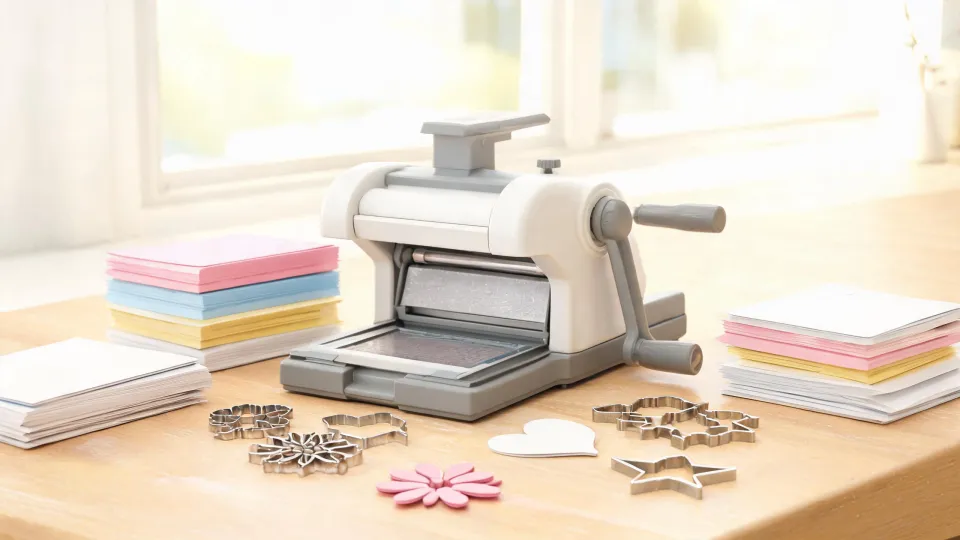
“Custom die cutting” sounds like one process. It isn’t. A hand-operated die cutting machine in a small studio has different capabilities from a high-speed commercial die cutter. Both can produce the same snowflake shape, but the tolerance and material strength are different.
I’ve specified small-batch work using a Sizzix Big Shot die cutting machine starter kit and I’ve also approved large commercial die-cut orders. Both are good at what they do. The problem starts when a buyer says “custom” but doesn’t say whether custom means manual, semi-automatic, or industrial. The supplier then guesses based on quantities and deadlines. Guesswork is why a 1,000-unit order can look different from an approved sample made on a different machine.
That’s a deeper reason behind “cheap-looking” corporate gifts: they aren’t necessarily worse. They were made under a different assumption about what “die-cut” meant.
Substrate Is the First Quality Standard
When I review stationery, I check substrate before decorative. If someone says “premium cardstock,” I stop. Paper weight equivalents are approximate—20 lb bond is 75 gsm, 80 lb text is 120 gsm, 80 lb cover is 216 gsm, and 100 lb cover is 270 gsm. Two of those could reasonably be called “premium cardstock,” but they will cut, fold, and feel completely differently.
For a die-cut Christmas ornament or a rigid gift folder, 80 lb text may be too flexible, while 80 lb cover can hold a shape. That distinction isn’t a design preference; it is a specification. When companies reject a corporate gift because it “feels cheap,” they’re often feeling the difference between 120 gsm and 216 gsm.
Color Needs a Measurement, Too
Color is another place where “brand red” fails. Pantone color matching guidelines use Delta E to describe difference. For brand-critical colors, a common tolerance is Delta E below 2. Values from 2 to 4 are noticeable to trained observers; values above 4 are visible to most people. But if a contract says only “red must match our logo,” you cannot measure failure. If the first production run is 3.5 Delta E from the approved red, is it acceptable? The supplier says yes. The brand team says no. Without a written tolerance, the conversation becomes an argument.
The Crystal Gift Test: Know What the Material Can Show
One useful example is a crystal gift. In a product photo, it looks clean and bright. But crystal or glass doesn’t reproduce CMYK like coated paper does. An engraved logo is often frosted, translucent, and dependent on lighting. A vendor can show a red logo on a digital proof, but if the final item is an etched crystal block, that red may not exist in the end at all. That isn’t a supplier error; it’s a physics issue.
The same idea applies to die-cut paper. A screen proof cannot show you the thickness of the card, the burnish of the cut, or how the piece catches light. I want to say we now reject fewer than 3% of first production samples, but I don’t want to jinx Q2. The improvement didn’t come from better suppliers. It came from requiring physical samples on the actual substrate. Should mention: physical approval is the only approval that matters for tactile products.
The Price of Vague Approval
In 2023, we received a batch of 5,000 stationery folders. The logo foil was visibly off. The standard we now use for critical printed-to-die alignment is ±1 mm. This batch measured about 3.2 mm off the drawing. The supplier said it was within industry standard. But our contract only said “aligned,” so the claim wasn’t easy to challenge. We rejected the batch anyway. They redid it, but the expedited freight, overtime prep, and launch delay cost our company around $22,000. A number that should have been in the original spec.
Since then, every vendor contract includes a list of numbers. I’ve become the person who asks “what tolerance?” before a purchase order. The vendors don’t mind, because they’d rather be measured than judged.
The Fix: Choose Your Process, Then Write the Numbers
If your plan is low-volume, hand-finished stationery or limited corporate holiday gifts, the manual die-cutting route can be a legitimate option. A Sizzix Big Shot die cutting machine starter kit can give an in-house team a predictable way to produce small batches of cards, die-cut ornaments, and creative gifts. It is not designed to replace a commercial converter producing 20,000 identical pieces. That’s fine; it doesn’t have to.
When I use Sizzix, I check the Sizzix official website to confirm die dimensions, platform compatibility, and cutting pad requirements. Reseller listings don’t always include the details I need. But even with the right tool, I still write the specification before I start:
- Name the substrate by weight or gsm. Use a number, not “cardstock.”
- Name the color by Pantone reference and tolerance. Use Delta E below 2 when possible for brand-critical work.
- Define die register. If printed artwork is supposed to align with cut shape, tell the supplier the allowed shift in millimetres.
- Require a physical preproduction sample. On final substrate, with the production die or tooling, not a digital mockup.
- Inspect against your sample. Build an incoming inspection step where one person checks colour, dimensions, and die-cut edge quality every time.
If your original question was “Where can I buy stationery for businesses?” I’d answer it this way: buy from a business-focused stationer, printer, or speciality supplier—but only after you have written the numbers. The channel isn’t what makes a corporate gift feel premium. Conformance to a good spec is what makes it feel intentional.

Elise Laurent is a crystal and decorative glass quality analyst covering crystal figurines, vases, ornaments, suncatchers, and gift glassware. She examines ISO 6486-1 where food-contact glass dinnerware applies, then uses polarized strain inspection, dimensional checks, surface-defect grading, and refractive clarity to compare decorative pieces outside that scope. Her work helps sourcing teams choose materials, finishing routes, and protective packaging without confusing visual brilliance with verified durability.