Sizzix Big Shot Pro in B2B Production: A Procurement Manager's Cost Breakdown
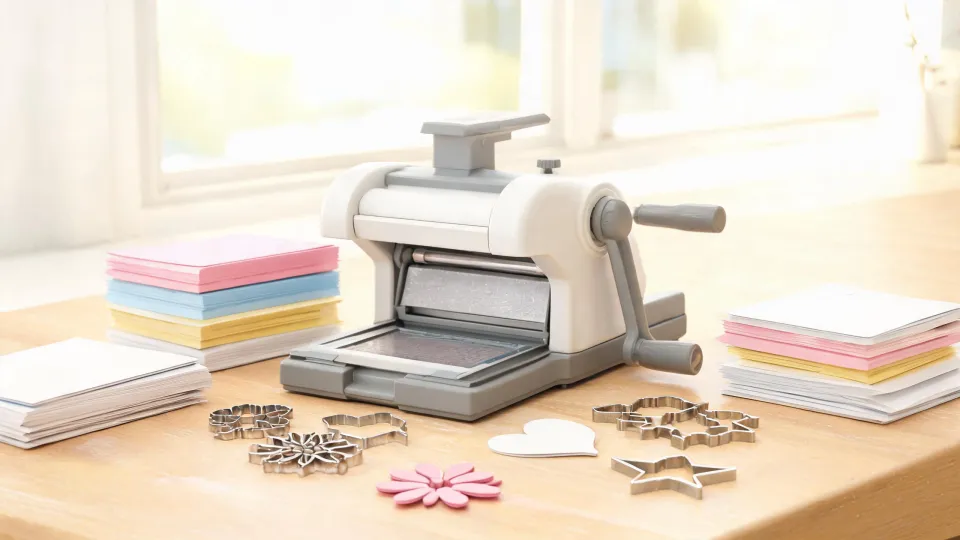
Here's the conclusion first: The Sizzix Big Shot Pro die cutting machine makes financial sense for B2B craft production when a design is standardized and run in batches of roughly 500 units or more. Below that, the machine probably won't pay for itself. At or above that volume, the per-unit cost drops enough that even custom Sizzix dies start to look like sensible production tooling.
I'm a procurement manager at a 40-person corporate gift manufacturing company. I've managed material and finishing budgets totaling around $700,000 since 2019, and I've documented every purchase in a cost tracking system. I'm not a machine engineer, so I won't pretend to be the final word on mechanics. What I can give you is a purchasing perspective on how the Sizzix Big Shot Pro behaves inside a real production budget.
What changed my mind: a Christmas ornament order
The trigger for me was a Q4 2023 order from a customer who needed 1,200 branded Christmas ornament blanks in a short time frame. I almost outsourced the cutting because I assumed the volume was too big for die cutting. The outside quote was $4.10 per unit. I was ready to sign it until my production manager reminded me that our Sizzix Big Shot Pro had been sitting idle since we bought it for samples.
I rebuilt the cost model, and the numbers told a different story. The custom die was $390 one-time. Materials came to about $1,340. Cutting and packing labor was $970. That gave us a total near $2,700, or $2.25 per ornament.
That single order saved us about $2,200 compared with outsourcing—but only because we had enough volume to spread the die cost.
The lesson was uncomfortable: I had treated the Big Shot Pro as a prototyping tool, not a production asset. The machine didn't change. My cost model did.
The Sizzix Provo Craft search problem
If you search for 'Sizzix Provo Craft,' the results can mix machine names, brand names, and retailer categories. I don't fully understand why every product is labeled the way it is, and I won't pretend to untangle that here. From a purchasing standpoint, the important thing is to look past the search-result confusion and evaluate machine platform size, compatible dies, and material guidance.
The Big Shot Pro is the large-format option. That wider platform matters when your product isn't a small cardstock shape. We use it for Christmas ornament blanks in felt and cardstock, greeting card inserts, and embroidery kit tags. We've also cut prototype packaging pieces for corporate gift sets before sending the final packaging to a commercial printer.
I should add a boundary here: I'm not a materials engineer. If you want to know whether a specific fabric or thick board will run through the Sizzix Big Shot Pro, check the official specifications or ask a Sizzix dealer. I can tell you that standardizing shapes will save labor; I can't promise universal material compatibility.
Custom Sizzix dies: often worth the upfront cost
Everything I'd read about die cutting said to start with standard dies and avoid custom tooling until demand was proven. For a hobbyist, that advice makes sense. For production, I've found the opposite. Custom Sizzix dies can remove entire production steps by combining cut lines and decorative edges in one pass.
In 2024, we ordered a custom die for a greeting card window. It was more expensive than a standard die, but it eliminated a hand-trimming step and cut related labor by about 70%. The payback point was around 800 units, and we crossed that in the first month of the product launch.
If I compare invoices across vendors, I've paid anywhere from $75 to $400 for custom tooling depending on die size and detail. This aligns with a general die cutting setup reference of $50 to $200 for standard complexity (public list prices, January 2025; verify current rates), with larger or more detailed dies running higher. The number that matters isn't the die price; it's the die price divided by the number of units that will use it.
Where the Sizzix earns its place
In our product mix, die cutting wins when designs repeat. Corporate gifts with a company logo in the packaging, Christmas ornament sets sold in the same configuration every quarter, greeting cards where the insert has to match the outer sleeve, and embroidery kits that require consistent closure tags all fit that pattern.
Manual cutting still has a place. For a truly one-off premium gift, hand finishing can add a level of detail that machines don't replicate well. But for batch work, the efficiency advantage is too consistent to ignore.
Does paint by number app use AI? Maybe. Does it matter?
Let's address the odd search term that probably landed some readers here: does paint by number app use AI? Many of the newer ones do, honestly. We tested an AI-assisted design pipeline for potential paint-by-number kits, and the cost question was not whether the app was AI. It was how much human cleanup the app's output needed.
An AI tool can cut concept time, but every unusable paint region still has to be fixed by a person. If the output is clean, the tool saves money. If it isn't, the automation just moves the work around. I'd argue the same is true for die cutting and for almost every production tool: efficiency shows up only when the surrounding process is stable.
When I would not buy this machine
I'll admit the Sizzix Big Shot Pro isn't right for every business.
If your average run is under 300 identical pieces, custom dies will likely be hard to justify. If your products change from order to order and dies can't be reused, the machine will sit idle. If your materials are outside the supported thickness range, you'll force the machine into jobs it wasn't designed for. And if you don't have someone on staff who can set up and maintain the system, the labor savings can disappear into setup mistakes.
We learned that the hard way when our Big Shot Pro sat unused for months. The machine didn't fail. My planning failed. In the end, the Sizzix became a production asset only after we matched it to the right order volumes. That's the real cost lesson: buy the system because your volume profile supports it, not because a single project made it look good.

Elise Laurent is a crystal and decorative glass quality analyst covering crystal figurines, vases, ornaments, suncatchers, and gift glassware. She examines ISO 6486-1 where food-contact glass dinnerware applies, then uses polarized strain inspection, dimensional checks, surface-defect grading, and refractive clarity to compare decorative pieces outside that scope. Her work helps sourcing teams choose materials, finishing routes, and protective packaging without confusing visual brilliance with verified durability.