Sourcing Sizzix Products for Corporate Gifts: A Cost Controller's Checklist
-
Step 1: Separate the machines from the dies before you compare anything
-
Step 2: Ask for the full custom die price, not just the die price
-
Step 3: Match the Sizzix big shot cutting machine to your actual order volume
-
Step 4: Build a prototype approval step into your timeline
-
Step 5: Treat embroidery kits, crystal gifts, and photo books as separate line items
-
Step 6: Compare per-unit delivered cost, not quote totals
-
One Last Check
If you're buying Sizzix products for your own production line or for a corporate client, the biggest mistake is treating the whole order as one bulk purchase. I say this after six years of sourcing promotional merchandise and managing a $180,000 annual procurement budget. This checklist is for buyers, product managers, and gift companies who need Sizzix equipment, custom dies, and finished gift items without blowing the budget.
Here are six steps. The last one sounds obvious, but it is the one that keeps catching people.
Step 1: Separate the machines from the dies before you compare anything
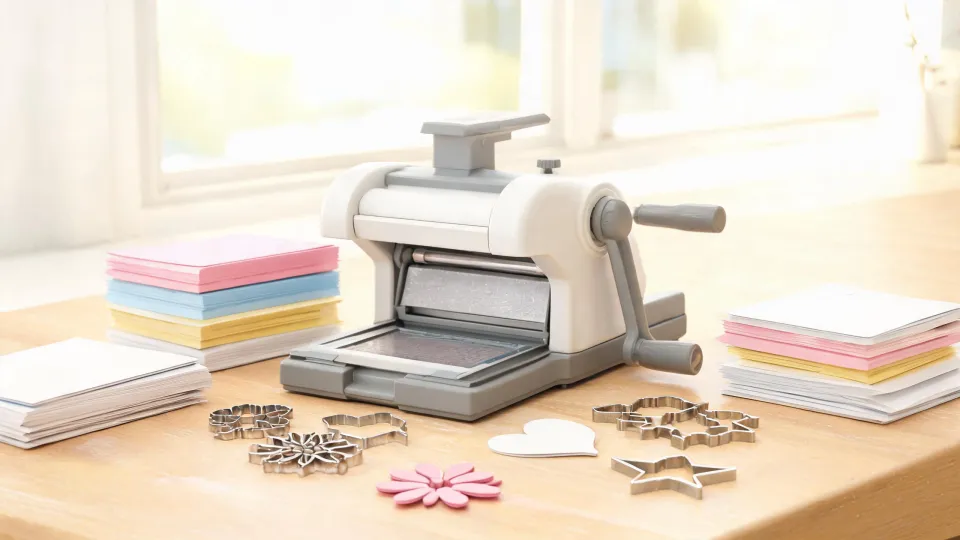
Sizzix products fall into two very different cost buckets. The first is the hardware: the Sizzix big shot cutting machine, the Sidekick, the Big Shot Express, and the larger Pro models. The second is the tooling: standard and custom Sizzix dies. If you lump them together in a quote spreadsheet, you won't be able to tell whether you're overpaying for equipment or for dies.
I learned this in 2023. I compared two vendors for a run of 5,000 custom ornaments. One quoted a package that included a Big Shot machine and several dies. The other quoted the same machines but with a lower line-item price on dies. The totals were close, so I almost signed with the lower-total vendor. Then I looked at the machine price: the second vendor had added a 20% margin to the machine and marked up the dies by 10%. It was still lower in total, but it told me how they make money. That matters for future orders.
Step 2: Ask for the full custom die price, not just the die price
Custom Sizzix dies are where hidden costs hide. A supplier might quote you $40 per die, then add a one-time tooling fee, a CAD fee, a steel rule height upcharge, and shipping for the die itself. The term 'custom Sizzix dies' can include everything or almost nothing.
Here is something vendors won't tell you: the first quote is usually a starting point. When a quote contains 'die setup', they expect you to ask about it. If you don't, it becomes profit.
The question I use now: 'What is not included in this price?' If the supplier hesitates, that is a red flag. The vendor who lists all fees upfront—even if the total looks higher—usually costs less in the end. We paid $450 in hidden fees on a single custom die order in 2024 because I failed to ask that question. (Note to self: never again.)
Step 3: Match the Sizzix big shot cutting machine to your actual order volume
The Sizzix big shot cutting machine is a workhorse for manual die cutting. It is also not the best choice for every volume level. We bought one for a small in-house packaging project, and it was perfect. Then we accepted a larger order for 3,000 die-cut gift tags. We spent two weeks pushing that machine to its limit. (Ugh.) The electric models would have paid for themselves in labor savings alone.
So: Are you producing one-off samples, short runs, or continuous production? For short runs, the manual Big Shot is fine. For anything beyond what fits into a normal production day, compare the manual and electric options before you fall in love with the lower price. The 'cheaper' machine is only cheaper if it doesn't slow down your workflow.
Step 4: Build a prototype approval step into your timeline
Custom dies require steel rule bending, and sometimes the first iteration doesn't cut the way you expect. Cardstock weight, fabric thickness, and embossing folders all change the result. If you don't add a prototype step, you will discover the problem after the delivery deadline has passed.
What most buyers don't realize is that 'standard turnaround' often includes buffer time that vendors use to manage their production queue. It is not necessarily how long your order takes. Use that buffer for a prototype check. Ask the vendor to send a sample cut, then test it on the exact material you plan to use.
Step 5: Treat embroidery kits, crystal gifts, and photo books as separate line items
A popular corporate gift bundle might include an embroidery kit, a crystal gift, and a custom die-cut box. These are three different categories with different sourcing paths. The embroidery kit includes fabric, thread, a needle, and instructions. The crystal gift might be etched or engraved. If you put them all under 'gift set' in your budget, you lose the ability to see where the margin is going.
For the embroidery kit, decide whether the Sizzix die is cutting the fabric pieces or just the packaging. For the crystal gift, keep in mind that a die cutter is not cutting crystal—some suppliers will let you use a Sizzix die to create an insert or display packaging that holds the crystal item. (This is where custom dies are brilliant.)
And if someone suggests adding a photo book to the set, do not start with the question 'what is best photo book app.' You'll spend an afternoon reading app reviews and still not have a procurement decision. The app matters less than paper weight, cover board, resolution requirements, and volume pricing. You're buying a manufactured product, not an app recommendation.
Step 6: Compare per-unit delivered cost, not quote totals
It's tempting to think that the lowest total quote is the best. That's the simplified version. The real calculation includes setup fees, shipping, packaging, damage rates, and the cost of your time managing the order. We once chose a quote that was $800 cheaper, but the items arrived with a 6% damage rate, and the redo cost us $1,200. The 'cheap' option cost more.
Use a simple formula:
(Total quote + freight + duties + rework + your labor hours) / usable units = per-unit delivered cost.
When I compared suppliers for a $4,200 annual contract in Q2 2024, per-unit delivered cost changed the ranking completely. One supplier had higher unit prices but lower freight and zero damage. The other looked cheaper on the spreadsheet but had a 4% defect rate. The TCO difference was 11%.
One Last Check
Before I sign any Sizzix-related order now, I check three things: machines separated from dies, every fee listed in writing, and a per-unit delivered cost that includes rework risk. If a supplier won't put the full cost in writing before the deposit, I don't move forward.
One more thought: this checklist worked for us, but we're a mid-size B2B company with predictable ordering patterns. If you're a seasonal business with demand spikes, the calculus might be different. And pricing I'm referencing is from public craft supplier listings as of January 2025. Verify current rates before you budget.
The checklist: machine vs. dies, full die pricing, machine volume match, prototype step, separate product categories, per-unit delivered cost. In that order.

Elise Laurent is a crystal and decorative glass quality analyst covering crystal figurines, vases, ornaments, suncatchers, and gift glassware. She examines ISO 6486-1 where food-contact glass dinnerware applies, then uses polarized strain inspection, dimensional checks, surface-defect grading, and refractive clarity to compare decorative pieces outside that scope. Her work helps sourcing teams choose materials, finishing routes, and protective packaging without confusing visual brilliance with verified durability.