Corporate Gifting with the Sizzix Big Shot Pro: A 6-Step Buyer's Checklist
-
Step 1: Define the recipient and the moment
-
Step 2: Match the machine to your volume and materials
-
Step 3: Order the custom die, then insist on a physical mockup
-
Step 4: Pair the die with the right gift components
-
Step 5: Calculate landed cost per gift, including shipping
-
Step 6: Make a conscious decision about gift cards
-
What I'd Skip Before the Next Order
I'm the office administrator for a 210-person professional services firm. I manage all the non-IT purchasing—roughly $70,000 a year across six or seven vendors—and I report to both operations and finance. This matters because corporate gifting is never just a creative exercise. It has to survive accounting.
Use this checklist when you need physical branded gifts and you want the handcrafted-but-consistent look that custom die-cutting gives. There are six steps, and step six is the one that gets skipped until finance asks about gift cards.
The box is not packaging. The box is the first impression.
Step 1: Define the recipient and the moment
Every custom die order starts with a question that has nothing to do with cutting: who is this for, and what moment are we part of? Holiday gifts for clients, employee milestone awards, conference giveaways, or a new-office launch all call for different materials, sizes, and finishing touches.
When our company expanded to a second location in 2023, I had to split the same budget across two offices without losing quality. We started by writing down the recipient segments and the exact occasion. That list kept us from ordering beautiful Christmas ornaments in March and generic notepads for a client thank-you where we needed more weight.
- Who is the recipient?
- Why are we giving this gift?
- How will it be delivered—handed out, mailed, or packed with another shipment?
This step sets the standard for everything else. If the recipient's first physical impression is your company's brand, then the box, card, and material matter as much as the gift itself.
Step 2: Match the machine to your volume and materials
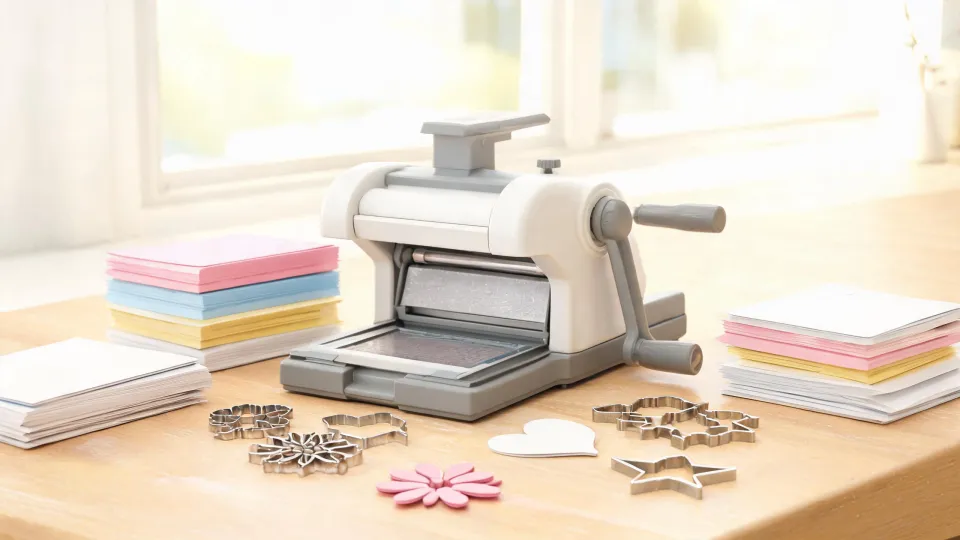
The Provo Craft Sizzix die-cutting machine line has a wide range of sizes, but I keep coming back to the Sizzix Big Shot Pro die cutting machine for corporate runs. It handles wider dies and larger sheets, which means fewer passes and more consistency when you're cutting 500 cards. For lower-volume projects, a smaller Sizzix machine is fine. The Sidekick is useful for sample cards and quick prototypes.
Before you order anything, ask your vendor for three numbers: maximum cutting width, maximum material thickness, and the die base size that fits the platform. Honest answer: I didn't fully understand machine sizing when I started, and it cost us a project. I'm still not entirely sure why die manufacturers make adapters so confusing. My best guess is that every machine has its own platform heights and the die makers expect you to know them already.
Also, think about materials in the same conversation. Cardstock, vellum, fabric, cork, felt, and thin leather all behave differently under a die. The Big Shot Pro's larger width saves time, but the stack height is not unlimited. Ask the die maker what materials they recommend for your design.
Step 3: Order the custom die, then insist on a physical mockup
Custom Sizzix dies are the heart of the project. You are not buying a finished product; you are buying the tool that makes the product. Send vector files, not JPEGs. Include the logo as clean paths. Specify the finished dimension and the material you plan to cut.
Here's where I made a costly mistake in my second year. I approved a custom die from a PDF proof. The shape looked correct on screen, but the actual cut in thick cardstock looked different—the fine logo details did not cut through. The die was technically fine, but the material was too heavy for the detail level. I had to reorder both the die and the run. That redo cost about $600 and a good chunk of credibility with my director.
Now I never let a die go into production before a physical sample is cut in the exact material we're using. Ask for two mockups: one in the heaviest material and one in the lightest. Keep the sample visible while the production order runs. Mental note: I once missed that step and nearly ordered a duplicate die with the same problem.
Last year, that physical sample caught a registration issue before we cut 800 ornaments. So glad I asked. If a supplier promises same-day custom die production, be suspicious. A custom steel-rule die takes time to make and test. Lead time is not an inconvenience; it's part of the quality.
Step 4: Pair the die with the right gift components
Once the die cuts cleanly, decide what the final gift actually is. In my experience, the strongest corporate gifts combine one item with a small branded component around it. A die-cut insert can turn a generic crystal gift into a branded presentation. Put another way: the crystal does the prestige, and the die-cut box does the branding.
Sizzix-powered outputs that work well as promotional products:
- Greeting cards with a recessed area for a logo or personal note
- Holiday ornaments with custom shapes
- Embroidery kits with die-cut fabric pieces
- Candle holder wraps and decorative sleeves
- Shaker boxes or custom packaging for a crystal gift
Do not feel obligated to put your logo on every die. Sometimes a single logo on the envelope is more premium. The extra cost for thicker cardstock or a better box is usually worth it. I've seen the difference when a client opens a flimsy box versus something with weight. The first tactile impression sets the perceived value.
Step 5: Calculate landed cost per gift, including shipping
The per-unit price from the die maker is not the total cost. Add the custom die design fee, material and setup fees, assembly labor, packaging, and shipping. If you are mailing these directly, postage is a line item you cannot ignore.
According to USPS (usps.com), as of January 2025, a First-Class Mail letter costs $0.73 per ounce. If you are mailing 300 flat greeting cards, that's $219 in postage before the envelope. A large envelope costs $1.50 for the first ounce. Those rates change, so verify current prices at usps.com before you commit the budget.
Also add spoilage. In Q2 2024, we ordered 500 die-cut ornaments and lost about 4% during assembly because some cardstock creased at the fold. On small production runs, ordering 10–15% extra is safer than placing a rushed second order.
Step 6: Make a conscious decision about gift cards
Someone in finance will eventually ask, 'shouldn't we just send gift cards?' The answer is sometimes yes, but it should be a decision, not a default. A physical gift with your logo and a Sizzix-crafted card sits on a desk for months. A gift card is used and gone. For brand recall, physical wins.
But there is also the question I hear from our finance team again and again: 'what gift cards work best for corporate gifting?' If you decide to use gift cards, choose cards with the simplest fee disclosure and the least friction for the recipient. Per FTC guidelines (ftc.gov), gift cards generally cannot expire before five years from issuance, and inactivity fees generally cannot start until after 12 months of no use. I would not put a card with a shorter expiration on a corporate order.
For a mixed group of recipients, a general-purpose prepaid Visa or Mastercard gives flexibility. Store-specific cards are fine if you know the recipient loves that store. For broad employee or client audiences, the card with no monthly fee, no surprise inactivity fee, and easy replacement is the most practical option.
What I'd Skip Before the Next Order
If this is your first custom die gift run, don't try to do everything. Skip the complicated multi-die kits until you've tested the simpler version. Do not skip the physical mockup. Do not skip postage in the landed cost. And don't assume every gift card follows the same rules—read the fee terms.
That's the checklist. The order can flex, but the physical sample and the total cost calculation are not optional. Get those right, and the Sizzix Big Shot Pro die cutting machine becomes a reliable part of your promotional products program instead of a one-off experiment.

Elise Laurent is a crystal and decorative glass quality analyst covering crystal figurines, vases, ornaments, suncatchers, and gift glassware. She examines ISO 6486-1 where food-contact glass dinnerware applies, then uses polarized strain inspection, dimensional checks, surface-defect grading, and refractive clarity to compare decorative pieces outside that scope. Her work helps sourcing teams choose materials, finishing routes, and protective packaging without confusing visual brilliance with verified durability.