Stock Promo Products vs. Custom Die-Cut Gifts: A Quality Inspector's Comparison
I'm a quality inspector at a gift and craft company. I review every deliverable before it reaches customers—roughly 200 unique items a year. In 2024, I rejected around 9% of first deliveries due to off-register imprints, inconsistent die cuts, and color mismatches. So when people ask me to compare product approaches, I answer differently than a sales rep would.
The question I hear most from B2B buyers is: should we spend our promotional budget on stock items, or invest in custom die-cut gifts?
Let me define the terms quickly:
- Stock promotional products: pre-made items (pens, mugs, tote bags, notebooks) with a logo added.
- Custom die-cut gifts: items cut to your exact shape with a die—think Sizzix die-cut ornaments, greeting cards, or brand-shaped pieces. The shape itself is customized, not just the print.
I'm going to compare these two options across four dimensions that procurement teams rarely lead with: perceived value, customization depth, total cost of ownership, and turnaround reliability.
1. Perceived Value: What the Recipient Feels
Stock products are predictable. That's both their strength and their weakness. I've unboxed hundreds of logo pens, mugs, and notepads—they're fine. But "fine" is exactly what people feel when they receive them. Fine, and forgettable.
Custom die-cut gifts change the equation. When a recipient opens a package and sees a greeting card cut into the actual shape of the company logo—or a Sizzix Christmas dies ornament that echoes the brand—they register effort. I've seen it in the follow-up comments clients share with us. Custom die-cut holiday cards stay on desks. Stock pens end up lost in the conference room.
But here's what I check as an inspector: the quality bar. A badly executed custom piece feels worse than a well-executed stock product. I look at cut edge smoothness, alignment between printed image and cut line, crease quality, and batch consistency. When those specs are controlled, custom wins. When they're not, it looks cheap fast.
Conclusion: custom wins on perceived value—but only when production quality is actually controlled.
2. Customization Depth: How Far Can Branding Go?
With stock products, customization usually means a logo imprint on a fixed shape. One color, two if you're lucky. You're stuck within the geometry of the product; a mug is a mug regardless of what's printed on it.
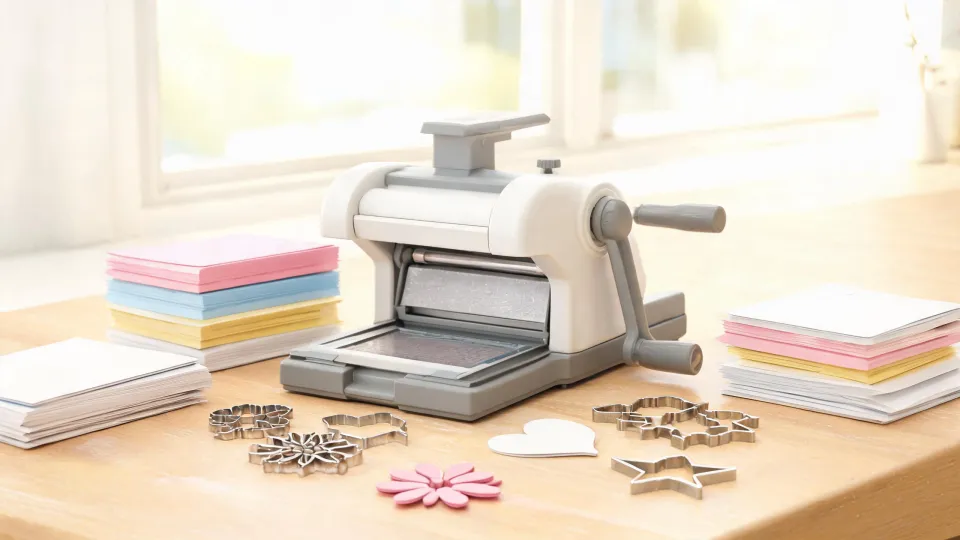
With custom dies, the silhouette itself is the brand. Using a Provo Craft Sizzix die-cutting machine, paired with steel-rule dies—either standard or custom-designed—you can cut paper, cardstock, fabric, or thin materials into any outline that fits your brand story. Seasonal collections like Sizzix Christmas dies let you produce holiday shapes that pair with corporate branding. Or you commission a custom die based on your actual logo.
This is also where I get the question: "What is a personalized gift card?"
In retail, a gift card is a pre-paid card with a fixed balance. In corporate gifting, a personalized gift card is something else: a custom, die-cut card tailored to the recipient—a name, a brand mark, a seasonal shape—designed to accompany the actual gift. Think of a crystal gift (an award, a paperweight, a crystal ornament) presented with a die-cut card that mirrors the logo shape. The card is the context-setting layer that makes the gift feel intentional.
There's a compliance angle here too. Per FTC guidelines (ftc.gov), marketing claims need to be truthful and substantiated. If you're calling something "custom" or "personalized," it needs to be designed around the recipient's or client's specific requirements—not just printed from a template. This matters in the promotional products space more than people think.
Conclusion: custom allows branding to extend to shape, print, packaging, and presentation. Stock caps you at the imprint.
3. Total Cost of Ownership: Where the "Cheap" Option Gets Expensive
I hear the same objection whenever I recommend custom die-cut for a corporate client: "But the unit price is way higher."
It is. Here's a ballpark based on publicly listed pricing and my own experience (as of early 2025):
- Stock promo items: $2–5 per unit, low setup fees, but minimum quantities often 500–1,000+, and quality control varies widely across suppliers.
- Custom die-cut items: $5–12 per unit depending on material and complexity, plus a one-time die design and tooling cost of $200–600. Minimum practical order is much lower—around 100 units—so it's accessible to smaller buyers.
That one-time die cost is where people get stuck. But spread it out: on a 500-unit order, a $400 die adds $0.80 per unit. On a 2,000-unit reorder two years later, the die cost is zero. I've seen clients reuse the same dies for years.
Meanwhile, the stock option's hidden costs show up during production. In our Q1 2024 quality audit, a batch of 8,000 stock items from a secondary supplier came in with an 11% defect rate—imprint misalignment, off-center logos, inconsistent coloring. The $200 savings from choosing the lower quote turned into a $1,500 problem: sorting, reshipping, packaging, and explaining the delay to the client.
The thing is, with custom die-cut, we inspect the sample first, so quality issues are caught before mass production. With stock items from a budget supplier, you're often trusting their batch quality—and seeing the result when it arrives.
Conclusion: stock wins on unit price. Custom wins on total cost when defects, reorders, and brand impact are factored in.
4. Turnaround Reliability: Fast vs. Trustworthy
Stock products ship quickly. If you need 2,000 branded mugs in seven days, a stock supplier can usually make it happen.
But in my audits, the cheapest stock suppliers are the ones most likely to push rushed orders through without inspection. When the batch arrives with quality issues, the "fast" option becomes the slow option.
Custom die-cut has a longer first-time lead because of die creation and sampling. Once approved, production is reliable, and reorders are faster. If you're not in a deadline crunch, the initial wait is a reasonable trade for batch-level quality control.
The surprise wasn't what I expected here: I assumed custom would be the riskier option because it has more moving parts—die making, multiple materials, sample approvals. Turned out the stock sub-tier suppliers had the higher defect rate in our audits. Custom's sample approval process caught problems early.
Conclusion: stock wins on initial speed; custom wins on reliability and reorder turnaround.
So Which Should You Choose?
Here's my short answer: neither option is universally good or bad. It depends on the scenario.
Stock promotional products make sense when:
- You need casual brand presence at a large trade show
- Your deadline is under two weeks with no room to negotiate
- Your order volume is 10,000+ units
- Batch-to-batch variance of "close enough" is acceptable for your use case
Custom die-cut gifts (like those made with Sizzix) make sense when:
- The gift represents your brand quality, not just your presence
- Your order fits in the 100–5,000 range
- You expect reorders (that die cost gets amortized every time)
- You want recipients to perceive effort and intention—the "who made this?" reaction
And if you're planning to mail die-cut greeting cards, remember to budget for postage. According to USPS pricing effective January 2025 (usps.com), First-Class Mail letters start at $0.73 and large envelopes at $1.50. Unusual die-cut shapes may not qualify for standard letter rates, so factor envelope size into your per-piece cost.
One Last Story From My Desk
Earlier this year, a client was choosing between a stock promo item—15% cheaper per unit, spec-comparable—and a custom die-cut gift for an important event. The spreadsheet said stock. My gut said custom. So I dug into the stock supplier's history and found three delayed batches and a product recall in the past twelve months. The client went custom, and the reaction at their event was exactly what they'd hoped for.
I've been at this for four years now, and I've learned that when the numbers and the gut disagree, it's usually because the spreadsheet is missing a factor: total cost, perceived value, reliability. If you're evaluating custom die-cut gifts for your next campaign, don't just ask for a unit price. Ask for the full picture—sample, spec sheet, and production timeline. Then decide.

Elise Laurent is a crystal and decorative glass quality analyst covering crystal figurines, vases, ornaments, suncatchers, and gift glassware. She examines ISO 6486-1 where food-contact glass dinnerware applies, then uses polarized strain inspection, dimensional checks, surface-defect grading, and refractive clarity to compare decorative pieces outside that scope. Her work helps sourcing teams choose materials, finishing routes, and protective packaging without confusing visual brilliance with verified durability.