Which Sizzix Die Cutting Machine Should Your Gift Business Buy?
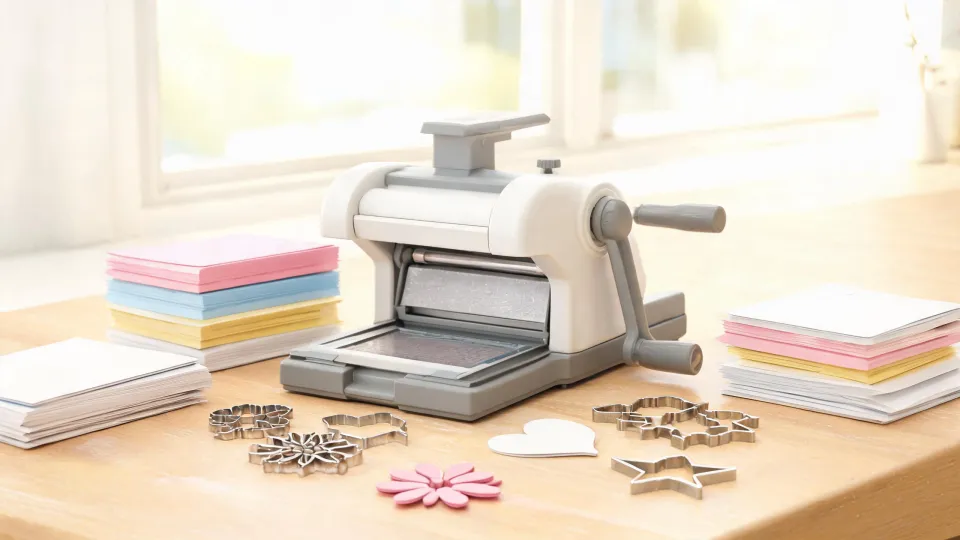
Ask five gift companies which Sizzix die cutting machine they'd recommend and you'll get five different answers. Not because four of them are wrong, but because the right machine depends on what you're producing, how many units you're moving, and who your clients are.
After six years of managing procurement for a promotional products company—and roughly $180,000 in tracked spending—I've seen gift businesses fall into three camps:
- Low-volume boutiques producing 100–500 personalized gifts per order
- Mid-size firms running 500–5,000 pieces with rotating designs
- High-volume manufacturers doing 5,000+ with custom brand shapes
Each camp needs a different machine. Here's the breakdown.
One thing before I dive in: the quality of your output is your brand. I know that sounds like a marketing line, but when a client opens a box of personalized corporate gifts, they're judging your company in that first thirty seconds. A clean, crisp die cut tells them you're professional. A ragged edge tells them you cut corners—literally.
Why the "Just Buy the Best One" Advice Is Wrong
It's tempting to think you can compare specifications and pick the clear winner. But the machine price is only part of the total cost. Dies, setup time, labor, maintenance, and consistency all factor in—and those look completely different depending on your production volume.
Most buyers focus on the machine's sticker price and completely miss the die costs, which can exceed the machine cost within the first year. The question everyone asks is "which Sizzix machine is the best?" The question they should ask is "which one costs the least per finished piece, given my order sizes?"
Total cost of ownership = machine price + dies + labor + maintenance + downtime. The machine with the lowest sticker price rarely wins that equation.
Scenario 1: You're Producing 100–500 Personalized Gifts Per Order
If you're a small gift shop or corporate gift reseller fulfilling orders in the hundreds, you don't need an electronic machine. Period. A manual Sizzix Big Shot will do everything you need.
Here's the math. The Big Shot goes for around $189 as of April 2025. Standard dies run $18–45. If you start with three dies and the machine, you're at roughly $280. For 300 personalized greeting cards, that's under a dollar per card in equipment cost—and the dies will still be cutting cleanly years from now.
When we first started, I pushed our team toward the Sizzix Switch instead. That was $350 of unnecessary spending for our volume at the time—or rather, not wasted exactly, but it would have been easier on our quarterly budget to start smaller. What I mean is: future-proofing is excellent in theory and expensive when growth doesn't come as fast as you expected.
One quality note: even the manual machine produces consistent, clean cuts on greeting cards, which is what your clients notice first when they open a gift box. The Big Shot is also sturdy—we've had ours for five years with zero maintenance issues. At least, I'm pretty sure it's been five years; I might be misremembering the exact purchase date.
The one case where I'd point you toward the Sidekick instead is if you're working with very small pieces—tags, ornaments, tiny die shapes—and you don't mind a more compact footprint. But if greeting cards are your bread and butter, the Big Shot's larger platform handles standard card sizes more comfortably.
Scenario 2: Your Orders Run 500–5,000 Pieces With Rotating Designs
This is where the Sizzix Switch die cutting machine starts to make sense. Its dual operation—manual and electronic—means you get the best of both modes. Run the long, repetitive batches in electronic mode. Switch to manual when you need precise placement or you're working with a tricky material.
Why does the dual mode matter for total cost? Time. I tracked our production rates for a 1,000-card order: the manual operation took about 18 hours. In electronic mode, the same run took under 10. That saves 8 hours per order, which at even $20/hour in labor is $160 per batch. The Switch retails around $549 as of April 2025. It pays for itself in roughly three to four large orders.
But there's a hidden cost I want to warn you about: die replacement. At higher volumes, thin-metal dies wear out. We saw quality degradation around the 8,000–10,000 cut mark on our most-used die. The first time, I blamed the material. The second time, I shrugged. After the third time we shipped a batch with slightly off cuts before a client noticed, I finally created a die-tracking spreadsheet. Should have done that after the first incident.
We lost a $6,500 annual account because of that third batch. The client didn't complain about the subtle quality drop—they just quietly started ordering smaller quantities. That's the quality-perception piece again. Die wear cost us $28 to fix. The account was worth $6,500 a year. I'll never forget that math.
Last thing about the Switch: check compatibility on the Sizzix website before assuming your existing dies work. Most standard dies do, but some older or specialty dies have different clearance requirements. Most buyers assume "any die fits any machine." Not true, and the official comparison chart takes five minutes to check.
Scenario 3: You're Doing High-Volume Production With Custom Brand Shapes
If your orders consistently exceed 5,000 pieces, or you're building a brand around proprietary shapes, you need a Big Shot Pro setup—often multiple machines running in parallel.
Here's the thing about custom dies: they're an investment. A custom die from Sizzix typically costs $150–400 depending on size and complexity. That sounds like a lot until you divide it by 5,000 units. At $300 per die and 10,000 pieces over its life, that's three cents per piece. And the custom shape makes your product instantly recognizable and impossible for clients to source elsewhere.
What I mean is: once you create a proprietary ornament shape for a corporate client, that client has to come back to you for replenishments. They can't shop the same design at another supplier. It's a retention play disguised as a design decision.
We invested $1,500 in custom dies in Q3 2024 for a major banking client's holiday gifts. The setup was painful, but the result: their branded ornament shape had zero alternative suppliers. They've already renewed for the 2025 season.
The Big Shot Pro itself runs around $399–449 as of April 2025. For high-volume shops, having two machines means redundancy—if one needs maintenance, you're not halting production. Downtime costs more than the second machine. The potential lost revenue during peak season is not worth saving $400.
Also worth noting: Sizzix's collaboration with designers like Tim Holtz gives you access to professionally tested design libraries. That means you can offer premium, established designs without commissioning original work—a cost-effective middle ground between standard and custom dies.
How to Tell Which Scenario You're Actually In
Still not sure? Here's a checklist I use when colleagues ask me what to buy.
- What's my average order size? Under 500? Start at Scenario 1. Over 500? Move to Scenario 2. Consistently over 5,000? You're in Scenario 3.
- How many of my products need custom shapes? If the answer is "most of them," you're closer to Scenario 3 than you think.
- How fast do I need to turn orders around? If clients expect delivery within a week, the Switch's electronic mode is a serious advantage.
And don't forget production timing, because it's the thing almost everyone underestimates. We get a question every February—"when to cut tulips for vase?"—but the paper version has a timeline too. If you're producing tulip-themed greeting cards and ornaments for spring corporate gifts, you need to start cutting 6–8 weeks before the season orders arrive. Not the week of. Plan die orders in late autumn if you want spring production to run smoothly.
My final honest take: if you're still torn between the Big Shot and the Switch, buy the Big Shot first. Prove the demand, build a client base, and upgrade to the Switch when you're placing 500+ unit orders with confidence. Every machine has its place, and buying what matches your current volume is never the wrong decision.
Check current pricing and die compatibility on the Sizzix website. The numbers I referenced are as of April 2025, and they've changed before—so verify before you budget.

Elise Laurent is a crystal and decorative glass quality analyst covering crystal figurines, vases, ornaments, suncatchers, and gift glassware. She examines ISO 6486-1 where food-contact glass dinnerware applies, then uses polarized strain inspection, dimensional checks, surface-defect grading, and refractive clarity to compare decorative pieces outside that scope. Her work helps sourcing teams choose materials, finishing routes, and protective packaging without confusing visual brilliance with verified durability.