Sizzix Cutting Machine vs. Outsourcing: Lessons from a School Promo Buyer
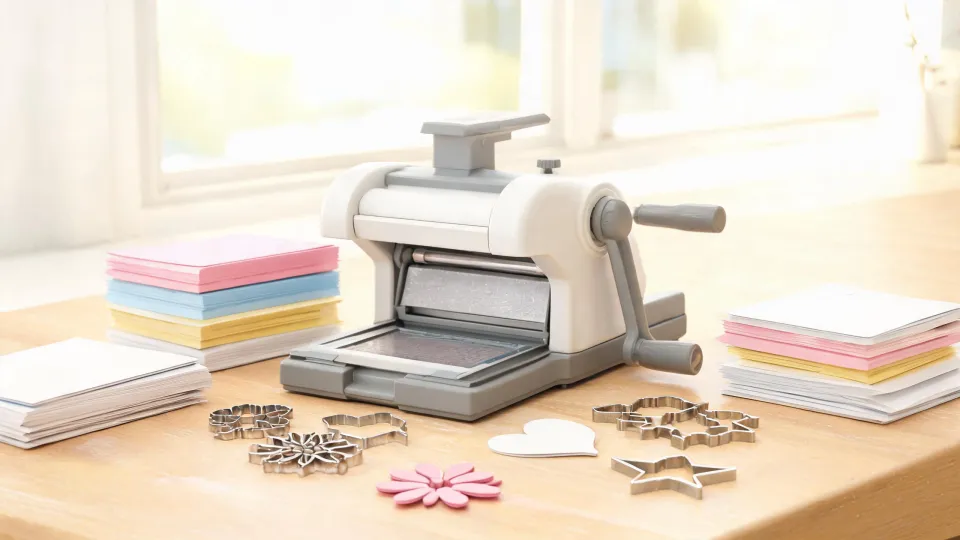
For the past six years, I've been the procurement coordinator handling promotional product orders for a group of 14 K-12 schools. I've personally made and documented 11 significant mistakes, totaling roughly $9,000 in wasted budget. Now I maintain our team's checklist to prevent others from repeating my errors.
One question I keep getting from other coordinators is whether they should buy a Sizzix cutting machine and make items in-house, or outsource the whole thing to a promotional products supplier. It's a reasonable question. A Sizzix (from Provo Craft) can cut paper, cardstock, thin plastic, and some fabric. With the right dies, you can make custom ornaments, greeting cards, even small gift tags. But 'can cut' is not the same as 'should cut.'
The honest answer? It depends. But not in a vague, both-are-great way. I've spent real money learning exactly where each approach works and where it falls apart. In this article, I'll compare the two based on four dimensions that have caused me the most pain: true cost per item, turnaround time, customization ability, and compliance.
The real comparison: 4 dimensions
1. True cost per item
Let's start with the obvious one. With a Sizzix cutting machine, you pay upfront. Based on prices I saw in early 2025 at craft retailers, a Sizzix Big Shot runs about $80-$120, a Big Shot Plus is around $100-$150, and a Big Shot Pro is closer to $300 plus. Then you need dies. A basic die runs $15-$40; a specialty set like the Christmas ornament shapes can be $40-$100. Add in materials—cardstock, adhesive, ribbons, and if you're doing crystal gifts, the blanks are not cheap.
Don't overlook the model difference. The Big Shot is manual; the Big Shot Pro is electric and can handle wider materials. For a school setting, the manual one is honestly fine for occasional use. The Pro is better if you're producing hundreds of pieces a week, but it's also bigger and louder. That means more storage space and a higher risk of sitting unused if the person who likes it leaves.
Outsourcing gives you a per-piece price. In my experience, a simple custom keychain comes in around $1.50 to $4 per unit for school quantities. A custom die-cut Christmas ornament with a tassel might be $2 to $5 per unit. That quote includes supplier overhead, equipment, labor, and often shipping headaches they deal with.
Here's what surprised me: the break-even point is way higher than most people think. It's tempting to think you can just compare unit prices. But identical specs from different vendors can result in wildly different outcomes. When I factored in the cost of blanks, the die, the failed cuts, and my own labor, a 50-piece in-house run actually cost more than outsourcing. I still kick myself for assuming that once we had a machine, everything would be cheaper. It isn't.
2. Turnaround time
I once had a school call on a Wednesday, asking for 200 custom folders by Monday morning. That's a classic rush order. The best outsourced quote I got was $400 extra for next-day production and overnight shipping. In-house? If you already have the die and materials, a Sizzix can cut those folders in an afternoon. For a true emergency, in-house wins.
But there's a catch. You need the right die in hand. And I learned this the hard way: I ordered a custom die for a school mascot, assumed it would arrive in time, and it didn't. The production lead time for custom dies is usually 5-7 business days, but during the holiday season it stretched to two weeks. So we ended up waiting longer than an outsourced order would have taken. Looking back, I should have checked the die manufacturer's lead time before promising the school a deadline. At the time, I assumed two days would be enough. It wasn't.
There's also the human factor. In-house production relies on staff who have other jobs. If the one trained person is on vacation, you're stuck. A supplier has dedicated production staff, so they can consistently hit shorter lead times for standard items.
3. Customization and quality
In-house doesn't automatically mean better quality. This was a painful lesson. We bought a Sizzix to make custom Christmas ornaments for a district event. The first batch looked fantastic on paper. But when we tried to move to slightly thicker material for a premium feel, every single piece had stress lines or peeled edges. We ended up tossing about 300 pieces. That's $450 in wasted material, plus three days of lost time.
For something like crystal gifts—acrylic or glass-like awards—the machine could cut the shape, but it couldn't give the professional, polished edge that we needed. The outsourced vendor used specialty equipment to polish and bevel the edges. Our versions looked DIY in the worst way.
Now, I'm not saying outsourcing is always better. For flat cardstock items, branded tags, thank-you cards, or simple paper ornaments, in-house with a Sizzix is excellent. You can tweak designs endlessly and make exactly what the school wants. But the more three-dimensional or material-specific the product, the more likely a supplier will beat you on quality.
For custom dies, the flexibility is nice—you can order a die with your school mascot and use it for years. But that flexibility only helps if you actually use the die enough to justify its cost.
4. Compliance and selling to schools
This is the dimension everyone forgets. If you're making and selling promotional products to schools, you need to be careful with claims and safety. Schools are sensitive to issues like lead in paint, choking hazards, and misleading environmental claims.
The FTC has clear guidelines about advertising claims. For example, if you say a promotional item is 'recyclable' or 'eco-friendly,' you need to be able to back that up. Per the FTC Green Guides, a product advertised as recyclable should actually be recyclable for a substantial majority of consumers. If you're making things in-house and writing your own marketing copy, you might accidentally make a claim that has no basis. I almost did this once—I put '100% eco-friendly' on a brochure for a ribbon, without realizing the ribbon had a plastic core. A sharp-eyed colleague caught it. That could have been an FTC compliance issue.
Outsourcers have teams who handle these details because they deal with compliance daily. Many suppliers have certifications or documentation you can request. If you include those in your proposal, you'll look much more professional when selling to schools.
Another practical point: if you're mailing promotional materials, USPS rules matter. I want to say our last bulk mailing used standard letter-rate envelopes, but don't quote me on that. Actually, we switched to large envelopes one year, and the postage jumped. According to USPS pricing effective January 2025, a First-Class Mail large envelope (1 oz) is $1.50. For an 800-contact school mailing, that's a big line item. In-house, you absorb that cost. Suppliers often have pre-negotiated shipping and can handle fulfillment directly.
There's also a federal law piece: under 18 U.S. Code § 1708, only USPS-authorized mail may be placed in residential mailboxes. If you're sending samples to teachers at home, you have to be careful. A supplier who does mailing regularly knows these rules; a well-meaning school employee might not.
So which do I recommend?
It depends on your volume, your staff, and your product mix.
Choose the Sizzix cutting machine if:
- You regularly need small batches of flat or simple custom items.
- You have a dedicated person who can run the machine weekly.
- You're comfortable managing your own compliance checklist.
Keep it simple. Things like paper ornaments, greeting cards, and flat cutouts work great on a Sizzix Big Shot or Big Shot Pro.
Choose outsourcing if:
- You need large quantities by a strict deadline.
- You're working with materials like crystal or coated cardstock that need professional finishing.
- You don't have the capacity to monitor FTC compliance and production quality.
- It's a one-off order. Don't buy a machine and dies for a single event. I know that sounds obvious, but I've made that mistake.
Final advice
Both paths can work. The biggest cost isn't the machine or the supplier—it's the wasted time and damaged reputation from choosing the wrong approach for the wrong job. Since I started writing our checklist, we've caught 47 potential errors before they turned into expensive disasters.
If you're trying to figure out how to sell promotional products to schools, remember: they're not just customers. They're bureaucracies with budget cycles, compliance rules, and hard deadlines. Plan accordingly. And if you already own a Sizzix (Provo Craft's die cutting line), don't feel like you need to use it for every order. It's a tool, not a business strategy.

Elise Laurent is a crystal and decorative glass quality analyst covering crystal figurines, vases, ornaments, suncatchers, and gift glassware. She examines ISO 6486-1 where food-contact glass dinnerware applies, then uses polarized strain inspection, dimensional checks, surface-defect grading, and refractive clarity to compare decorative pieces outside that scope. Her work helps sourcing teams choose materials, finishing routes, and protective packaging without confusing visual brilliance with verified durability.