The Custom Sizzix Christmas Dies Disaster That Taught Me a $1,150 Lesson
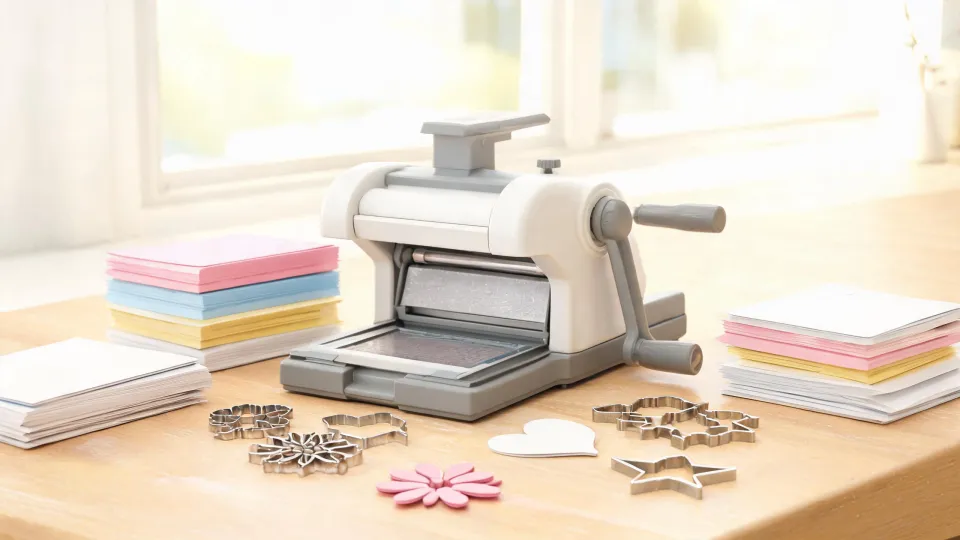
In September 2022, I approved a custom die proof that I didn't fully understand. It looked fine on my screen. It was not fine on cardstock.
That one approval cost us 420 greeting cards, a 5-day delay, and about $1,150 in rework. It also changed the way our team looks at every order for custom Sizzix Christmas dies. (Finally, if you ask me.)
I've been sourcing corporate gifts, greeting cards, and custom craft products for over eight years. I've personally made and documented 13 significant mistakes, totaling roughly $34,000 in wasted budget. This one was far from the most expensive, but it was the most preventable.
The Order That Almost Wasn't
In late summer 2022, a small regional museum gift shop reached out. They wanted 500 die-cut holiday greeting cards, 200 hanging ornaments, and a short run of crystal gift pieces for their annual donor thank-you packages. The whole project was around $6,800. For them, that was a big commitment. For us, it was below our usual project threshold.
I'm not proud of this, but I almost pushed it to "maybe later."
Here's the thing about small orders: when I was starting out, the vendors who treated my $200 orders seriously are the same ones I still trust for $20,000 orders today. Small doesn't mean unimportant. It means potential. So we took the project.
We planned to use two Sizzix Christmas dies for the greeting card cover—a standard Tim Holtz snowflake die and a custom die we designed from the shape of the museum's front window. The ornaments would use another custom Sizzix die in a winter-tree silhouette. I had used Sizzix die cutting machines in past projects, including the Sizzix Big Shot Pro for thicker materials, and I knew the dies were capable of clean cuts. The issue wasn't the machine. The issue was me.
The Proof That Looked Fine
Our die maker sent a digital proof of the custom window die. I zoomed in, rotated it, and checked the measurements against the greeting card template. Everything aligned. I wrote "approved" in the email and moved on to the next task.
I did not ask for a physical test cut.
The die came in a week later. We ran a small test with cheap copy paper, and it looked okay. Then we switched to the actual cardstock—a heavy, textured paper with a 30% cotton content. That's when the trouble started.
The delicate inner window lines of the custom Sizzix die didn't punch cleanly. Instead, they tore around the edges. The tree silhouette die was worse: the narrow branches folded, leaving a ragged white line instead of a crisp cut. We tried adjusting the pressure. We tried different cutting pads. We changed the stack thickness. Not ideal, not even serviceable. Out of the first 500 greeting cards, 420 were damaged.
My first reaction was "blame the die." But the die's cutting geometry was actually fine—for the wrong material. I had approved the design without testing how it would behave in a 30% cotton cardstock. The digital proof showed a shape. It didn't show stress fractures, fiber tearing, or the fact that the intricate pattern needed a softer cardstock to survive.
The Actual Cost of a "Small" Order
The rework was ugly. We had to:
- Source a new cardstock that could handle the die-cut detail (we ended up paying a premium for a non-textured cover stock)
- Book a rush run with our converter to restock the 420 greeting cards
- Re-die-cut all 200 ornaments with a redesigned custom die because the original was too fragile for production
- Explain to the museum that the first delivery date was gone
All told, the mistake added about $1,150 and five working days to the project. (Ugh.) It also required a very awkward phone call with the museum director, who was more understanding than I deserved.
For anyone curious about the pricing side: custom die setup in this kind of commercial run often starts around $50 to $200 depending on complexity, based on publicly listed supplier pricing I've checked as of January 2025. That's not the expensive part. The expensive part is the assumption that a digital proof is enough. We ended up spending $312 on a last-minute physical test die and rush materials that we could have spent a week earlier, on purpose.
The side request I let slide
While we were deep in the die-cutting mess, the museum also asked a simple question in an email: "By the way, where can I find diamond painting kits? We want to set up a craft table for our holiday open house."
I skimmed it, assumed it was a one-off ask, and never followed up. It felt like a distraction from the real problems. In hindsight, it was exactly the kind of small request that tells you what a client is planning next. They weren't asking for dozens of kits. They were asking if we could be a partner who helps with ideas, not just a person who processes orders. I missed the opportunity because I was too embarrassed about the cardstock to look beyond the current crisis.
Lessons From the Cutting Table
That October was not my finest moment. But it did produce a set of rules I still use:
- Always ask for a physical test cut before approving a custom die. Real cardstock behaves differently than a PDF.
- Design dies for the material, not for the screen. A 30% cotton textured cardstock is beautiful for writing, terrible for intricate die cuts.
- Rush costs are not about difficulty. People assume rush upcharges are because the work is harder. Actually, rush work is unpredictable—it interrupts planned schedules and turns small surprises into expensive ones. That's what you're paying for.
- Small requests are a signal. The diamond painting kits question should have been a doorway. Instead, I left it shut.
- Small clients deserve the same level of scrutiny as large ones. We treated this project like a minor order, and it found every hole in our process.
I've also stopped saying "I'll check it on my screen." The screen is a lie. The proof is paper.
The museum did get their greeting cards in time for the holiday season. The crystal gift pieces arrived with no issues—crystal gift engraving turned out to be the least complicated part of the whole project. We're still doing work with them today, including their request for a spring collection with new custom dies. I hope they never know how close we came to making that first bad call permanent.
No one remembers the small order they almost turned away. But they definitely remember the small order that went sideways.

Elise Laurent is a crystal and decorative glass quality analyst covering crystal figurines, vases, ornaments, suncatchers, and gift glassware. She examines ISO 6486-1 where food-contact glass dinnerware applies, then uses polarized strain inspection, dimensional checks, surface-defect grading, and refractive clarity to compare decorative pieces outside that scope. Her work helps sourcing teams choose materials, finishing routes, and protective packaging without confusing visual brilliance with verified durability.