Which Sizzix Machine Should You Actually Buy? A Procurement Manager's Scenario Guide
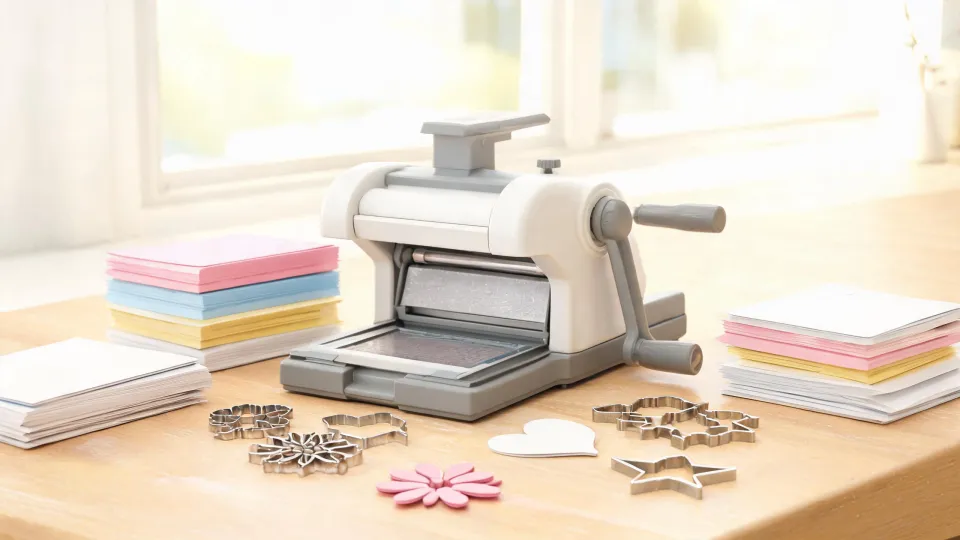
-
Before Anything Else: Answer These Three Questions
-
Scenario A: High-Volume Ornaments & Corporate Gifts — Go With the Sizzix Big Shot Pro
-
Scenario B: Greeting Cards & Mixed Paper Products — Don't Overlook the Standard Big Shot or Express
-
Scenario C: Scrapbooking Services & Low-Volume Custom Work — The Sidekick Is Enough
-
How to Find Your Scenario — And Stop Second-Guessing
When someone asks me "which Sizzix machine should we buy?" the honest answer is: it depends. And I don't mean that in a wishy-washy consultant way. I mean there are genuinely different machines built for genuinely different production realities — and picking the wrong one costs real money.
I've spent the past six years managing procurement for a mid-sized gift and craft company. That's roughly $180,000 in cumulative spend on die cutting machines, custom dies, materials, and replacement parts, all tracked in our cost system. In that time, I've bought equipment that paid for itself in weeks, and I've bought a machine that sat in the corner after three months because it didn't match our workflow. The difference wasn't quality. It was fit.
So let me break this down the way I wish someone had for me: by scenario. Figure out which one sounds like your operation, then read that section.
Before Anything Else: Answer These Three Questions
Every buying decision comes down to three variables. I've stopped recommending machines until I know these:
- What's your monthly output? Are we talking 50 custom ornaments or 3,000 greeting cards? These are different businesses.
- What materials dominate your runs? Cardstock and lightweight paper are forgiving. Acrylic, chipboard, and heavy kraft paper are not.
- Who's operating the machine? Skilled crafters who've used die cutters for years? Or production staff who rotate shifts and need consistency?
Your answers put you in one of three scenarios. In my experience, about 60% of B2B buyers I've talked to actually belong to Scenario B. The other 40% are either overbuying or underbuying based on advice meant for someone else.
Scenario A: High-Volume Ornaments & Corporate Gifts — Go With the Sizzix Big Shot Pro
If you're producing corporate Christmas ornaments, premium branded gifts, or custom die-cut products in the thousands, the sizzix big shot pro die cutting machine is usually the right call. Not because it's the most expensive option — because it's the cheapest per good unit.
Here's what convinced me. We switched to the Big Shot Pro in Q1 2023 after a failed run using a smaller machine to cut thick chipboard. That run produced a 7.2% reject rate and cost about $340 in wasted material per production batch. After switching, our reject rate dropped to 1.8%. Based on our tracking, the Pro paid for itself in 4.2 months of regular production. That's not a marketing line — that's from our cost spreadsheet.
A few honest caveats. The Pro is heavy, and it takes up a real chunk of bench space. If your workshop is tight, that's a genuine trade-off. And yes, it costs more upfront — but when you factor in labor, material waste, and the cost of redoing rushed orders, the total cost of ownership usually favors the Pro for anyone doing serious volume.
One more thing: the Pro handles custom sizzix dies exceptionally well. We've run custom company logos, monogrammed ornaments, even a series of branded snowflakes for a hotel chain's corporate gifts. If custom die-cutting is part of your offering — and for corporate gifts, it usually should be — the Pro's larger platform makes a real difference.
Now, the scenario where buying the Pro is a mistake: if your volume doesn't justify it. Which brings me to the next scenario.
Scenario B: Greeting Cards & Mixed Paper Products — Don't Overlook the Standard Big Shot or Express
If greeting cards and paper crafts are your core product line, the Sizzix Big Shot Express is the machine I'd rather buy. I'll admit, I was skeptical of the "Express" branding at first. It felt like a marketing upgrade more than a real one. But the surprise wasn't the speed — it was the die-swap mechanism. The spring-loaded platform holds the die in place during each pass, so operators don't have to realign on every single cut. In our greeting card line, we measured a 14% faster die-change time compared to the Pro. When you're switching between 20+ dies in a single production day, that's real output.
Here's the counterintuitive part: for paper-based work, the Pro's larger capacity doesn't matter much. A standard greeting card is rarely wider than 6 inches. The Express gives you the same cutting precision, a smaller footprint, and a lower total setup cost — in our analysis, roughly $400–600 less when you factor in accessories and maintenance. We actually run both machines in our shop for different product lines. But if I had to pick one machine for a paper-heavy operation? The Express, every time.
I should also mention the original Sizzix Big Shot here. The standard model is still a solid workhorse. The Express is the same machine with a better die-lock mechanism, and worth the modest premium if operators are switching dies frequently. For straight-ahead, low-variety runs, the classic Big Shot is perfectly fine and usually available at a slightly lower price point.
Scenario C: Scrapbooking Services & Low-Volume Custom Work — The Sidekick Is Enough
This is the one where I might get pushback, but I think the Sizzix Sidekick is the most underrated machine for smaller B2B operations. If you're running a boutique shop, a custom scrapbooking service, or you need a demonstration machine for craft fairs and retail events, the Sidekick covers most of what a standard Big Shot does — just in a smaller envelope.
A client of ours runs a gift shop and took on a custom order for 120 die-cut gift tags for a local hotel chain. She did it with a Sidekick over three days and said the machine handled it with zero issues. In that setting, buying a Pro would've been capital waste. The Sidekick cost her a fraction of the price and took up a fraction of the bench space.
So when people ask me "what to buy for scrapbooking" in a retail or small-batch context, the Sidekick is honestly the answer. It's not a compromise. It's the right tool for a different scale of work.
How to Find Your Scenario — And Stop Second-Guessing
If you're still not sure which bucket you fall into, here's the decision rule I've built after years of procurement tracking:
- If your orders are under 200 units per week, mostly paper-based, and you're not planning a big scale-up in the next year — the Sidekick or standard Big Shot is enough. Invest the saved capital in custom dies or marketing instead.
- If you're doing 200–1,000 units per week of mixed materials, or you need custom sizzix dies for client work — the Big Shot Express is your sweet spot. It balances speed, footprint, and flexibility.
- If your monthly volume approaches 3,000+ units, or you're cutting thick materials, oversized ornaments, or switching dies multiple times per shift — the Big Shot Pro will save you money on labor and rejects within a season. It shows up in the TCO, not the sticker price.
I'll add one cautionary story from our own books. In Q4 2024, we took a rush order for 900 custom ornaments with a 10-day deadline. I had about two hours to decide on the production approach before the client's cut-off for the holiday season. Normally I'd do a sample test run and verify the die registration. There was no time, so I trusted our existing setup and skipped the test batch. The result: a registration issue halfway through the run forced us to redo about 150 pieces — roughly $900 in lost material and labor. The machine wasn't the culprit. The missing test run was.
So the real advice is this: the machine matters, but matching it to your actual production volume matters more. Buy for the work you're doing today. If you're growing, buy one step above your current output — not two. And whatever you choose, leave time for a sample run before the big order lands.

Elise Laurent is a crystal and decorative glass quality analyst covering crystal figurines, vases, ornaments, suncatchers, and gift glassware. She examines ISO 6486-1 where food-contact glass dinnerware applies, then uses polarized strain inspection, dimensional checks, surface-defect grading, and refractive clarity to compare decorative pieces outside that scope. Her work helps sourcing teams choose materials, finishing routes, and protective packaging without confusing visual brilliance with verified durability.