Sizzix Big Shot Cutting Machine: Corporate Gift Tips and the Greeting Card Size Question
-
The short answer
-
Why I trust it for deadline work
-
What I learned the hard way about custom dies
-
What is a greeting card size? The version I use
-
Where a Sizzix Big Shot fits in a production workflow
-
One specific use case: crystal gifts
-
The small-order rule I live by
-
When I tell clients not to use a Big Shot
Use a Sizzix Big Shot cutting machine for short-run corporate gift cards, custom die-cut packaging, and greeting cards when you need repeatable quality in-house—but treat the custom die, not the machine, as the real deadline. In 2024, that distinction helped me keep a $14,000 corporate gift order from falling apart. I'm a production coordinator at a promo products company, and I've handled 200+ rush orders in eight years, including same-day turnarounds for clients arriving at trade shows with only a logo and a deadline.
The short answer
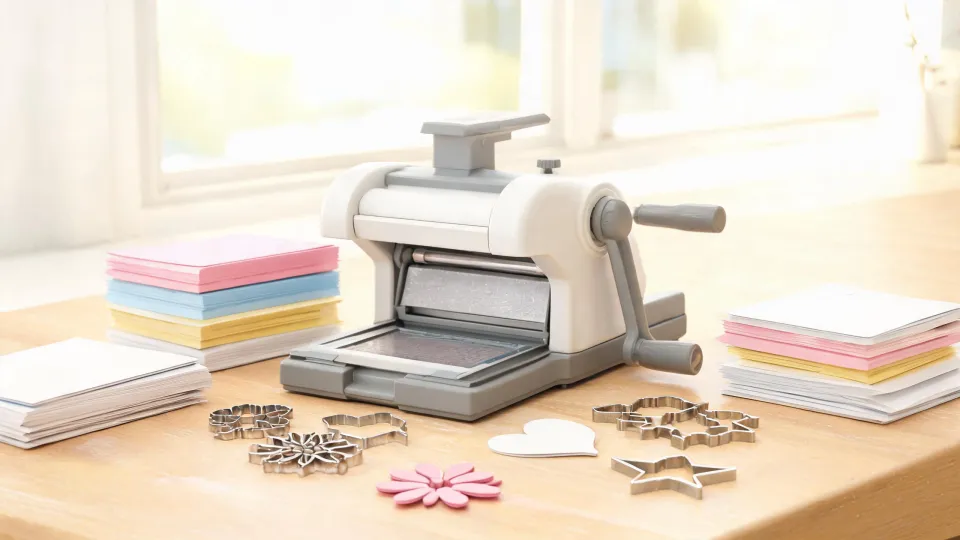
The Sizzix Big Shot is a manual die cutting machine that presses steel-rule dies through cardstock, thin chipboard, fabric, cork, and some plastics. It isn't a digital cutter. It won't turn a logo file into a shape by itself. But when you have a die that matches your design, it gives you consistent, repeatable cuts. That's the whole game for corporate gifts.
According to Sizzix (sizzix.com), the Big Shot is designed to work with Sizzix dies and many thin dies, but not all die sizes fit every machine. Check compatibility before you order.
The most useful Sizzix die size for corporate greeting cards is A2: a folded card measuring 4.25 by 5.5 inches. If someone asks me what is a greeting card size, that's my default answer. A2 fits the standard A2 envelope (4.375 by 5.75 inches) and is the closest thing to a universal card size in the US.
Why I trust it for deadline work
In March 2024, a client called at 9 AM. They needed 300 A2 greeting cards for a hotel welcome gift the next morning. Normal greeting card print turnaround is three to five business days. We had a Sizzix Big Shot and an A2 die in stock, so we cut 300 card bases from flat sheets of cotton cardstock. The machine handled the job with a steady rhythm, and by 3 PM we had all 300 cut, folded, and packed with printed inserts. The client got their cards that night.
What saved us wasn't speed. It was preparation. The die was already cut. The material was already tested. We knew the cardstock would crease cleanly because we tested it the week before. The machine itself is slow if you count each pass. But when every card needs to look identical, the Big Shot beats hand-cutting and matches the consistency of a print vendor for short runs.
I went back and forth between a manual Big Shot and an electric die cutter for two weeks. Manual was cheaper and portable. Electric was faster. On paper, electric made sense. My gut said manual was less likely to fail mid-run, and for the 25-to-500-piece jobs I manage, manual is enough. So far, that's still true.
What I learned the hard way about custom dies
Most rush mistakes I see are not machine mistakes. They're die mistakes. Custom Sizzix dies are excellent for logo-shaped ornaments, box inserts, and decorative edges. But they are made to order. In 2023, I almost lost a $12,000 ornament order because I assumed a custom die would take five business days. It took eleven. The client pulled the order, and I paid $800 extra to another vendor to finish by hand. That hurt.
Three things matter in a custom die order: die spec, proof approval, delivery date. In that order. We didn't have a formal approval chain for custom die artwork at the time. It cost us when an unauthorized die fee appeared on an invoice because a designer changed the shape after the die had already been quoted. The third time we sent a die proof to the wrong email address, I finally created a checklist: die spec, material sample, proof approval, delivery date, backup vendor. I should have built that after the first incident, not the third.
Custom dies usually cost somewhere in the range of $50 to $250 depending on size and complexity, based on quotes I collected in 2024; verify current pricing before budgeting. The bigger cost is lead time. If you need a custom die for a corporate gift, order it as soon as the design is approved, not after your client approves the sample.
What is a greeting card size? The version I use
Clients ask me 'what is a greeting card size?' more than you'd expect. Usually they're trying to pick a die, order envelopes, or verify a print file. Here's the practical answer:
- A2: 4.25 by 5.5 inches folded. The default greeting card. Fits an A2 envelope.
- A6: 4.5 by 6.25 inches folded. Good for thank-you cards. Needs an A6 envelope.
- A7: 5 by 7 inches folded. More of an invitation or statement card. Needs an A7 envelope.
When you buy a Sizzix die, read the product description carefully. A die labeled 'greeting card' might cut the card base, only the decorative front panel, or a sleeve. I once ordered a card die and got only the front panel. Cute. Useless when the design required a full card.
Cardstock weight also changes the answer. The Sizzix Big Shot can handle a range of materials, but a die that cuts regular paper may not cut a thick cotton cardstock cleanly. In a single afternoon in March 2024, we tested six cardstocks with the same A2 die. The cheap white stock won because it creased cleanly and didn't crack. The expensive 250 gsm cotton stock looked great but folded like a broken sidewalk.
Where a Sizzix Big Shot fits in a production workflow
It doesn't replace commercial printing. If you need standard products, an online printer like 48 Hour Print is often the better route for business cards, brochures, and flyers, with quantities from 25 to 25,000 and standard turnaround days. Online printers also handle rush orders on many products. But they're usually not the answer for custom die-cut shapes, unusual finishes, quantities under 25, or same-day in-hand delivery. Those are the jobs where an in-house Sizzix setup saves the day.
Be honest about volume, too. If a client asks for 10,000 die-cut greeting cards, I'm not running that through a Big Shot. That's commercial die cutting, not a craft room. The Big Shot is for samples, short runs, final touches, and emergencies. That's still a valuable niche.
One specific use case: crystal gifts
Let me talk about crystal gifts for a second. A crystal gift—paperweight, candle holder, ornament—isn't something you die-cut. But the packaging around it can make or break the client's unboxing experience. A die-cut insert that holds the crystal, a branded card with the company logo, a decorative sleeve in corporate colors: these are the details that turn a glass object into a coordinated corporate gift. A Sizzix Big Shot is perfect for those short runs.
The small-order rule I live by
One of our die suppliers treated my first order—250 die-cut tags, about $300—with as much care as a national chain's 25,000-piece contract. I still use them for larger runs today. I don't call that loyalty. I call it data. The supplier who respects a small order is the supplier who will answer the phone when a big deadline goes sideways.
Small doesn't mean unimportant. It means potential. If a supplier adds a 'small order penalty' that triples the unit price or won't touch a 25-piece project, I walk. There are too many options that treat short runs as normal. With Sizzix, the custom die is a one-time cost. Once you own it, you can cut 5 pieces or 5,000. That's why I tell startups and boutique gift lines to start with a standard die, prove the product, then invest in a custom die once the design is locked.
When I tell clients not to use a Big Shot
I'm not going to pretend a die cutter is the answer to every project. If the greeting card order is 10,000 pieces and the design is standard, you should use a commercial print vendor. If the deadline is tomorrow and you don't own the die yet, the Big Shot won't help. If you need to cut a shape you haven't tested on your machine, assume it won't work without a test.
Also, the Big Shot won't make the crystal gift itself. It makes the card, the insert, the sleeve. That's still the part of the gift people remember.
The machine isn't the magic. The die, the material, and the lead time are the magic. Once I started treating those three things as the real project, the Big Shot became one of the most reliable tools in my production room. It won't do everything. It doesn't have to.

Elise Laurent is a crystal and decorative glass quality analyst covering crystal figurines, vases, ornaments, suncatchers, and gift glassware. She examines ISO 6486-1 where food-contact glass dinnerware applies, then uses polarized strain inspection, dimensional checks, surface-defect grading, and refractive clarity to compare decorative pieces outside that scope. Her work helps sourcing teams choose materials, finishing routes, and protective packaging without confusing visual brilliance with verified durability.