Why Custom Christmas Ornament Orders Miss Deadlines (and How Sizzix Die Cutting Changes the Timeline)
October 2024. A client called at 4:30 on a Thursday afternoon. They needed 750 branded Christmas ornaments for a December 1 employee gala. The catalogue lead time from their usual vendor was six weeks. They had nineteen days.
I get this call a lot. In seven years of coordinating corporate gift orders — roughly 300 rush jobs, maybe 280, I'd have to check our system — the shape of it never changes. The buyer isn't careless. The supplier isn't lazy. The timeline just doesn't work. And then everybody scrambles, and the scramble is where the real problems emerge.
That's the surface problem. The deeper problem is less comfortable to talk about, and it's the same whether the order is custom die-cut ornaments, a crystal gift with engraved names, or a batch of wall art prints for an office lobby: we keep treating a production problem like a shopping decision.
You're not buying a product. You're buying a process — and the process is where orders go to die.
The Part Nobody Tells You: The Die Has to Be Made First
When you order a custom Sizzix die-cut Christmas ornament — say, a snowflake with a company logo cut out of heavyweight cardstock — you're not ordering a product. You're ordering a process. A steel-rule die has to be made, tested, and mounted before the first sheet can be cut. That single step usually takes three to five days, no matter who you buy from.
I've never seen an honest supplier compress die-making into one day. The ones who promise that are usually skipping the test cut, which means the customer discovers the misalignment after the full batch is already cut. That's a much more expensive mistake.
When I first started managing these orders, I assumed the quoted lead times were padded. I negotiated hard. I pushed suppliers to shave days. After two seasons of late deliveries and rejected batches, I stopped asking "what's your fastest turnaround?" and started asking "where is the die made, and can I see a sample?"
Most buyers never ask that second question. And honestly, I get why — budgets are real, deadlines are tight, and the listing says "custom ornament" with a green "ready to ship" label. But the label is describing the product, not the process.
Why "Where to Buy" Searches Lead You Straight Into the Trap
The search strings are predictable: "where to buy sizzix die cutting machine," "where to buy affordable wall art prints," "custom crystal gift." Search engines deliver marketplaces, and marketplaces are excellent at selling finished goods. They are mostly terrible at custom production — because they're built for transactions, not for the back-and-forth of die approval, color proofing, and material selection.
There's a distinction that took me too long to learn, and I should add it clearly: buying a machine and buying finished products are two separate decisions with two separate partners.
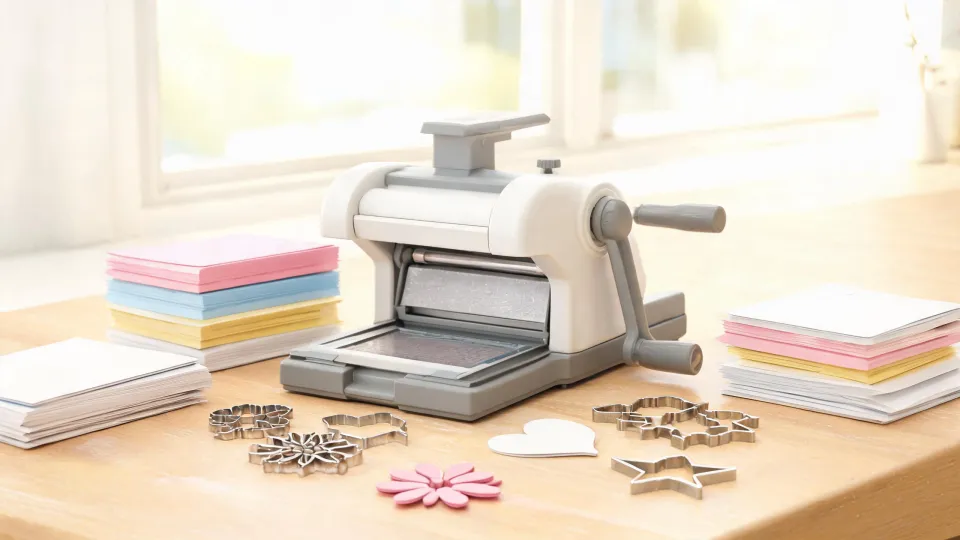
If you're asking where to buy a Sizzix die cutting machine because you're setting up in-house production, you want an authorized Sizzix reseller who can talk about model selection, die compatibility, and service. The Sizzix Big Shot cutting machine, for example, is a solid workhorse for moderate volumes. The Big Shot Pro takes wider dies and thicker material stacks, which matters if you're cutting larger ornament shapes or packaging inserts.
If you're asking where to buy finished custom ornaments, you want a production shop that already runs that equipment and knows what it can and can't do — not a reseller, and not a marketplace seller who may be drop-shipping from three different factories. The reseller can sell the machine but may not have a single die on the floor. The production shop won't sell you a machine but will cut your sample. Asking the wrong one costs you days.
What a Late Order Actually Costs
Let me give you a concrete example.
In Q4 2023, a regional bank needed 1,200 die-cut cardstock ornaments for client appreciation. Their logo, a specific holiday red, delivered in time for a December reception. They asked three suppliers for quotes. A marketplace vendor undercut the others by about 22% and promised delivery in ten days. The bank's procurement policy was straightforward: lowest responsive bid.
The vendor delivered on day nine. The red was wrong. Not subtly wrong — the Delta E was somewhere around 5 or 6, which is plainly visible to most people. For context, Pantone's color matching guidelines put brand-critical tolerance at Delta E below 2. The bank rejected the whole batch. Re-cutting and re-shipping took two more weeks. The reception had to be reorganized, internal communications had to re-explain the delay, and the total cost landed at roughly double the original budget.
We weren't the vendor, so I can't claim credit for that recovery. (Should mention: we weren't the bank's supplier either.) But it's a good illustration of what a "good price" costs when the process fails.
That's the thing about missed deadlines in this industry. It's never just the shipping delay. It's the client's event. It's their internal credibility. It's the procurement manager who chose the supplier. And then, quietly, it's the next year's order going to someone else — which is exactly what happened to us indirectly, because the bank's following holiday project went to a competitor.
The Materials Trap (and the Resolution Trap)
There's another layer nobody thinks about until it bites: materials. The same die that cuts beautifully in 80 lb cover stock — around 216 gsm, roughly business-card weight — will tear, shift, or leave ragged edges in a flimsier 24 lb bond (about 90 gsm). Paper weight conversions are approximate, but the principle is exact: every material behaves differently under a die.
A production shop with real experience will ask what material, what weight, what finish, what direction the grain runs. A marketplace listing just asks you to click "cardstock" and hope. If a supplier can't tell you the gsm of the material they plan to cut, that's a red flag.
The same logic applies to anything printed. Custom wall art prints, printed die-cut pieces, even the printed backing card on an ornament — the file must be 300 DPI at final size for commercial print. That's the industry standard. 150 DPI can be acceptable for large format viewed from a distance; it is not acceptable for a gift held in the hand. The path to affordable wall art prints isn't a lower listing price — it's a file that prints right the first time. I've rejected more design files than I can count because they were 72-DPI exports pulled from a website.
One Thing I Still Don't Fully Understand
Honestly, I'm not sure why some die suppliers hit their registration tolerance batch after batch while others drift after the first hundred cuts. My best guess is it comes down to discipline — whether they re-check the die and the pressure settings at the start of every shift. But I've never seen a supplier's quality log, so I can't say for certain.
What I can say, from experience: a physical sampler is worth far more than any PDF proof. A custom die job should always start with a cut sample that the buyer can hold. Any supplier who won't provide one has a reason, and it's rarely a good one.
An Old Belief Worth Retiring
The notion that custom dies are only practical for massive runs comes from an era when steel-rule tooling was hand-made and expensive. That's changed. CNC die-making and Sizzix-compatible systems have brought custom dies within reach of surprisingly short runs — a 500-piece ornament run is no longer exotic. Some suppliers still price and schedule as if it were. That's their inefficiency, and it's becoming a competitive disadvantage for them.
So What Actually Works
I'm not going to pretend there's a magic solution — everything I've learned suggests you reduce risk more than you eliminate it. But these four practices have held up across the 180-odd rush orders we tracked last year, with about 95% on-time delivery as of January 2025:
- Buy from a partner who owns the die process. If the supplier has a Sizzix Big Shot or Big Shot Pro on the floor, and can make custom dies in-house, they control the critical path. That's the real answer to "where to buy sizzix die cutting machine" with support: a supplier who will also produce and test a sample for you.
- Ask the die question before the price question. How long to build the die? Can I see a cut sample? Who's accountable if the die fails? Those answers tell you more than any quote.
- Build a proofing buffer into the schedule. Design review, color approval, material sign-off — each cycle eats a day. Plan for them instead of discovering them.
- Consolidate the seasonal categories. The suppliers with the best track records we work with handle more than ornaments. A single account manager coordinating a die-cut ornament run, a crystal gift engraving batch, and a wall art print order means fewer handoffs, fewer miscommunications, and one shipping schedule.
I'm not claiming efficiency fixes everything. There are projects where the hand-made, slow, artisanal approach genuinely beats production speed — and we use those suppliers when the job calls for it. But for the standard corporate gift cycle, efficiency is the competitive advantage. The partner who understands die lead times, material weights, and color tolerances is the one who can absorb your emergencies. The one who doesn't is the emergency.
The next October phone call will still come. A client will still need 750 ornaments in nineteen days. The only question is whether that order lands in a marketplace cart or on a production partner's worktable. In my experience, that decision determines everything else.

Elise Laurent is a crystal and decorative glass quality analyst covering crystal figurines, vases, ornaments, suncatchers, and gift glassware. She examines ISO 6486-1 where food-contact glass dinnerware applies, then uses polarized strain inspection, dimensional checks, surface-defect grading, and refractive clarity to compare decorative pieces outside that scope. Her work helps sourcing teams choose materials, finishing routes, and protective packaging without confusing visual brilliance with verified durability.