Ordering Corporate Chocolate Gift Boxes? Here's the 5-Step Checklist a Quality Inspector Uses
-
Step 1: Define Your 'Unboxing' Experience Before You Call a Vendor
-
Step 2: Ask for the 'What's NOT Included' List Alongside the Quote
- Step 3: Specify Print Quality and Packaging Standards in Writing
-
Step 4: Request Three Types of Samples (Don't Skip the Third)
-
Step 5: Audit the Final Delivery Against Your Spec Sheet—Including Shelf Life
-
Common Mistakes to Avoid
If you're a procurement manager or marketing director tasked with sourcing corporate chocolate gift boxes for the holiday season, you've probably already typed "where can I order corporate chocolate gift boxes?" into a search engine. The search results are overwhelming.
I'm a quality compliance manager at a gift and craft manufacturing company. I review every packaged deliverable before it reaches our B2B clients—roughly 200+ unique items annually. I've rejected about 12% of first deliveries in 2024 due to specification mismatches, packaging defects, or branding inconsistencies. This guide is the checklist I wish every buyer would follow before they place that purchase order.
Most buyers focus on per-unit pricing and completely miss setup fees, artwork revision costs, and packaging minimums that can add 30-50% to the total. Let me show you the five steps that will save you time, money, and a potentially awkward call with the CEO.
Step 1: Define Your 'Unboxing' Experience Before You Call a Vendor
This is the step everyone skips because they think it's just about the chocolate. It's not. For a corporate gift, the packaging is the product. The chocolate is the content.
Before you request a quote, answer these three questions on paper:
- What is the first thing the recipient will see when they open the outer shipping box? Is it a branded mailer? A plain box with a tissue wrap? A custom rigid box with a ribbon?
- How many layers of packaging between the outer box and the chocolate? Each layer is a cost and an impression. Two layers is standard. Three feels premium. Four can feel wasteful.
- Will the brand logo be printed on the chocolate itself? Custom-molded chocolates require a dedicated mold, which adds an upfront tooling cost. Stickers on cellophane wrap are cheaper but less permanent.
Why this matters from my desk: In Q1 2024, a client approved a "premium gift box" without specifying the inner tray. The vendor delivered a one-piece cardboard divider instead of a molded insert. The chocolates rattled. Three arrived broken. The client assumed the vendor cheaped out. The vendor followed the brief. The blame was shared. A two-minute conversation about the inner tray would have fixed it.
Step 2: Ask for the 'What's NOT Included' List Alongside the Quote
I've learned to ask 'what's NOT included' before 'what's the price.' The vendor who lists all fees upfront—even if the total looks higher—usually costs less in the end.
When you get a quote for custom corporate chocolate gift boxes, request these line items specifically:
- Artwork and pre-press fees: Is the first round of proofs included? How about revisions after round two?
- Die costs: If you're using a custom box shape (not a standard square), the die is a one-time cost. Ask for it as a separate line item so you can amortize it over future orders.
- Packaging and fulfillment: Will they individually wrap each box? Insert a personalized note card? Shrink-wrap pallets for bulk shipment? These are often billed as separate services.
- Shipping and insurance: Chocolate has a shelf life. Expedited shipping is often required. Ask for the shipping cost breakdown, not a blanket "shipping and handling" fee.
Let me rephrase that last point: The third time we ordered the wrong quantity, I finally created a verification checklist. Should have done it after the first time. The biggest line-item surprise we see is shipping, especially for temperature-sensitive products.
Prices as of April 2025; verify current rates with your vendor.
Step 3: Specify Print Quality and Packaging Standards in Writing
This gets into print production territory, which isn't my absolute expertise. What I can tell you from a quality inspection perspective is how to specify what you want so there's no ambiguity.
Include these three specifications in your order contract:
Color Matching
According to Pantone Color Matching System guidelines, industry standard color tolerance is Delta E < 2 for brand-critical colors. Delta E of 2-4 is noticeable to trained observers; above 4 is visible to most people. If your brand uses a specific Pantone color (e.g., Pantone 286 C for a corporate blue), specify that the packaging must hit Delta E < 2 against the official swatch. Do not rely on screen proofs for color approval.
Print Resolution
Standard commercial offset printing runs at 300 DPI at final size. If your packaging includes a photo or detailed illustration, verify the source file is at least 300 DPI. A 72 DPI web image blown up to fit a box will look fuzzy.
Maximum print size calculation: Print size (inches) = Pixel dimensions ÷ DPI. Example: A 3000 × 2000 pixel image at 300 DPI will print at 10 × 6.67 inches maximum.
Paper and Board Weight
Paper weight equivalents (approximate):
- 80 lb text = 120 gsm (brochure weight for box wrapping)
- 80 lb cover = 216 gsm (standard business card weight; good for rigid box panels)
- 100 lb cover = 270 gsm (heavy card stock for premium box structures)
If you want a box that feels substantial, specify 100 lb cover at minimum for the outer shell.
I'm not 100% sure, but lower-weight board can warp under humidity, which is a problem if you're shipping chocolates across climate zones. Take that with a grain of salt and ask your vendor about their substrate recommendations.
Step 4: Request Three Types of Samples (Don't Skip the Third)
Most buyers ask for a digital proof. Some ask for a physical mockup. Very few ask for a production pilot sample. That's a mistake.
- Digital proof: Shows layout and color placement. Good for spotting text errors. Useless for judging color accuracy, material feel, or structural integrity.
- Physical mockup (prototype): Usually hand-made or short-run produced. Shows you the structure, the paper quality, and the approximate look. But the print is often a digital print, not the final production method.
- Production pilot sample: A small run (e.g., 10-25 units) produced on the actual production line, using the exact materials and printing method. This is the only sample that tells you what your final order will look like.
People think expensive vendors deliver better quality. Actually, vendors who deliver quality can charge more. The causation runs the other way. A production pilot sample will reveal whether your vendor falls into the "looks great on paper, shaky in reality" category.
In 2022, I ran a blind test with our marketing team: same chocolate gift box prototype produced by two vendors. 78% identified Vendor A's sample as 'more professional' without knowing the difference. The cost increase was $0.85 per piece. On a 5,000-unit run, that's $4,250 for measurably better brand perception.
Step 5: Audit the Final Delivery Against Your Spec Sheet—Including Shelf Life
This step feels obvious but is almost never done systematically. People open the first few boxes, see that they're pretty, and assume the whole batch is compliant. That assumption is a risk.
Create a 3-point audit:
- Visual inspection of 5% of units (minimum 20 boxes): Check for print alignment, color consistency across boxes, scuffs on the outer packaging, and correct assembly. Log any defects by type.
- Structural integrity test on 3 units: Stack them two feet high. Do they collapse? Shake them gently. Do the contents rattle? Open and close the box ten times. Does the lid stay snug?
- Chocolate condition and expiry date: Check the shelf life on every batch. I assumed 'same specifications' meant identical results across vendors. Didn't verify. Turned out Vendor A used a 6-month shelf life and Vendor B used a 12-month shelf life for 'the same' product. For corporate gifts distributed in November, a 6-month expiry is fine. For gifts held in a client's warehouse until March, it's a problem.
What about the original question: where can I order corporate chocolate gift boxes? I'm not a sourcing specialist, so I can't speak to every vendor's reliability or lead times. What I can tell you from a quality perspective is that the platform you use matters less than how you vet the vendor. A reliable vendor on a standard B2B marketplace is usually better than an unvetted specialist found on a social media ad.
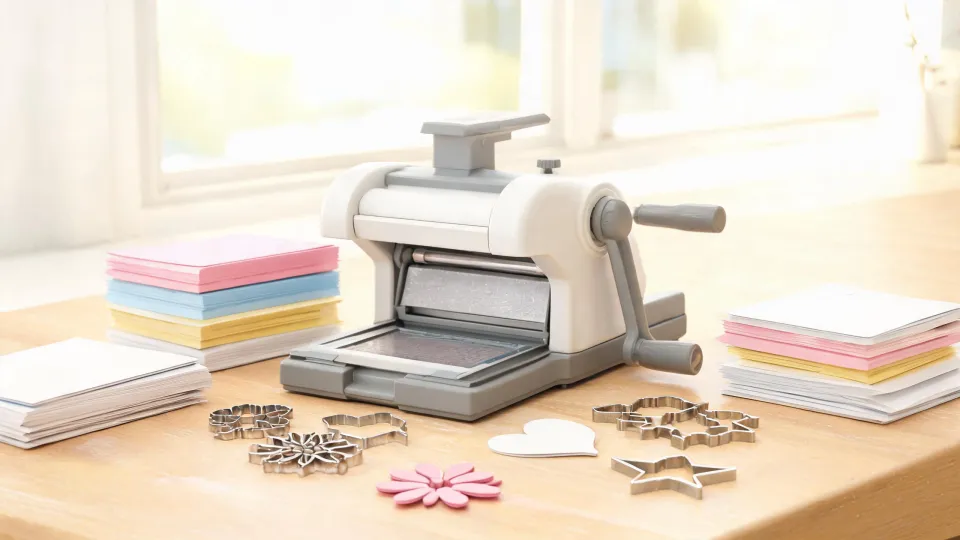
That said, for B2B orders that require custom sizzix die cutting machines and custom Sizzix dies for your packaging (e.g., unique box shapes, custom inserts, or decorative elements), you'll want a vendor experienced in craft manufacturing and die-cut packaging. The Sizzix platform offers both manual and electric die cutting machines—from the compact Sizzix Sidekick for smaller runs to the Sizzix Big Shot Pro for high-volume custom shapes. If your corporate gift box includes a customized die-cut window or a branded tag, ask your packaging vendor if they work with Sizzix dies or are open to custom die design and production.
Common Mistakes to Avoid
- Focusing only on the chocolate and forgetting the packaging structure. The box is what sits on the recipient's desk. Make it memorable.
- Assuming 'premium' means 'over-engineered.' A clean, well-fitted box with great print quality beats a complicated box with sloppy execution every time.
- Skipping the production pilot sample to save two weeks. The time you save upfront can turn into a month of rework if the production run has issues.
- Treating the vendor relationship as a transaction. The vendors who gave us the best results were the ones we briefed thoroughly, paid fairly, and treated as partners. They flagged issues before they became problems.
The final word: A corporate chocolate gift box is a miniature brand experience. Treat the procurement process with the same rigor you'd apply to any other branded asset. Use this checklist, ask the hard questions, and you'll get a result you're proud to hand to your client.

Elise Laurent is a crystal and decorative glass quality analyst covering crystal figurines, vases, ornaments, suncatchers, and gift glassware. She examines ISO 6486-1 where food-contact glass dinnerware applies, then uses polarized strain inspection, dimensional checks, surface-defect grading, and refractive clarity to compare decorative pieces outside that scope. Her work helps sourcing teams choose materials, finishing routes, and protective packaging without confusing visual brilliance with verified durability.