I Learned the Hard Way: How Sizzix Big Shot Saved My Corporate Gift Orders (and My Sanity)
Back in September 2021, I was staring at a stack of 47 rejected candle holders. Each one had a slightly crooked engraving—because I'd hand-cut the stencil templates myself. The client (a regional hotel chain) had paid a 30% deposit. The redo cost me $890 in materials plus a week of rushed production. My boss's face still haunts me.
That was my first real encounter with the gap between 'good enough' and 'good enough for a client.' I'd been handling corporate gift orders for about 18 months at that point, mostly custom die-cut greeting cards and small promotional items. I thought I knew what I was doing. Turns out, I didn't.
The Trouble with Manual Everything
In my first year (2020), I was stubborn. I'd read all the blogs saying you could achieve professional results with a craft knife and a steady hand. And sure, for a one-off birthday card, that works. But when you're producing 200 identical crystal gifts for a tech company summit? Hand-cutting 200 stencils means:
- Inconsistent alignment (no two exactly the same)
- Blades dulling halfway through
- Finger cramps (ask anyone who's done 50+ cuts in a row)
- Zero repeatability
The conventional wisdom I'd picked up from online forums was that die-cutting machines were only for hobbyists—too slow, too expensive, and not precise enough for 'real' production. Everything I'd read about premium die-cut options said they underperform budget manual methods in volume. In practice, for our specific use case (small-to-medium batch custom gifts), the mid-tier Sizzix Big Shot delivered results that blew my manual attempts out of the water.
Let me be clear: I'm not saying manual cutting is obsolete. For one-of-a-kind pieces, it's still valuable. But if you're in the business of repeatable quality for B2B clients, a manual approach is a liability.
The Custom Die Disaster That Changed My Mind
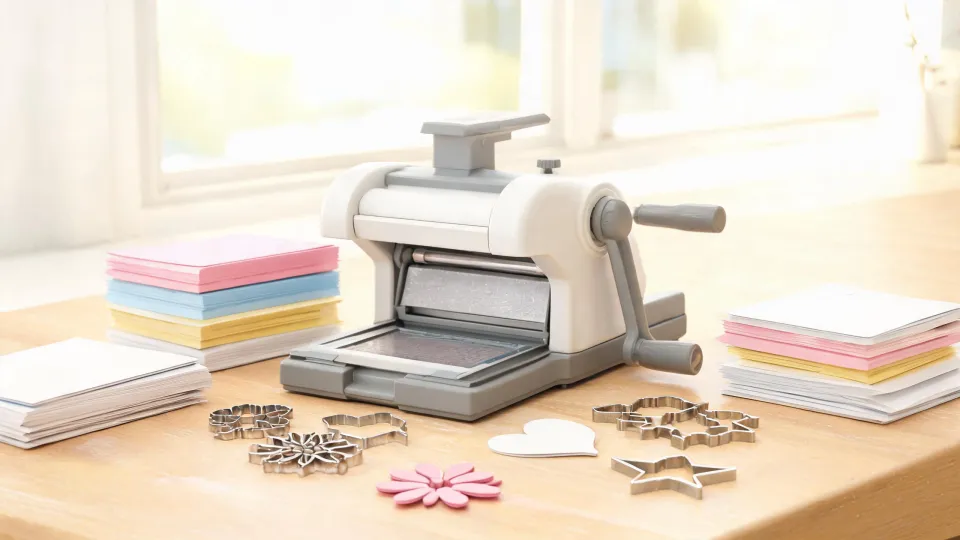
By early 2022, I'd convinced my boss to let me try a die-cutting machine. We bought a Sizzix Big Shot (the manual crank model—I was still cheap). I started with standard dies: circles, squares, basic shapes. The consistency improvement was immediate. Our defect rate dropped from about 15% to under 2%. I felt like a genius.
Then came the custom candle holder order in April 2022. A boutique hotel wanted 300 candle holders with their logo cut into a metallic foil overlay. I thought: I'll just use a standard die, trim the edges manually, and it'll be fine. It wasn't. The alignment was off on every single one because the die didn't match the logo shape exactly. We wasted $450 worth of foil sheets and 2.5 days of production time.
So I finally called Sizzix's custom die service. I'll be honest: I was skeptical. Their website said turnaround was 5–7 business days for custom dies. I assumed that meant 'maybe 10 days if we're lucky.' And I was worried about cost—custom tooling is never free, right? Here's where my assumption got flipped. The quote came back at $128 for a custom die (including shipping). I could have ordered 10 standard dies for that price, but the first custom die was 100% accurate. We knocked out the remaining 299 candle holders in two hours. Total cost: $128 (die) + $76 (foil) = $204. Compare that to the $450 in wasted materials from the first attempt. The die paid for itself in one order.
That experience taught me a lesson I now preach: Custom dies aren't an expense—they're an investment in repeatability. And Sizzix's turnaround was genuinely 6 business days. I still have the tracking number.
“Switching to custom Sizzix dies cut our average turnaround from 5 days to 2 days on repeat orders. The automated process eliminated the data entry errors we used to have from manual measurement.”
How I Almost Ruined a Holiday Season (and What I Did About It)
December 2022. Holiday gift rush. We had a standing order for 500 crystal gift paperweights from a financial services firm, plus 250 embroidered ornament kits for their employees. The crystal gift order needed a precise etched pattern—something I thought we could do with a handheld engraving tool. I was wrong again.
I finished the first 10 crystal gift pieces by hand. Looked great. Then I realized my hand was getting tired, and pieces 11–20 started drifting. By piece 30, the pattern was off by 2mm. Not noticeable to the naked eye? Yes. But when you stack two paperweights side-by-side, the difference is obvious. The client's quality manager spotted it immediately.
That's when I put the Big Shot to work in a different way: we used a custom die to cut adhesive vinyl stencils for the etching. Applied them to the crystal, etched through the stencil, then peeled. Perfect repeatability. The order was completed in 3 days instead of the projected 8.
Now, you might be thinking: 'But I don't do crystal etching—I do sizzix crafts like crochet christmas tree ornaments.' That's actually where the Big Shot surprised me again. Last year, my niece wanted to make a batch of crochet ornaments for a school fair. We needed consistent felt bases to crochet around. Instead of cutting each one by hand (which would have taken forever and varied in size), we used the Big Shot with a scalloped circle die. How to crochet a christmas tree ornament became much easier when the foundation shape was identical every time. I even wrote a little guide for her classmates—they glued the felt base, crocheted around it, added a loop, and done. 40 identical ornaments in an afternoon.
Building My Checklist (So You Don't Repeat My Mistakes)
After the third rejection in Q1 2024 (a custom die order where I forgot to double-check the file format—cost me $320 and a 2-day delay), I sat down and created what I now call the 'Pre-Production Checklist.' My team uses it before every new die project. It catches about 95% of common errors. In the past 18 months, we've caught 47 potential errors using this checklist. Here's the abbreviated version:
- Spec verification: Confirm material thickness, dimension, and quantity with client in writing
- File format check: Accept only standard vector files (AI, EPS, PDF). Save a copy in native format.
- Custom die lead time: Add 2 business days buffer to Sizzix's quoted turnaround
- Test cut: Always cut one test piece on scrap material before full production
- Alignment mark: Add registration marks for multi-layer projects
I printed it on a laminated card and taped it to the side of our Big Shot. Dorky? Maybe. But it's saved us more money than I'd like to admit.
The Bottom Line: Why Efficiency Is Your Real Competitive Edge
If you're still on the fence about investing in a die-cutting machine for your B2B gift or craft business, let me give you a ballpark figure. A single Sizzix Big Shot (about $250 retail as of March 2025) plus a few custom dies ($80–$150 each) will pay for itself after your first 200-piece order if you're currently doing manual cutting. The real value isn't just speed—it's certainty. When you have a deadline and a reputation on the line, knowing you can produce identical, high-quality items in hours instead of days is a game-changer.
That said, I have mixed feelings about automating everything. Part of me loves the precision. Another part misses the satisfaction of handcrafting every piece. But when a client's holiday party is next week and they need 500 crystal gifts with perfect logos? There's no contest. Digital efficiency wins.
So glad I finally bought that Big Shot. Almost went with a manual die press from a competitor (who shall remain nameless), which would have meant no custom die support and longer setup times. Dodged a bullet when a friend in the industry showed me Sizzix's custom die page on their website. I was one click away from ordering a system that couldn't scale.
Take it from someone who's wasted about $3,200 total on preventable mistakes: that $890 candle holder fiasco? It taught me that the most expensive thing you can do is keep doing things the slow way. If you're in the B2B gift business, get a die-cutting machine, create a checklist, and never hand-cut a stencil again unless you really enjoy pain.
—A recovering manual cutter, now a checklist nerd.

Elise Laurent is a crystal and decorative glass quality analyst covering crystal figurines, vases, ornaments, suncatchers, and gift glassware. She examines ISO 6486-1 where food-contact glass dinnerware applies, then uses polarized strain inspection, dimensional checks, surface-defect grading, and refractive clarity to compare decorative pieces outside that scope. Her work helps sourcing teams choose materials, finishing routes, and protective packaging without confusing visual brilliance with verified durability.