Why Our Corporate Gifts Kept Disappointing (Until I Started Cutting Them Ourselves)
When I took over purchasing in 2020, I thought I had it figured out. Find a vendor, send them our logo, order 200 custom candle holders, done. The first batch arrived on time, looked okay, and my VP seemed pleased. But by the second order, things started slipping. By the third, I was apologizing to department heads for gifts that didn't look 'quite right.' It took me two more years to understand what was really going wrong.
Surface Problem: The Gifts Never Matched the Samples
I'd approve a sample—say, a candle holder with a laser-etched floral pattern—and the production run would come back with a slightly different shade or a misaligned design. At first I blamed the vendor. 'They must have switched materials,' I thought. But after the third incident, I started wondering if the problem was on my end.
Let me back up. In 2022, we decided to give each of our 400 employees a holiday gift: a handcrafted embroidery kit in a custom box with our company logo. I found a supplier who could source the kits and stamp the boxes. The sample looked great. But when 400 boxes arrived, the stamping was faint on half of them, and the embroidery thread colors didn't match the logo we'd provided. The vendor said we'd approved the artwork. We had—but the artwork was low-resolution, and no one caught it because we were rushing.
Deeper Problem: We Didn't Understand What We Were Really Asking For
Here's what I didn't realize at first. Ordering custom gifts isn't just about picking a product and a design. It's about understanding the manufacturing process. Laser etching, die cutting, screen printing—each method has tolerances, limitations, and cost drivers. When you don't know those, you can't write a good spec. And when you can't write a good spec, the vendor fills in the gaps however they want.
Take our candle holder project. I wanted a die-cut shape of a daffodil to be attached to the front. I told the vendor 'cut a daffodil shape.' They sent back a design that looked nothing like the reference image I'd attached—because my reference was a photograph, not a vector file. They'd traced it loosely. By the time I realized, the die had already been made. We ate $600 in rework costs.
The deeper issue wasn't the vendor's fault. It was that I had no way to verify the design before committing to tooling. In a custom die-cut project, the die itself is a fixed cost that runs $80–$300. Once it's made, changes are expensive or impossible. I needed a way to test the design physically, with my own hands, before ordering production.
The Cost of Not Knowing: Time, Money, and Credibility
Let me put some numbers on this. In 2023 alone, I processed seven custom gift orders using external vendors. Two had issues that required re-runs. One had such a mismatch in color that we had to throw away 60 units. Total rework cost: roughly $1,400. Plus my time—probably 15 hours of back-and-forth emails, phone calls, and rescheduling. And then there's the soft cost: when gifts arrive late or looking cheap, it reflects on me.
I remember one particular disaster. We needed 250 embroidered kits for a sales conference. The supplier promised four-week turnaround. At week three, they sent photos showing the thread colors were wrong—they'd used 'navy' instead of 'dark blue.' We'd approved a PMS color code, but their thread supplier only had a 'navy' option. They assumed we'd be fine with it. We weren't. The entire order had to be re-stitched. By the time it arrived, the conference was over. My boss had to give out apology cards instead of gifts. (ugh).
That was the moment I started rethinking our entire approach. I'd been treating custom gifts as a transaction. But they're a process—one that requires prototyping, testing, and verification at multiple stages. The external vendors I was using offered samples, sure, but by the time I saw a physical sample, I'd already paid for tooling or setup. The sample was just a preview of the final product—and if it was wrong, I'd already committed.
What Changed: Bringing Control In-House
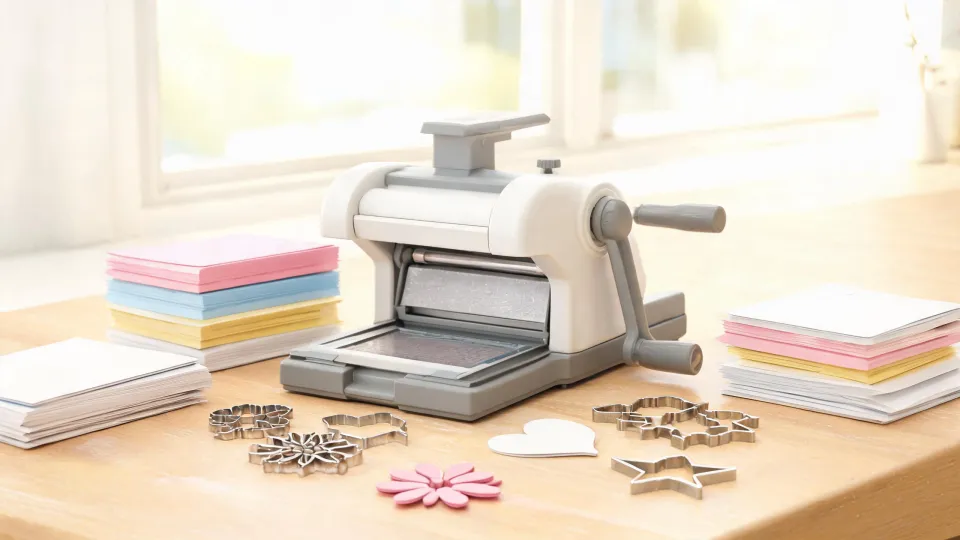
At the start of 2024, I bought a Sizzix die cutting machine for our office. Not the big industrial one—just the Sizzix Sidekick, a manual mini die cutter. It cost under $100. The idea wasn't to replace our vendors entirely; it was to give us a way to prototype our own designs before sending them out for production.
The change was immediate. Now, when we want a custom shape—a daffodil for a vase decoration, a company logo as a cutout on a card, a specific ornament silhouette—I can cut it myself in paper, cardstock, or thin plastic. I bring the physical piece to the vendor and say, 'This is exactly what we want. Match the outline.' No more ambiguous vector files or misunderstood references.
And for small-batch gifts—like 50 embroidered kits for a department event—we now make them in-house. Sizzix dies can cut fabric layers for the embroidery kits, and matching cardstock inserts for the boxes. The quality is consistent because we control every step. (note to self: we need to standardize the process documentation next month.)
It's not just prototyping. Once we have a die that works, we can use it for multiple runs. We created a custom daffodil die for our spring corporate gifts; that same die now gets used for employee recognition cards throughout the year. The upfront cost of the die (about $50 for a standard steel-rule die via Sizzix custom service) paid for itself after the second use.
I'm not saying every company needs a die cutting machine. But if you're ordering custom-shaped gifts more than twice a year, the math shifts. Here's my rule of thumb: If your total annual rework cost exceeds the price of a Sizzix machine plus one custom die (around $200–$300), it's worth considering. After rework and the 15 hours I wasted, I'd already spent three times that in 2023 alone.
A Quick Checklist I Now Use Before Any Custom Order
- Cut a physical prototype with our Sizzix machine (or if the shape is too complex, have the vendor send a paper proof that I can verify against our die-cut version).
- Confirm color codes with the vendor's actual materials—ask for a physical swatch, not an email photo.
- Get written confirmation on the lead time, including buffer for potential revisions.
- Include a clause in the PO that tooling is contingent on final prototype approval.
This checklist sounds obvious now, but I'd skipped it multiple times—and each time, it was the step that caused the problem. (I really should have written this down earlier.)
Prevention > Cure: The Real Lesson
Five minutes of verification beats five days of correction. I learned that the hard way. The Sizzix machine didn't just save us money—it changed how I think about procurement. Instead of reacting to problems after they've already happened, I now build validation into the process from the start. That's the real value: not the machine itself, but the mindset shift it enabled.
If you're an admin buyer who's been burned by custom gift orders before, I'd recommend trying this approach. Get a small manual die cutter—Sizzix has several models—and see if it helps you catch issues early. Even if you never use it for production, just having the ability to mock up designs will save you headaches. Trust me.

Elise Laurent is a crystal and decorative glass quality analyst covering crystal figurines, vases, ornaments, suncatchers, and gift glassware. She examines ISO 6486-1 where food-contact glass dinnerware applies, then uses polarized strain inspection, dimensional checks, surface-defect grading, and refractive clarity to compare decorative pieces outside that scope. Her work helps sourcing teams choose materials, finishing routes, and protective packaging without confusing visual brilliance with verified durability.