How Sizzix Christmas Dies Saved Our Corporate Gift Program (and What They Taught Me About Hidden Costs)
Last September, I sat at my desk with a spreadsheet open to a tab labeled "Holiday Gifts 2024." There were 40 client gifts, 120 employee gifts, and 35 remote contractors who needed something that wouldn't arrive too late. I hated every row.
I'm the office administrator for a 140-person branding agency. I manage all the promotional and corporate gift ordering—roughly $40,000 a year spread across eight vendors. I report to both operations and finance, so every line item needs a reason. When I took over purchasing in 2020, the gift budget was the easiest to cut. By 2024, I'd learned the hard way that a bad gift program makes people think you don't care.
In past years, we did the safe thing: branded notebooks, a nice card, maybe a small candle. It worked, but it felt generic. And generic corporate gifts annoy people. So when a friend told me about the Sizzix Foldaway die cutting machine, I almost shrugged it off. Another machine, another craft project, another thing to store. The downside felt familiar.
But then she showed me a Christmas ornament she'd made with Sizzix Christmas dies. It wasn't perfect. The ribbon was crooked. But it looked like a human being had made it. That was the difference.
The numbers said outsourcing was cheaper. My gut said an in-house die cutter would change how our gifts felt. My gut won, sort of.
Actually, the first question wasn't whether to buy the machine. It was whether to use a custom die. And that's where the real story starts.
How the Sizzix Foldaway Die Cutting Machine Got Into Our Office
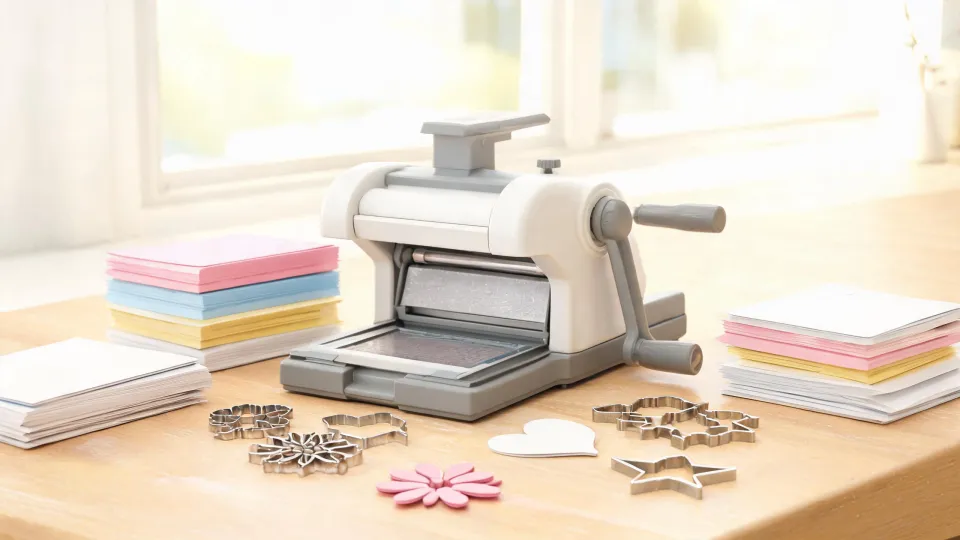
I'll be honest: I didn't buy the machine for the Foldaway feature. I bought it because it folds flat. Our supply closet is basically a phone booth, and most die cutting machines are not exactly compact. The Sizzix Foldaway die cutting machine solved that. When not in use, it stored in a drawer. The manual operation was also a plus—no cords, no drivers, no waiting for software updates.
We tested it on sample Christmas cards first. I ordered a few sets of Sizzix Christmas dies, including one from the Tim Holtz collection. The quality was good, and the learning curve was shorter than expected. Our operations assistant picked it up in about twenty minutes. The hardest part was weeding out the little pieces of paper.
The machine handled cardstock and thin felt without a problem. It won't cut metal or thick acrylic, so don't try that. I mention it because I'm guessing someone will ask. It was great for our purpose, but it's not a magic cutter.
The bigger test came when a client asked for 150 custom ornaments with their logo. My first instinct was to order a custom die. Sizzix does custom dies, and that's one of the reasons I had looked at them. But the timeline was tight, so I went to a local trade shop instead. That's where I learned about hidden costs.
The Custom Die Quote That Almost Fooled Me
The trade shop quoted me $95 for a custom die. Great. I almost said yes on the spot.
Then I asked: "What else is involved?"
Turns out, they charge a setup fee, a shipping/handling fee, and a "design adjustment" fee because the client's logo wasn't in a vector format. Total: $260. The quote I'd been excited about was less than half the real number.
Honestly, I'm not sure why they don't put that number on the first page. My best guess is they want the easy yes before the sticker shock.
I don't want to pick on that shop. Custom die setup in commercial printing often runs $50–200 depending on complexity, based on published rate structures I checked in early 2025. The issue wasn't the fees. The issue was that they didn't show the total until I asked.
I've learned to ask "what's NOT included" before "what's the price." The vendor who lists all fees upfront—even if the total looks higher—usually costs less in the end.
The same thing didn't happen with the Sizzix Christmas dies. The price on the label was the price. No setup. No hidden design fee. The only thing I had to watch was compatibility.
At that point, I had to make a call. The upside was a personalized gift that might actually stand out. The risk was that we'd sink two weeks into a machine and still miss the mailing deadline. I kept asking myself: is saving a few hundred dollars worth looking useless to my VP if this flops?
I said yes. Not because I was confident, but because the alternative—another year of branded notebooks—felt worse.
A $24 Mistake That Made the Point
The warnings about die compatibility were in the product description. I skipped them. I ordered a die that was too large for the Sizzix Foldaway platform. It wouldn't cut through the cardstock properly.
That $24 mistake was probably worth it. I only believe in checking specifications after ignoring them and paying the price.
This is the part of the story where I should say everything went smoothly. It didn't. We had a small crisis when the die cut shapes started sticking to the stack. A few ornaments got crushed in the box. I had to reprint labels. Nothing fatal, but it wasn't as clean as the Pinterest version.
But the team figured it out. We learned to use a thin foam pad under certain dies, and we were careful not to overfill the platform. The Sizzix Foldaway is a manual machine, so after a long afternoon of cutting, my wrist was sore. If we were doing thousands of pieces, I'd want an electric model. For three hundred cards and ornaments, manual was fine.
What the Embroidery Kit Taught Me About Personalization
At the same time, I was looking for a gift that the employees would actually keep. I found a small embroidery kit with a simple holiday design. The kit itself was nice, but on its own it felt a little empty, like a gift bag with no message.
We added a Sizzix die-cut card with the person's name on it. That changed everything. A personalized gift doesn't have to be expensive. It has to prove that someone noticed the person.
Once we figured that out, we turned the ornament idea into a mini production line. We cut stars, snowflakes, and a batch of small gift tags for clients. By the end of December, we'd made maybe 350 pieces. Maybe 320, I'm mixing it up with the 2023 number. Either way, enough to make the supply closet look like a paper explosion.
How to Send a Digital Greeting Card?
A colleague from HR asked me, "How to send a digital greeting card?" She had a list of 35 remote contractors who would never receive physical gifts in time. We couldn't mail them all ornaments.
My answer was simple: email is fine, but the generic template is not. We took a photo of one of the die-cut cards, added a short line to each email, and sent it as a PDF. Some people got a GIF version. It wasn't fancy. But the personal line was the part that made it feel like a real greeting card.
The real answer to "how to send a digital greeting card?" is: keep it short, personalize it, and don't bury the message under a heavy attachment.
Did It Save Money?
Here's the honest math. The custom-printed cards we used in previous years cost around $2.20 each. Our die-cut materials were maybe $1.10 per card. We made about 300 cards in-house. That's a material savings of maybe $330. The machine itself cost more than that. Add two afternoons of labor, and the spreadsheet said break-even or worse.
But the spreadsheet didn't capture the reaction. One client sent a photo of the ornament on their tree. Another told our account manager it was "the first nice thing a vendor sent all year." That's not nothing.
It was around $2,400 in total out-of-pocket—maybe $2,700, I'd have to check the final P&L. If I'm being honest, I'm not sure the Sizzix program paid for itself in cash. But it paid in client retention and in the way our own employees talked about the company during the holidays.
What I'd Do Differently Next Time
The big lesson wasn't about die cutting. It was about pricing. Every vendor should show the total cost before you commit. If they don't, ask for the list of possible extras first. Use that question as a filter. The vendor who gets annoyed by that question is probably hiding something.
Now, we have a Sizzix Foldaway die cutting machine in a drawer, and it'll probably come out again for spring gift tags. I'm not sure custom dies will be in our future. My best guess is we'll use standard dies more and reserve custom work for the orders where a logo genuinely matters.
If you're thinking about a similar setup, check the die sizes before you buy. Learn from my $24 mistake. And remember that the hidden cost of any new tool is usually the labor and the patience required to use it.
Also, invest in transparent vendors. The fastest quote isn't worth the surprise invoice. That's one lesson I'll keep.

Elise Laurent is a crystal and decorative glass quality analyst covering crystal figurines, vases, ornaments, suncatchers, and gift glassware. She examines ISO 6486-1 where food-contact glass dinnerware applies, then uses polarized strain inspection, dimensional checks, surface-defect grading, and refractive clarity to compare decorative pieces outside that scope. Her work helps sourcing teams choose materials, finishing routes, and protective packaging without confusing visual brilliance with verified durability.