Sizzix for B2B Craft Production: A Procurement Manager's Cost Breakdown
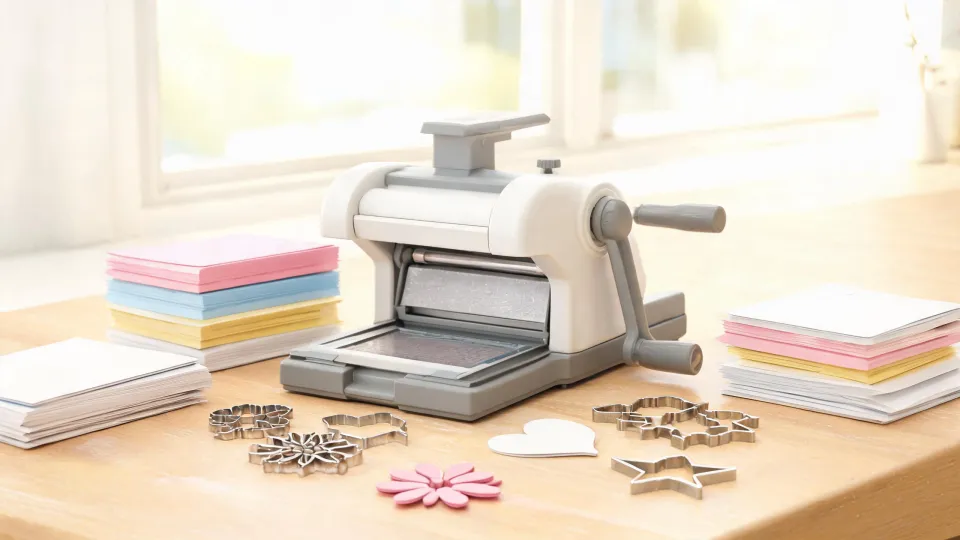
If you're buying Sizzix for B2B craft or gift production, the short answer is: budget for the die system, not just the machine. In our 2024 fiscal year, dies were 62 percent of our total Sizzix spend. That isn't a mistake. It's the part that makes the machine scalable.
I'm a procurement manager at a 42-person corporate gift and craft manufacturer. I've managed our craft production budget for six years—currently around $160,000 annually—and negotiated with more than a dozen die and machine vendors. When I audited our 2023 spending, custom dies accounted for 58 percent of our Sizzix-related costs. In 2024, that number moved to 62 percent. If you're planning a Sizzix purchase for a business, plan for that. At least, that's been my experience with volume runs.
What was best practice in 2020 may not apply in 2025. The fundamentals haven't changed—repeatable dies are still the core—but the execution has transformed. You can now get a machine that handles paper, fabric, and thin materials in one platform, and that changes the cost equation for a small shop.
Why I trust this math
When I first started in procurement, I assumed the machine was the big-ticket item. That was wrong. Our first year, the machine made up 19 percent of the Sizzix category; dies made up 58 percent. The machine is a fixed cost. The die is the repeatable tool that turns raw material into a sellable product. Once I understood that, I stopped treating custom die quotes as an afterthought.
People often think custom dies are expensive because the cutting machine is complex. Actually, the relationship runs the other way: a $250 machine with a $45 die can produce thousands of identical ornaments, while a $2,000 machine without the right die doesn't produce anything. The die is the product; the machine is just the press.
Here's the math I run for every new product: (machine cost + die cost + material + labor) divided by volume. For 2,000 greeting cards, a $45 die adds 2.3 cents per card. That's the number I care about.
How I break down the Sizzix budget
If you're planning a Sizzix build-out, here's how I categorize the spend. Don't take these as quotes—take this with a grain of salt, because prices shift—but they give you a framework.
- Machines: The Big Shot Express and Sidekick cover most standard work; the Big Shot Pro handles wider dies. In our 2024 orders, we paid roughly $260 for a Big Shot Express and $400 for a Big Shot Pro.
- Standard dies: Most Sizzix dies, including the Tim Holtz Christmas line, run between $15 and $50 wholesale. These are repeatable tools, not consumables.
- Custom dies: For corporate logos or custom shapes, we've paid $150 to $500 per die depending on size and detail. Design time runs 3 to 6 weeks; don't plan on same-day delivery.
- Consumables and platforms: Cutting pads, embossing folders, adhesive sheets, and replacement platforms. These are the line items people forget.
What's the total cost picture? For a product like a Christmas ornament, our first-run cost per unit is usually in the $0.65 to $1.20 range before packaging. That includes machine amortization, die amortization, cardstock, and labor. At 5,000 units, the die cost almost disappears.
Why Sizzix Tim Holtz Christmas dies work for corporate holiday orders
The Sizzix Tim Holtz Christmas dies line is one of the easiest ways to justify the machine cost. The designs have retail recognition, which matters when you're selling to a corporate client who wants to give a gift that feels like a product, not a craft project.
We use these dies for two product families: Christmas ornaments and candle holders. For a 3D ornament, we cut two cardstock shapes and glue them back-to-back with a ribbon loop. For a candle holder, we cut a cardstock or vellum sleeve that wraps a pillar candle. The die cost is $30 to $45; on a run of 2,000 candle holders, the die cost is about two cents a piece. That's the kind of math I can defend to a CFO.
One caveat: don't assume every Tim Holtz die works with every machine. The larger Christmas dies need a Big Shot or Big Shot Pro platform; the Sidekick is fine for small shapes but not for a 12-inch garland. Check the die's maximum width before you promise a client a certain product.
Sizzix fabric cutting machine: what it can and can't do
The Sizzix fabric cutting machine question comes up a lot in my industry. The machine that handles fabric isn't a completely different product line; it's the same Big Shot platform with fabric-specific dies and cutting pads. We cut felt, bonded cotton, and some thin interfacing. I'm not a textile engineer, so I can't speak to every weave. What I can tell you from a cost perspective: for 1,000 felt embroidery kit pieces, the die cost amortizes to pennies, and the consistency is better than hand-cutting.
One thing I learned the hard way: don't use a paper die on fabric and expect clean edges. Our first felt run produced ragged corners because I tried to save money on a separate die. The second run, with a fabric-rated die, was clean. The cost difference was maybe $15. The redo cost more than that.
How big is 8x8 photo book? Sizing and shipping math
Clients ask us, how big is 8x8 photo book? It's 8 inches square, or about 20.3 centimeters. That makes it larger than a standard greeting card but too short to qualify as a USPS large envelope. For image specs, use the standard print resolution of 300 DPI. Max print size equals pixel dimensions divided by DPI. A full-page 8x8 image needs 2,400 by 2,400 pixels. If a client sends a 1,200 by 1,200 photo and asks for full-bleed, it will print at about 4 inches—not 8.
Shipping is where the size math matters for B2B pricing. According to USPS Business Mail 101, a large envelope needs a minimum length of 11.5 inches. An 8x8 book doesn't meet that, so it mails as a package instead of a flat. First-Class package rates at usps.com vary by weight and zone, but they start higher than letter or flat pricing. I always check the size and weight before quoting a client.
Where my advice breaks down
This worked for us, but our situation is a mid-size B2B manufacturer with predictable order patterns. If you're a one-person shop doing short-run custom work, the calculus changes. A die-cutting machine can be worth it, but only when the dies are amortized across volume. For one-off prototypes, manual tools are still faster. If you ask me, that's not a bad thing.
I also can only speak to domestic operations. If you're shipping internationally, customs, insurance, and carrier rates are a different spreadsheet. And if you're considering third-party dies, check compatibility first. We had a die that didn't cut deep enough—no, actually, the die fit, but my platform stack was wrong. That's on me for not checking specs.
One last thing. I should add that the custom die process is not a commodity. We compare quotes from at least two die makers before any custom order, and we've been burned by 'free setup' offers that had hidden costs. But with Sizzix's own line and the Tim Holtz collection, the cost is usually predictable.

Elise Laurent is a crystal and decorative glass quality analyst covering crystal figurines, vases, ornaments, suncatchers, and gift glassware. She examines ISO 6486-1 where food-contact glass dinnerware applies, then uses polarized strain inspection, dimensional checks, surface-defect grading, and refractive clarity to compare decorative pieces outside that scope. Her work helps sourcing teams choose materials, finishing routes, and protective packaging without confusing visual brilliance with verified durability.