What’s the Best Corporate Gift Company? A Quality Inspector’s Honest Take
It started with a 50,000-unit candle holder sleeve order. A tech client wanted a holiday gift set: a textured cardstock sleeve around a candle holder, a die-cut logo window, and a gift card tucked into a matching holder. The prototype looked great. The sample got approved. Then the bulk shipment arrived and our quality team flagged nearly every carton.
That morning, someone asked me what's the best corporate gift company. I didn't have a good answer, because the company we were counting on had just failed us in a pretty expensive way.
The vendor said “within industry standard”
I'm the quality and brand compliance manager at a promotional products company. I review every deliverable before it reaches customers—roughly 200 unique items a year, from corporate gifts to embroidery kits to crystal and candle holder product lines. In 2024, I rejected about 12% of first-round deliveries. Most were die-cut edge issues, off-brand color, or packaging that didn't survive transit.
This candle holder order was my biggest rejection of the year. The logo cut on the sleeve was off-center by a few millimeters. The edges were rough enough to catch on a thumb. And the gift card insert collapsed when someone actually tried to slide the card in. We had specified the exact tolerance, but the vendor said it was “within industry standard.” I told them to redo it. They did, at their cost, but the replacement batch took another three weeks. That quality issue cost us a $22,000 redo and delayed the client's launch.
In retrospect, the real problem wasn't just the vendor. It was us. We hadn't verified the production run before they shipped. We approved a sample, but we didn't have a clear verification protocol for the actual bulk product. When I implemented our verification protocol in 2022, we caught issues early. Here, I got sloppy, and it hurt.
Why we started using Sizzix die cutting machines
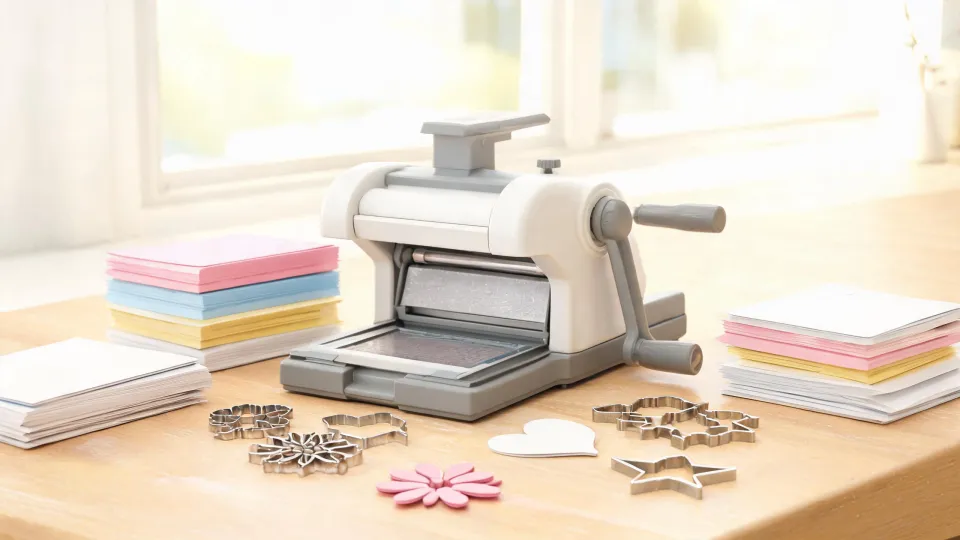
After that failure, we decided to bring our prototypes and short production runs in-house. We needed repeatable die cutting, not hand-trimmed one-offs. Honestly, I thought Sizzix was a scrapbooking brand at first. I didn't realize how seriously their bigger machines are used in small-batch making and product development.
Turns out, Sizzix has a range of die cutting machines, from manual models to electric options. According to Sizzix (sizzix.com), their machines can cut, score, and emboss a range of materials. For our cardstock, thin plastics, and leatherette candle holder sleeves, that was exactly what we needed.
We also ordered a custom Sizzix gift card holder die. The original spec was a simple folded card with a slot, but the vendor's standard die didn't match our layout. When we designed our own custom Sizzix die, the card holder became one consistent piece. It cut, scored, and creased in a single pass. No more collapsed inserts.
Here's something vendors won't tell you: “custom” in this industry often means “from our existing die library.” True custom tooling is different. It takes longer and costs more upfront, but it gives you control over the exact shape, sharpness, and repeatability. That control matters when you're making promotional products at any serious volume.
The turning point was repeatability
The first in-house run we did with Sizzix die cutting machines was a candle holder sleeve with a custom logo cutout. The first cut looked good. The fiftieth cut looked the same. The two-hundredth cut also matched. I want to say our rejection rate on that run was around 2%, but don't quote me on that exact number—it was low enough that I stopped thinking about it as a risk.
What I do remember is our Q1 2024 quality audit. By that point, we had a documented process for every new corporate gift concept: design the die, run a sample, measure it against the spec, then do a first-article inspection before full production. According to ISO 9001:2015 (iso.org), organizations are supposed to verify that purchased product meets specified requirements. That sounds like paperwork, but it's literally what we failed to do on the candle holder order.
It's tempting to think all die cutting machines are the same. They're not. Manual cutting methods still have a place—for one-off samples, a craft knife is fine. But for a 50,000-unit corporate gift run, hand-cutting isn't repeatable. The fundamentals haven't changed, but the execution has. What was best practice in 2020 doesn't hold up in 2025.
So what's the best corporate gift company?
I get asked this more than you'd think. My honest answer is: it's not the company with the biggest catalog or the fastest quote. It's the company that can prove they control the production process.
Ask a potential corporate gift partner about their tooling. Ask who owns the dies for custom shapes. Ask if they do first-article inspection before full production. Ask what happens when the logo cut is half a millimeter off—do they ship it anyway? The ones who hesitate are telling you something.
My experience is based on about 200 mid-range corporate gift orders. If you're working with luxury executive gifts or ultra-budget trade show swag, your experience might differ. But I'd still look for the same thing: verification, not promises.
Honestly, I'm not sure why samples and bulk production diverge so often. My best guess is that suppliers put their best people on samples, then shift to a faster production line. That's why we now keep a physical approved sample and a written standard in the same folder. If the die-cut edge is rough on the bulk run, it doesn't matter how good the rendering looked on a screen.
What's the best corporate gift company? The one that can show you the die, the tolerance, and the inspection record. For us, that meant building the capability in-house with custom Sizzix dies and the right die cutting machines. It wasn't just a purchase—it was a process change. That's what saved the next order.

Elise Laurent is a crystal and decorative glass quality analyst covering crystal figurines, vases, ornaments, suncatchers, and gift glassware. She examines ISO 6486-1 where food-contact glass dinnerware applies, then uses polarized strain inspection, dimensional checks, surface-defect grading, and refractive clarity to compare decorative pieces outside that scope. Her work helps sourcing teams choose materials, finishing routes, and protective packaging without confusing visual brilliance with verified durability.