I Spent 6 Years Buying Corporate Gifts. The 'Cheap' Ones Cost the Most.
I've bought roughly 1,847 corporate gifts over the last six years. I know the number because I track every order in our procurement system—vendor, unit price, shipping, and follow-up response. And I've arrived at a conclusion that might surprise you:
The most expensive corporate gifts are the generic ones.
Not the ones with the highest price tag. The ones that get opened, set aside, and forgotten. A $14 crystal gift with zero brand recall isn't a bargain. It's a tax on your marketing budget. I paid that tax for years. I'm writing this so you don't have to.
It took me six years and about 200 gift decisions to understand the difference between "affordable per unit" and "actually worth buying." This is the story of how those two things diverged—and what the numbers look like when you get them right.
The Year the Spreadsheet Called Me Out
In 2023, we spent $18,400 on corporate gifts. Crystal gifts. Branded pens. Premium gift baskets. When I audited the program—tracking client responses, follow-up conversations, and whether anyone could recall the gift three months later—the numbers were sobering.
Only 12% of recipients could name what they received. Only 4% remembered the brand without prompting. One client asked us to stop sending "the usual" because their office was overflowing with indistinguishable branded items.
I don't have hard data on industry-wide gift retention. But based on our own client calls, my sense is that most corporate gifts are forgotten within two weeks. And "forgotten" is a financial outcome, not just a sentimental one.
Why does that matter? Because we optimized for unit price. Every gift looked efficient on the invoice and "throwaway" in reality. The gap between those two is the true cost of a gift program.
The Q2 2024 Experiment
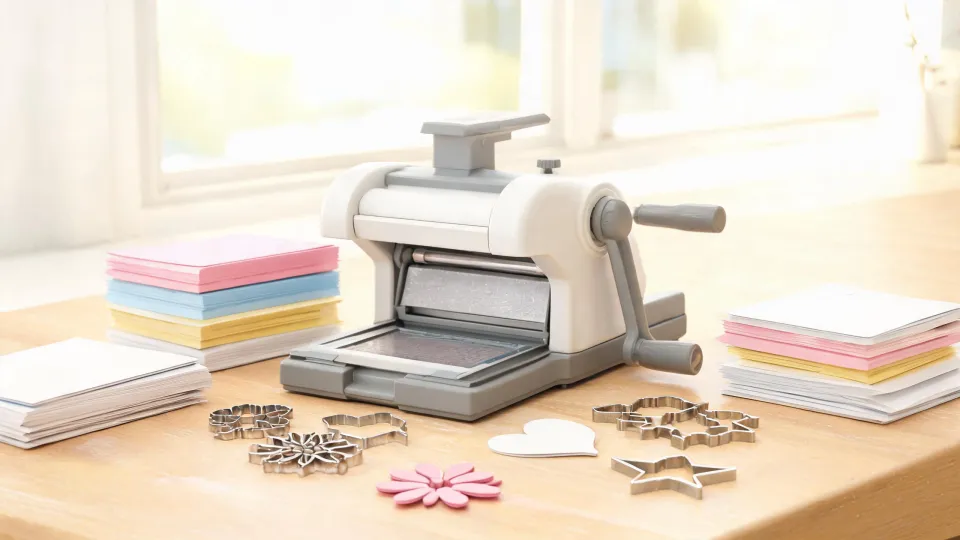
In Q2 2024, we tried something different. Instead of ordering from a corporate gift catalog, we bought a Sizzix Big Shot Pro die cutting machine, commissioned two custom Sizzix dies—one for our logo, one for a winter motif—and produced 500 die-cut ornaments and gift tags for our top clients and prospects.
When I compared 2023's crystal gifts and 2024's custom die-cut gifts side by side, I finally understood why the details matter.
The custom gifts were opened differently. Recipients photographed them. They asked about the process. A few posted them on LinkedIn. One salesperson told us a client had the ornament hanging in their office three months later—and mentioned us in a meeting.
We chose a heavy birch veneer for the ornaments and a soft-touch cardstock for the tags. Nothing exotic. But the texture alone set them apart from anything a catalog would have produced.
Two team members spent about a day and a half cutting, assembling, and tying ribbon. That labor is real money. But even with it, our all-in cost stayed below the stationery vendor quote.
The custom gifts cost more per unit on paper. But follow-up conversation rates nearly tripled on the same client list, comparing Q1 (stock gifts) to Q2 (custom ones). That's not a marginal improvement. That's a different return on investment.
What Procurement Should Know About Die Cutting
I didn't know the difference between manual and electric die cutting machines when we started. I didn't know what "platform compatibility" meant. And I didn't realize that Sizzix—owned by Provo Craft, so you'll sometimes see the name "Sizzix Provo Craft"—has been making die cutting machines since the late 1990s, with a die library that includes collaborations with Tim Holtz.
Tim Holtz is a big name in mixed-media crafting, so that collaboration gave us extra confidence that the design ecosystem would keep growing.
Here's why that matters for procurement: ecosystem.
A die cutting machine is only as useful as the dies it can cut. With Sizzix, we had access to hundreds of standard dies off the shelf, plus custom die design when we needed something specific. For a corporate gift program, that flexibility means one platform can produce ornaments, greeting cards, gift tags, and stationery sets.
I also learned that machine choice is a budgeting decision. The Big Shot Pro handles larger blanks and higher volumes—right for batch production. A smaller machine like the Sidekick covers test runs and prototypes. Asking "which machine do I need" before "where do I buy it" will save you money.
And if you're going to call your gifts eco-friendly, be careful. Per FTC Green Guides (ftc.gov), environmental claims need substantiation—"recyclable" only counts where at least 60% of consumers have access to recycling. When we switched to recyclable cardstock, we verified both the material and the claim. That's the kind of detail that separates a credible program from greenwashing.
I'd rather spend ten minutes explaining die cutting options to a client than deal with mismatched expectations later. An informed customer asks better questions and makes faster decisions. I've learned that's true for suppliers, too—the more I understood their world, the better my procurement choices got.
Where to Buy a Sizzix Die Cutting Machine
A lot of people ask me where to buy a Sizzix die cutting machine. The honest answer: through the official Sizzix website, authorized craft retailers, or—for B2B volume—a distributor that carries the brand.
One warning: buy from authorized sources. We saw listings on third-party marketplaces that looked slightly cheaper, but the dies were gray-market imports with no warranty backing. Not worth the risk for a time-sensitive production run.
But that's not the first question you should ask. The first question is: what are you producing? A holiday ornament, a thank-you card, a stationery set, a recognition piece? Each product implies a different machine size, die type, and material stack.
This is also where I see businesses searching "where to buy personalized photo stationery sets." That query splits in two: you can order from a stationery vendor, or you can produce them in-house with a die cutting machine and a few dies.
We priced both in late 2024. The vendor route won below 300 sets; in-house production with our Sizzix won above that threshold, especially because we could iterate without minimum order charges.
And don't ignore shipping. According to USPS pricing effective January 2025, a First-Class Mail large envelope (1 oz) costs $1.50, with additional ounces at $0.28 (usps.com/stamps). If you're mailing die-cut cards and ornaments, weight and size are real cost drivers. Shipping was 14% of our total gifting spend in 2024.
For us, the shipping math changed how we design the gifts themselves. We now favor flat, lightweight items—cards, tags, slim ornaments—for batches over 100 recipients. That's a design constraint that saves real money.
But Wait: "Custom Dies Are Expensive"
I know the objection. I had it myself. Custom dies cost money. Equipment costs money. This sounds like the opposite of cost control.
Fair. Here are the actual numbers from our Q2 2024 run:
- Custom Sizzix die (our logo): $180 one-time
- Cardstock and materials: $85
- Ribbon and finishing: $60
- Machine amortization (one-third of the Big Shot Pro): $350
Total: $675 for 500 pieces. That's $1.35 per unit for a fully customized, branded gift. For context, the personalized photo stationery sets we priced from a vendor came to $4.20 per unit. The crystal gifts from 2023 ran $14 each—and generated almost zero follow-up conversations.
Looking back, I should have done this math in 2023. I didn't, because I was fixated on unit price. Total cost of ownership includes design flexibility, production time, recipient response, and the cost of being forgotten. The last one never appears on an invoice, but it's the most expensive line of all.
Yes, custom dies have an upfront fee. Yes, you need access to a machine or a production partner. But above roughly 300 pieces per run, the math consistently favors custom—at least in our experience. Below that, buy from a specialized vendor. No shame in that.
The Gift That Gets Remembered
After six years of tracking invoices, evaluating 14 vendors, and building more spreadsheets than I care to count, here's what I've come to believe: the corporate gift market rewards tailored, tactile, useful items—and custom die cutting makes those practical at a scale that used to require massive production runs.
I'm not saying every company should buy a die cutting machine. I'm saying the decision framework should change. Stop optimizing for unit price. Start optimizing for cost per meaningful impression.
The best gift I sent all year wasn't the most expensive. It was the one that showed a client we understood them. Custom dies let you do that at scale—and that's a procurement win, not an indulgence.
Generic gifts feel safe because they're easy to justify. But easy justifications aren't the same as good investments.
So next time you budget for corporate gifts, ask yourself: will your clients remember what you sent them in January? If the answer is no, the problem isn't your budget. It's the assumption that generic is the cost-effective choice.
It isn't. I've got the spreadsheets to prove it.

Elise Laurent is a crystal and decorative glass quality analyst covering crystal figurines, vases, ornaments, suncatchers, and gift glassware. She examines ISO 6486-1 where food-contact glass dinnerware applies, then uses polarized strain inspection, dimensional checks, surface-defect grading, and refractive clarity to compare decorative pieces outside that scope. Her work helps sourcing teams choose materials, finishing routes, and protective packaging without confusing visual brilliance with verified durability.