What a Sizzix Gift Card Holder Die Order Taught Me About Total Cost
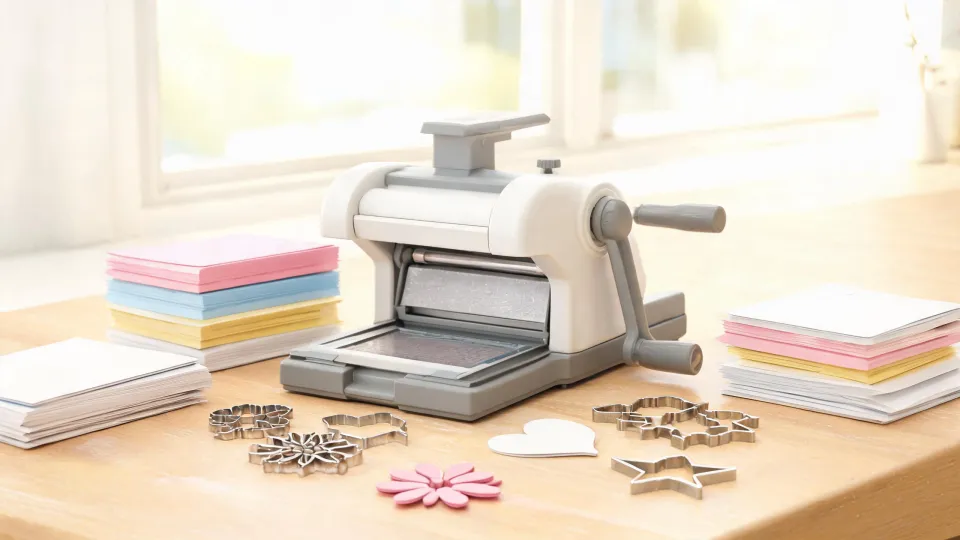
Last September, I sat at my kitchen counter with a Sizzix Big Shot on one side and a spreadsheet on the other. Our 14-person gift company had six weeks to produce 2,500 corporate holiday gift sets. If that sounds simple, you haven't read the spec sheet yet.
I'm a procurement manager, and I've managed our sourcing budget for six years. I've negotiated with 40-plus vendors and documented every order in our cost tracking system. So when a client asks for a custom die, I don't just order one. I calculate the total cost of ownership.
The client wanted each set to include: a gift card sleeve cut with the Sizzix gift card holder die, a Sizzix Christmas ornament die cut from glitter cardstock, and a small crystal gift—a paperweight with their logo etched in. And they wanted their company logo stamped on the back of the sleeve. That last line meant we needed a custom die, not just a standard one.
The Request That Made Me Recalculate
We've used Sizzix machines for years. The Big Shot and the Sidekick are workhorses. The brand's reputation in the crafting community—especially with the Tim Holtz collaboration—made the die selection easier. But custom dies were new territory.
When I searched 'sizzix gift card holder die,' I found dozens of options. Some were standard dies. Some promised custom logo work. I narrowed it to three quotes. Here's where it got interesting.
Three Quotes, One Real Price
The first supplier was a national die manufacturer. They quoted $340 for the whole thing: the card holder die, a custom Sizzix logo die for a decorative brand mark, one revision, and shipping. Lead time: 12 business days. No minimum order.
The second supplier was a discount website. The same Sizzix gift card holder die was listed at $150. That looked like a steal until I added the rest:
- Die: $150
- Setup/form fee: $90
- Custom Sizzix logo stamp: $45
- Revision fee (if needed): $30
- Shipping and handling: $35
Total: $350, with a 15-day lead time. The $150 price was the hook. The $90 setup fee was the trap. I almost went with them—almost—until I calculated the total.
The third supplier was a six-person die shop in Ohio that specializes in small craft runs. They quoted $210 for the card holder die plus the custom Sizzix logo die. Shipping was $12. They said they'd send a digital proof first, so there shouldn't be a revision fee. I want to say that was the only quote that included a same-day email reply, but don't quote me on that.
Here's the thing: the discount vendor wasn't actually cheaper. The national vendor was close, but their production schedule was tight. The small shop priced the same job at $222 all-in, and they treated us like a real customer. Not a small nuisance. A customer.
The most frustrating part of the process: two suppliers sold the same 'Sizzix gift card holder die,' but neither listed material thickness limits. You'd think die specs would include that, but they don't. We were cutting glitter cardstock and thin chipboard, not construction foam.
The Side Quest: 'Which Are The Best Diamond Painting Kits?'
While I was waiting for die proofs, a prospect emailed me a question I get weekly now: 'Which are the best diamond painting kits?' I almost archived it. But they explained the real need: 500 kits as a team-building gift for their holiday party.
I had to apply the same total-cost logic to a completely different product. The cheapest diamond painting kit was $1.85 per unit. It came with no tray, no labeled bags, and a canvas with a misaligned grid. The one I actually ordered was $2.95 per unit, but it included a resealable bag for each color and a verified drill count. That extra $1.10 saved us from the inevitable 'our gemstones fell off' complaint after the event.
That side quest reinforced the main lesson: a lower ticket price can mean a higher total cost.
Production, Packaging, and the Crystal Gift
The Ohio shop delivered early. The proof was clean. The Sizzix gift card holder die cut exactly as expected, and the custom Sizzix logo die embossed the brand mark without tearing the paper. We ran the Sizzix Christmas ornament die through the Big Shot with a cutting pad and got perfect glittered ornaments from the first batch. Exactly what we needed.
We ran a sample batch of 20 first. The custom Sizzix logo die needed a slight pressure adjustment on the Big Shot—not a bad thing, since the small shop included the first tweak in the quote. A big company might have billed a revision fee. That was the difference between a vendor and a partner.
For the crystal gift, I used the same TCO checklist. One vendor quoted $2.50 per paperweight plus $180 freight. Another quoted $2.20 per paperweight with freight included. That's a $0.30 difference per unit, but a $750 difference on the whole order. I also checked the FTC Green Guides before we put 'crystal' and 'eco-friendly' on the packaging. Environmental claims need evidence. You don't call a gift 'recyclable' just because it's glass.
We also planned shipping for the final sets. A folded gift card holder fits in a standard letter envelope, but an ornament inside pushes it into large envelope territory. According to USPS pricing effective January 2025, a First-Class Mail letter (1 oz) is $0.73, and a First-Class Mail large envelope (1 oz) is $1.50. Source: usps.com/stamps. We had to switch to a rigid mailer, which changed the per-unit shipping cost by $0.60. I didn't see that line coming. It was the same kind of hidden fee I'd almost ignored in the die quote.
So glad I checked the USPS thickness limit before buying envelopes. Almost used standard letter envelopes, which would have meant 2,500 sets stuck at the post office.
The Bottom Line for Small-Batch Buyers
Most buyers focus on per-unit pricing and completely miss setup fees, revision costs, and shipping that can add 30 to 50 percent to the total. The question everyone asks is 'what's your best price?' The question they should ask is 'what's included in that price?'
The 'you need to buy custom dies from a big manufacturer' thinking comes from an era before laser-cut, digital die-making. Today, a small specialty shop can produce precision dies that match the big players, and they often answer the phone.
Small orders don't have to be treated like small problems. The Ohio die shop didn't turn up their nose at a one-off custom die. Today, they're my first call for custom dies. That $222 order turned into a $4,200 annual contract. Look, I'm not saying you should always pick the smallest supplier. I'm saying you should look at the whole cost, not the hook price.
If you're sourcing custom dies, ask four things: Is setup included? Are revisions included? Is shipping included? What happens if the die doesn't work with my machine? The answer will tell you more than the sticker price.
Was the process perfect? No. But it reminded me that cost, value, and service are three different things. A lesson learned the hard way.

Elise Laurent is a crystal and decorative glass quality analyst covering crystal figurines, vases, ornaments, suncatchers, and gift glassware. She examines ISO 6486-1 where food-contact glass dinnerware applies, then uses polarized strain inspection, dimensional checks, surface-defect grading, and refractive clarity to compare decorative pieces outside that scope. Her work helps sourcing teams choose materials, finishing routes, and protective packaging without confusing visual brilliance with verified durability.