I'm a Procurement Manager Who Bought a Die Cutting Machine. Here's Why.
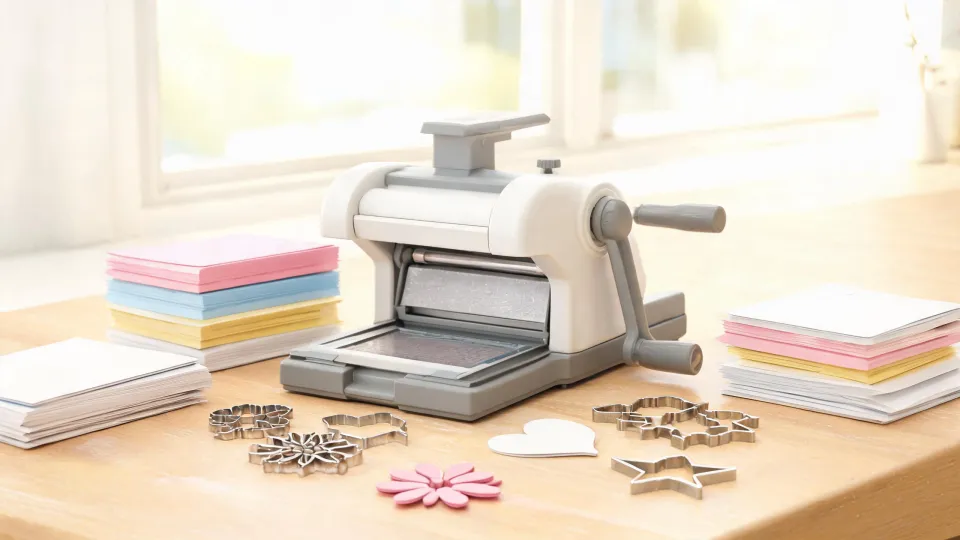
It was 9:40 on the first Tuesday of November 2024 when our VP of Sales dropped a request on my desk. Two hundred crystal gifts for our year-end client appreciation program. Custom engraved, delivered by December 10th.
"Get me a quote and make sure it's not embarrassing."
The quote came back at $14.50 per unit, everything included. Total: $2,900 plus shipping. It wasn't a bad number for fully custom crystal gifts with a short timeline. But I had that itch.
I've managed our promotional products budget—about $40,000 annually across categories—for six years now. Every invoice goes into our cost tracking system. And what that data kept telling me was: bundled quotes hide the expensive parts. So I asked for a line-item breakdown.
The crystal itself: $6.80. The custom greeting card: $3.75. The gift box, tissue, and assembly: $2.10. Engraving setup and per-piece cost: $1.85. 22% of the bundle was the card. A folded piece of cardstock with our logo printed on it.
The Unlikely Solution: Sizzix
I'm not a craft person. My version of creativity is a well-structured spreadsheet. But I knew enough about print and packaging to wonder whether we could produce that card in-house. And every search led me back to one name: Sizzix.
You've probably seen Sizzix machines at craft stores, or you might know them by the full brand name, Sizzix Provo Craft. The Big Shot and Big Shot Pro models are staples in the papercrafting world, and Tim Holtz's signature Sizzix dies have a cult following. But I wasn't looking at it from a hobbyist angle. I needed to know: can a die cutting machine produce a one-off run of custom greeting cards, ornaments, and gift tags at a reasonable total cost?
Short answer: yes. Here's the longer answer, including the parts where I messed up.
Building the Comparison (Spreadsheet Included)
The question I started with was practical: where to buy a Sizzix die cutting machine at a business-appropriate price? Retail availability turned out to be broad: Amazon, Michael's, JOANN, Hobby Lobby, and Sizzix's own online store. The Big Shot bundle runs roughly $120–$160 depending on what's included; machine-only pricing sits around $80–$100. Those are current listings as of January 2025—verify current pricing before you budget. But the machine is the cheap part. The custom dies are the real lever.
Sizzix can manufacture custom steel-rule dies based on your design. For our purposes, we needed a die with our company logo and a "Season's Greetings, Thank You" message that could cut and emboss the card front in one pass. Quotes came in at $85–$150 depending on die size and complexity.
Here's the spreadsheet I built (abbreviated):
Option A: Full-service vendor
- 200 crystal gifts, card, box, delivered: $2,900
- Timeline: 3 weeks after proof approval
- Risks: minimal, but zero reusable assets
Option B: Hybrid approach
- Crystal gifts from a wholesale supplier, engraved: $7.20 × 200 = $1,440
- Gift boxes: $0.60 × 200 = $120
- Sizzix Big Shot machine: ~$140
- Custom Sizzix die: ~$110
- Blank cardstock and envelopes: ~$70
- One-time setup total: ~$320
- Option B total: $1,880
The delta was roughly $1,020—a 35% gap on paper. That was before the digital greeting card add-on and before I made my material specification mistake. Why do I sound confident about the baseline prices? Because I verified them. Between November 11–15, 2024, I requested quotes from four promotional product suppliers and three wholesale gift distributors. Comparable engraved crystal gifts ranged from $6.50 to $9.80 per unit at quantities of 200, depending on dimensions and engraving detail.
I placed the order. The machine arrived. And then I hit the moment that nearly derailed the whole project.
The Turn: Cardstock Is Not "Just Cardstock"
Our first custom Sizzix die came back with a design flaw—or so I thought. The lettering was too thin for the textured cardstock we'd bought. Instead of a clean embossed message, the letters tore the paper fibers. It looked like a bad fax. I stared at the test piece and felt that cold wash of dread every procurement person knows: this is the thing that's going to cost me my credibility.
Then I read the die manufacturer's material guide. Buried in a table at the bottom: "Fine detail dies require smooth, uncoated cardstock in 80–110 lb weight." Our cardstock was 65 lb, textured, and coated. Every variable was wrong.
What saved us was a 12-point checklist I'd created after a $1,200 reprint disaster years earlier. Step 4 reads: Confirm material specifications with the vendor before placing the order. I had skipped it because I assumed cardstock was cardstock. It isn't. That mistake cost $95 and ten days—cheap, compared to the alternative of discovering it at delivery time.
I ordered a bolder replacement die with a 10-day turnaround and switched to the recommended smooth cardstock. The second test was perfect.
Looking back, I should have verified materials before placing the first custom die order. At the time, I was so deep in unit economics that I rushed past the technical spec. If I could redo that decision, I'd have spent 20 minutes on the material guide first. Given what I knew then—which was nothing about how differently cardstock can bond and tear—my mistake made sense. It still stings. Granted, the hiccup was minor. But the lesson stuck: the checklist exists precisely for moments when you're confident enough to skip it.
What About Digital Greeting Cards?
Somewhere in the middle of this, our marketing coordinator asked a question that redirected the entire project: "Should these gifts include a digital greeting card?"
Her point: several of our top clients had stopped mailing holiday cards entirely. What if the physical card had a QR code that led to a personalized digital greeting experience?
How do you send a digital greeting card in a corporate setting? It's honestly not complicated. We used a QR code generator, hosted personalized pages on a private landing site, and had each account manager record a 30-second video message. Total cost: about $11/month for hosting, plus roughly two hours of our graphic designer's time. The gain: one of our client's procurement directors told our VP it was the best vendor gift they'd received all season. The physical Sizzix card got their attention; the digital layer created the memory.
That's the optimization nobody quotes in a bundle. The original vendor didn't even offer it as an option. Because why would they? It's not in their product catalog.
Results: The Numbers, Final
All 200 crystal gifts were delivered on December 8th, two days ahead of schedule.
Final accounting, including the machine, both dies, all materials, the QR platform, and our coordinator's assembly time:
- Total: ~$2,085
- Per unit: $10.42
- Compared to the original quote: 28% savings
The machine and dies remain in our office. Reorders for future appreciation gifts will come in around $8.70 per unit, because the setup cost is already paid. That's the compounding benefit of owning part of your supply chain.
What I'd Tell Another Procurement Manager
If you're considering a similar move, or just trying to decide between a full-service vendor and an in-house alternative, here are the questions I'd ask before committing:
- What's your volume? The math only works if the machine pays for itself. At 200 units, we broke even on the first run. Under 50 units, buy the full-service option and move on.
- What materials will you cut? Read the specifications before buying. Sizzix machines handle cardstock, felt, thin wood, some plastics, and fabric—they are not universal cutters. If your product requires metal or thick acrylic, this is not the right tool.
- Who owns the project? In-house production needs someone patient enough to follow a checklist. Our coordinator had zero craft background and succeeded anyway. That says more about checklists than craft skills.
- What's the timeline? Custom dies take 1–2 weeks. If your deadline is next Friday, this plan won't work.
- What does "done" look like? Define your quality standard before you start. Then test on the actual materials. In my experience, 20 minutes of upfront verification beats 5 days of rework every single time.
Online printers like 48 Hour Print work well for standard products—business cards, brochures, flyers—and their turnaround is genuinely fast. But for custom die-cut shapes, unusual finishes, or personalized short runs, an in-house approach can be surprisingly competitive. At least, that's been my experience with a mid-sized company's corporate gifting program. Your context and cost structure may differ.
The full-service quote wasn't a rip-off. It was fair pricing for a bundle of services we didn't need all of. The savings came from identifying which part we could responsibly produce ourselves, verifying the specifications, and accepting a little more risk in exchange for much better economics. In six years of managing our promotional products budget, that single decision has been the most consequential—and the one I nearly talked myself out of.

Elise Laurent is a crystal and decorative glass quality analyst covering crystal figurines, vases, ornaments, suncatchers, and gift glassware. She examines ISO 6486-1 where food-contact glass dinnerware applies, then uses polarized strain inspection, dimensional checks, surface-defect grading, and refractive clarity to compare decorative pieces outside that scope. Her work helps sourcing teams choose materials, finishing routes, and protective packaging without confusing visual brilliance with verified durability.