Sizzix for Corporate Personalized Gifts: Custom Dies, Embroidery Kits, and Concrete Candle Holders
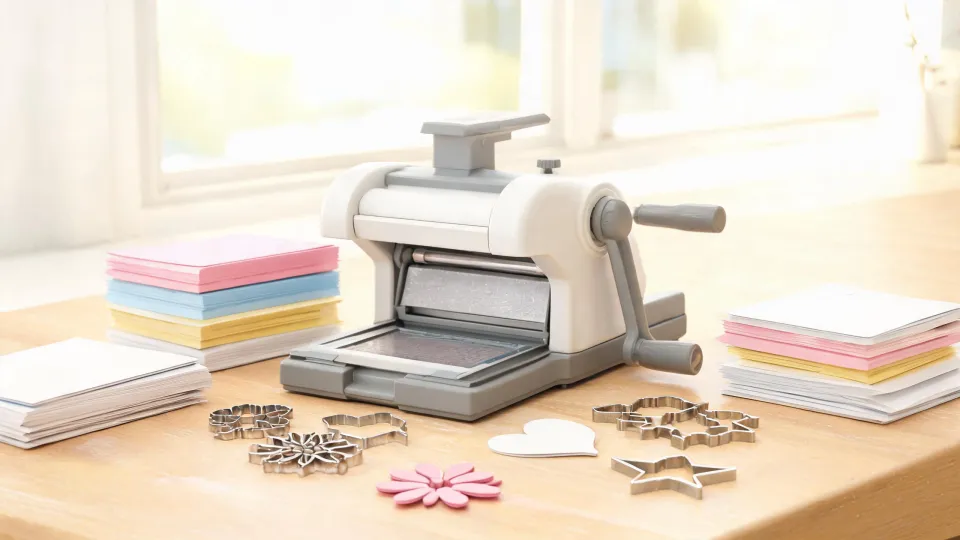
There is no single answer to 'how should we make our personalized gift?' The right method depends on order size, deadline, and how many times you'll repeat the design. I've been a quality and brand compliance manager at a gift company for four years, and I review roughly 200 unique production orders per year. In Q1 2024 alone, I rejected 9% of first deliveries for issues that could have been avoided with a better upfront production choice.
I will not pretend one approach works for all. I'll break it down into three common situations: a small order with a tight deadline, a recurring mid-size order, and a 'homemade' premium gift like a concrete candle holder. The right choice depends on which situation you are in.
Situation 1: Small order, tight deadline
If you need 100 customized gift boxes delivered in two weeks, the fastest tool is probably the Sizzix original die cutting machine. Manual machines sound slower than electric ones, but for a one-time batch they don't require setup time or software updates. You can die-cut cardstock, thin leather, felt, and even some plastics.
For Christmas-themed corporate gifts, the Sizzix Tim Holtz Christmas dies are my first recommendation. They produce clean, consistent ornament and card shapes. If you need a one-time logo shape, order a custom die even if it feels expensive. In a short production run, the custom die is the part that guarantees every piece matches the first. Hand-cut versions drift, and you will reject more returns than the die cost.
In one March project, my team thought hand-cutting 90 ornaments was faster than waiting three days for a die. It wasn't. Looking back, I should have ordered that custom die immediately. The numbers said the die would arrive in three days and cost about $225. My gut said the client could wait. The first hand-cut batch had a 12% reject rate. The die produced zero rejects on the second run. The surprise wasn't just the time saved; it was how much less stress the team had.
Rush fees are not just for speed. If a custom die can be made in 48 hours, you are paying for certainty. In March 2024, we paid $400 extra for expedited die production. That saved a $15,000 event order. I do not lose sleep over that invoice.
One more tip: don't let the machine choice distract you. A bigger electric machine is nice, but for a small urgent batch the Sizzix original is easier to set up and clean between materials. Speed per sheet matters less than speed to a finished, approved item.
Situation 2: Recurring orders and larger batches
When you order the same gift repeatedly, the calculation changes. A Sizzix Big Shot Pro can handle bigger dies, and steel-rule custom dies become more affordable per unit. But there is a limit.
- Need 500 identical shapes? Use a custom die.
- Need a personalized name on each item? An embroidery kit may be better than a die.
A die gives you identical shapes. It does not give you individual names. An embroidery machine, or a simple embroidery kit used by your assemblers, can personalize a tote bag or a stocking in a way that a die cannot.
In our 2024 audit, we saw a shipment of 800 embroidered stockings where the thread color was specified as 'gold.' The vendor interpreted it as bright yellow. It was not a defect on inspection, but it was the wrong brand color. That issue reminded me to put color standards into the contract, not just the design file.
Also watch shipping. Many corporate gifts are mailed directly to recipients, not shipped to one warehouse. According to USPS pricing effective January 2025, a First-Class Mail letter costs $0.73 up to one ounce, and a First-Class Mail large envelope costs $1.50 up to one ounce. If your gift is thicker than 0.25 inches, it cannot go as a letter. It may qualify as a large envelope if it stays under 0.75 inches, but it will still need the $1.50 rate rather than $0.73. A die-cut ornament in a rigid envelope can quickly move into parcel rates. Keep the package flat, and check USPS Business Mail 101 if you are designing the outer envelope. Source: usps.com.
Situation 3: The 'homemade' premium gift
Some clients do not want a polished factory output. They want something that feels handmade. The most common request we receive is a concrete candle holder. A buyer often searches 'how to make a concrete candle holder at home,' then asks us to replicate it on a larger scale. You can use Sizzix to make it easier.
With a Sizzix Big Shot, you can cut a stencil from flexible plastic or rubber sheeting. Use that stencil to press a logo or a pattern into wet concrete before it cures. The process is simple:
- Mix a small batch of concrete and fill a silicone mold.
- Insert a disposable cup or a waxed cardboard candle sleeve to form the center cavity.
- Press the die-cut stencil into the top surface.
- Let it cure for at least 24 hours, ideally in moderate humidity.
- Seal the concrete before adding the candle.
If you make concrete candle holders as gifts, remember that concrete is porous. If you do not seal it, moisture from the candle may leave a watermark. Also, concrete dust is not something you want to cut with the same die you use for paper. Clean the die after each use. If your client wants a specific color, do a small sample first. Concrete pigments are not consistent across brands.
Is a concrete candle holder the right personalized gift for every client? No. But for a small interior design or hospitality company, it feels more intentional than a logo pen.
Which situation are you in?
Ask these three questions before you pick a production method:
- How many identical units do you need, and how many times will you repeat this order?
- What does 'good enough' look like on day one? If you cannot describe it, no machine will save you.
- What is the penalty for late delivery?
If your deadline is fixed and the order is small, pay for the custom die or rush production. Uncertain delivery dates are more expensive than delivery fees. That is not a generic principle; it is the reason our rush approvals exist.
Of course, there is overlap. A company might start in Situation 1 and, six months later, realize they are in Situation 2. That is fine. The point is to re-evaluate production choices when the order pattern changes.
One compliance note. If you advertise an item as 'handmade' or 'custom,' make sure that claim is accurate. Per FTC guidelines, advertising claims need substantiation. If you sell a concrete candle holder that you cast in your own workshop, call it handmade. If you assembled an imported kit and branded it 'custom,' stop and think about what custom means to the buyer. Source: ftc.gov/business-guidance/advertising-marketing.
The takeaway
There is no universal production method. For small urgent orders, a Sizzix original die cutting machine with standard dies or a custom die gives you control. For repeated batches, combine steel-rule dies with embroidery kits for personalization. For a home-gift feel, use die-cut stencils to shape concrete candle holders.
What I don't recommend: waiting until the last week to decide. That is the only production scenario I see regularly that always costs more.

Elise Laurent is a crystal and decorative glass quality analyst covering crystal figurines, vases, ornaments, suncatchers, and gift glassware. She examines ISO 6486-1 where food-contact glass dinnerware applies, then uses polarized strain inspection, dimensional checks, surface-defect grading, and refractive clarity to compare decorative pieces outside that scope. Her work helps sourcing teams choose materials, finishing routes, and protective packaging without confusing visual brilliance with verified durability.