Rush Custom Dies and the Fine China Lesson: What One Holiday Order Taught Me About Sizzix Custom Dies
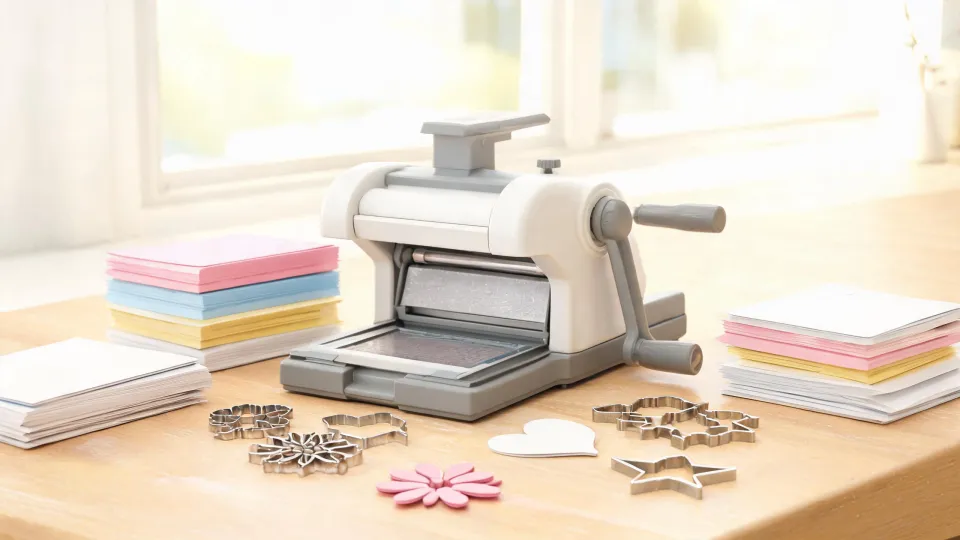
The call came in on Thursday, October 24, 2024. I was in triage mode before I even looked at the calendar. The client's annual corporate gifting event was Friday, November 1—eight days later. They needed 1,500 Christmas ornament gift card holders and 1,500 matching greeting cards. And they wanted a Sizzix custom die to cut the ornament shape, score the gift card slot, and emboss the border in one clean pass.
I almost said yes right there. That would have been a mistake.
Why This Was Not a Standard Rush Order
For context, I'm a production coordinator at a custom paper and print shop in the Midwest. We make gift packaging, greeting cards, ornaments, and corporate event giveaways. In seven years, I've handled more than 200 rush orders. Most of them sound impossible at first and turn out to be manageable. This one was different—not because the work was exotic, but because of what could go wrong.
The client had seen Sizzix die cutting machines at a trade show and wanted the same look for their business gifts: a die-cut ornament that folds into a gift card holder. Not a generic die from a retail pack. They wanted a proprietary design. In practice, that meant a Sizzix custom die with an interior pocket, a curved top loop, and a pre-scored seam so the holder pops open.
What they described was, technically, a Sizzix gift card holder die: one tool that cuts the outer shape, creates the slot for the card, and scores the fold.
The greeting card side of the project was simpler: a 4.25 by 5.5 inch fold with a tiny snowflake cut on the front. The client wanted the whole package to feel like a keepsake, not a paper sleeve. They also asked us to include a small insert explaining the gift theme. That was the first mention of fine china.
I initially treated this as a standard die-cutting project with a slightly compressed timeline. In my experience, custom Sizzix dies for gift packaging usually carry a ten to fifteen business day lead time. I had once pushed a die supplier to deliver in five days. Eight days felt comfortable, maybe even easy.
That logic left out two things. It was late October, and every die manufacturer in the country was already slammed with Christmas orders. And our client didn't need the die. They needed 1,500 finished pieces. There is a difference between getting a tool and delivering an order.
What Fine China Has to Do With Paper
By Friday at noon, we had artwork approved, die specifications confirmed, and an expedited custom Sizzix die ordered. The rush fee was $825 on top of the $2,400 die cost, as of October 2024. I called it the price of certainty. At the time, I thought the hard part was over.
The die arrived Tuesday afternoon, four days later, which was faster than expected. We set up one of our Big Shot Pro die cutting machines, ran a single test sheet, and the whole team leaned over the table.
The test cut was good. The score was not.
This is where the phrase 'fine china' entered the story for real. The bank's marketing director asked in an email: 'Where does the term fine china come from? We're thinking of calling the gift insert "A piece of fine china from our table to yours."'
Short version: European traders named porcelain 'chinaware' because the best porcelain traveled from China through Chinese trading ports. By the nineteenth century, 'fine china' meant the high-quality, translucent porcelain reserved for special occasions. It looks delicate, but it is fired at high temperatures and is genuinely strong—until you hit it at the wrong angle with the wrong force.
That last sentence became the analogy for thick paper. The client loved the porcelain idea, so we added a filigree pattern to the ornament die: tiny leaves and a flower, with a pale blue liner peeking through the cut holes. It was a paper homage to porcelain, not porcelain itself. That distinction mattered.
We approved the new design and ran a full sheet of 300 gsm matte stock through the Big Shot Pro. The fold area cracked on the fifth sheet.
When the Score Fails, the Story Changes
There's a rule in paper engineering: grain direction determines how cleanly a fold bends. I knew that rule. I knew 300 gsm was at the upper edge of this die's comfort range. I also knew I should do a verification fold test before running a full production sheet.
I skipped it because I thought, what are the odds?
The odds caught up with us. The crack appeared not because the die was wrong, but because the paper grain ran parallel to the fold instead of perpendicular. We needed a different batch of stock with the same color and finish. Our normal supplier couldn't get the right grain to us for three days. A local distributor had one pallet with the correct grain and a 300 gsm weight. It cost $380 extra, and we picked it up that evening.
The real fix was not clever. It was methodical: correct paper, adjusted scoring pressure, clean test sheet, then a small batch run to inspect the fold on each sheet. We repeated that sequence until the Sizzix custom die produced a clean ornament every time.
Friday, Interpreted
At the same time, the client's buyer emailed: 'Just confirming the first 300 will be delivered by 10 a.m. Friday.'
We both used the word Friday. I meant Friday at 3 p.m., in time for their event at 7 p.m. She meant Friday at 10 a.m., because the leadership team wanted to see the gifts before the dinner. Same word, two different commitments. The discovery happened because she asked a direct question instead of assuming.
Missing the Friday deadline would have been costly. The order value was $18,500, and the agreement included a $4,000 late penalty. More importantly, the buyer had selected us for a second project later that month. We chose the harder option: the die operator started at 5 a.m., a courier delivered the first 300 by 9:45 a.m., and the remaining 1,200 followed on a truck that arrived before noon. We made the deadline with two hours to spare.
The event went ahead. The client's leadership passed the ornament around and reportedly called it the most thoughtful corporate gift they had done. I was relieved. But after the project, I wrote down what not to repeat.
The Boundary Lesson
The biggest lesson wasn't about custom Sizzix dies, Christmas ornament shapes, or even where the term fine china comes from. It was about knowing the difference between what your company can do quickly and what it can do well.
Anyone can say yes to a custom die project in eight days. The supplier who asks about paper grain, scoring pressure, and the client's internal approval chain is the one who actually delivers. And the supplier who says 'this is outside our lane' is more valuable than the one who says 'we can do everything.'
Personally, I don't trust a vendor who claims they can handle all materials, all quantities, and all timelines. A specialist who knows their limits will tell you when to go elsewhere. We are good at die-cut paper gifts: greeting cards, gift card holders, Christmas ornaments, packaging for corporate gifts. We are not the right source for actual porcelain. If someone asked me to die-cut fine china, I'd send them to a ceramic engraver.
That honesty is what 'fine' should mean in craftsmanship. It doesn't mean flawless. It means refined enough to know the material, respect the process, and admit when something belongs to another specialist.
We still use Sizzix machines for these jobs. The manual Big Shot and Big Shot Pro give us repeatable pressure without software updates, and Sizzix custom dies are designed for medium to large runs of paper and thin cardboard. Our policy now is simple: if a custom die order leaves fewer than two working days for testing and delivery buffer, we review the full plan before committing. Last quarter, that policy saved us from three missed deadlines.
And for the record, the phrase 'fine china' still reminds me of that old project. The name came from China, but the lesson came from a cracked piece of 300 gsm paper. Know your material. Set your boundaries. Repeat.

Elise Laurent is a crystal and decorative glass quality analyst covering crystal figurines, vases, ornaments, suncatchers, and gift glassware. She examines ISO 6486-1 where food-contact glass dinnerware applies, then uses polarized strain inspection, dimensional checks, surface-defect grading, and refractive clarity to compare decorative pieces outside that scope. Her work helps sourcing teams choose materials, finishing routes, and protective packaging without confusing visual brilliance with verified durability.