Can I Make a Last-Minute Photo Book Gift Online? Yes—But Compare It with Sizzix Custom Dies First
-
Let’s answer the easy question first
-
Two routes, one deadline: what I put side by side
-
Comparison 1: total cost for 60 gifts
-
Comparison 2: certainty under deadline pressure
-
Comparison 3: customization and brand shelf life
-
But let me be honest: the Sizzix route isn’t zero work
-
So, can I make a last-minute photo book gift online?
-
Choice guide for busy procurement people
Let’s answer the easy question first
Yes, you can make a last-minute photo book gift online. I’ve done it. My office needed a 40-page recap book for a client event, and when the standard delivery window looked too tight, we paid for rush service and had the book two days before the meeting.
But that experience led me to a different question. I’m the person who tracks every dollar we spend on client gifts and promotional products. A photo book is a good gift when the photos are the story. For a product launch, an executive thank-you, or a holiday reminder, the real job is to keep your brand on a desk, not in a drawer. That changed the comparison for me.
Two routes, one deadline: what I put side by side
In Q4 2024, I needed 60 client gifts for a date that could not move. The request sounded like, “Can’t we just make photo books online?” So I compared the two practical options:
- Option A: have an online photo service print a customized photo book gift, with our logo on the cover and event photos inside.
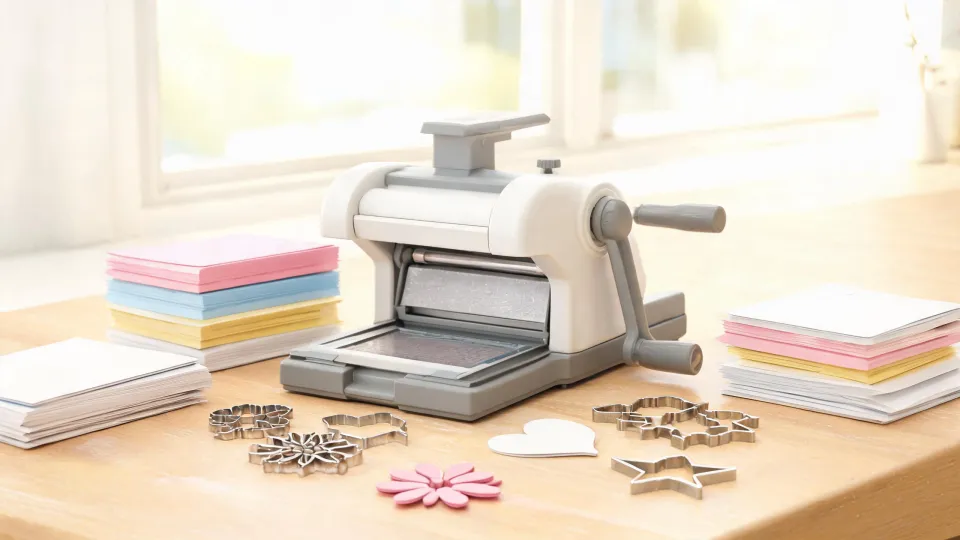
- Option B: create a small production area with a Sizzix mini die cutting machine and Sizzix custom dies to make branded greeting cards and ornaments.
This wasn’t a hobby-versus-print debate. It was procurement. I tracked total cost, delivery certainty, and branding value. The outcome surprised me.
Comparison 1: total cost for 60 gifts
Most buyers focus on the per-unit price and completely miss rush fees, proof charges, freight, and the occasional surprise line item. The question everyone asks is, “What’s your best price?” The question I now ask is, “What does the final invoice look like?”
The online photo book route—using a mass-market service with a rush option, as of mid-December 2024—came out to roughly $31 per gift once I added processing and expedited shipping. That works out to about $1,900 for the batch. Not outrageous, but not the “as low as” number in the marketing email.
Option B did not look cheaper at the start. Sizzix custom dies are a real upfront cost, and you need the machine to run them. For the first campaign, I assigned the full cost of the Sizzix mini die cutting machine plus one custom die to the project. With cardstock, envelopes, a printed insert, and a few hours of assembly labor, the first run of 60 die-cut greeting cards came to about $7.60 per gift.
Why the difference? Because the machine and die become reusable assets. The photo book’s rush fee is gone forever. The more surprising part: the custom dies let us make the same branded shape for the next product launch at a much lower unit cost.
Comparison 2: certainty under deadline pressure
In March 2024, I paid $400 extra for rush delivery on another project. I didn’t love the invoice. But the alternative was missing a $15,000 event. I keep this note in my cost-tracking spreadsheet:
The value of guaranteed turnaround isn’t the speed—it’s the certainty. For event materials, knowing a deadline will be met is often worth more than a lower price with “estimated” delivery.
An online photo book can be fast. The part you don’t control is the handoff. The printer might finish in four days, then a carrier decides your address needs another day. Unless you pay for the highest service level, a “guaranteed by Thursday” can become Friday. That still scares me for event work.
With the Sizzix route, the risk moves into your building. Once the custom die and Sizzix mini die cutting machine were on hand, the remaining schedule belonged to us. We tested one cut, approved the material, and produced the full batch in an afternoon. I still ordered the die early because shipping can delay any tool, but after that there was no print queue and no “in production” status.
What most people don’t realize is that “standard turnaround” often includes buffer time that the vendor uses to manage their production queue. It may not be how long your order actually takes. A rush fee often moves you to the front of a line; it doesn’t make the work itself quicker. In-house, the queue is yours.
Comparison 3: customization and brand shelf life
This is where the photo book lost in our evaluation. I understand the appeal: polished, familiar, and easy to personalize. If the gift is about photos—a year-in-review, an event recap, a family gift—a photo book is genuinely the right format. But as a promotional product, it has a weakness. Rectangular printed products eventually pile up in the same drawer.
A die-cut greeting card or ornament shaped like your product, your logo, or the launch theme has a better chance of ending up on a desk or a holiday tree. In B2B, “novelty” shouldn’t be your core strategy, but a distinctive shape is easier to remember than a cover that looks like dozens of other covers.
Sizzix custom dies let you lock in a branded shape and use it across greeting cards, ornament tags, welcome notes, and product teasers. It’s a repeatable tool, not a one-off art project. That consistency matters when you order the same item for different regions or seasons.
But let me be honest: the Sizzix route isn’t zero work
I don’t want to oversell it. An online photo book takes about twenty minutes to upload and checkout. A die-cut gift run needs dies, cardstock, assembly space, and a couple of careful hands. If your team has no interest in making anything, Option B will not survive your operations. Manual cutting would be inefficient at volume; the Sizzix machine is what makes the repeated shape consistent.
The most frustrating part of custom gift projects isn’t usually making the product. It’s the “we just learned we need 20 more” requests that show up after approvals. After the third such request, I stopped seeing the Sizzix mini die cutting machine as a craft supply. It became a backup plan that gives us a production slot whenever the calendar says “now.”
So, can I make a last-minute photo book gift online?
Yes, you can. For one book or a handful of personal photo gifts, a rush online order is a genuine solution. Get the date in writing, choose the fastest shipping option, and accept that you are paying for certainty. That can be the right call.
For corporate gifts, though, the stronger answer is: compare before you buy. In our 60-unit test, the last-minute online photo book was not the budget winner, and it didn’t produce the brand shelf life we wanted. The Sizzix route was more economical and more predictable once the equipment was in the building.
If you already have a Sizzix machine, or you have been thinking about buying one for seasonal cards, this is a useful reason to test Sizzix custom dies. If you don’t have one and you only need five premium books, skip the machine. Let the online book shop do its job.
Choice guide for busy procurement people
- Order last-minute photo books online when you need one to 10 gifts, the photos are the content, and you can accept a vendor-controlled deadline with rush shipping.
- Choose Sizzix custom dies and a Sizzix mini die cutting machine when you need 20 to 100 branded greeting cards, ornaments, or gift inserts, and you can add a few days of preparation before production.
- Consider a hybrid: make the online photo book the core gift, then produce a custom Sizzix die-cut gift tag or wrap to tie it to your brand. You get the warmth of photos plus a finish that doesn’t look order-ready for every company.
As of January 2025, my cost tracking sheet still starts with the same question: what are we really buying? If the answer is time certainty and brand recall, the cheaper-looking internet option is often the expensive one. That’s why I’ll keep comparing.

Elise Laurent is a crystal and decorative glass quality analyst covering crystal figurines, vases, ornaments, suncatchers, and gift glassware. She examines ISO 6486-1 where food-contact glass dinnerware applies, then uses polarized strain inspection, dimensional checks, surface-defect grading, and refractive clarity to compare decorative pieces outside that scope. Her work helps sourcing teams choose materials, finishing routes, and protective packaging without confusing visual brilliance with verified durability.