Budget Blowout on Corporate Gifts? The Problem Isn't the Vendor. It's the Machine.
Look, I've been a procurement manager for a mid-sized promotional products company for the better part of a decade. I manage a $180,000 annual budget for client gifts and internal swag. I've tracked every single order in our system since 2019. And you know what I've learned?
The single biggest budget killer isn't the vendor. It isn't the shipping. It's the hidden costs we engineer into the product before we even send the RFQ.
Here's the thing: every time you order a custom-shaped, die-cut corporate gift, you're paying for a one-time setup. You pay for the die itself—the physical, steel-rule cutting form—and you pay for the setup time. If you order 100 pieces, that setup cost is amortized over 100 units. It's a fixed cost that hits a small batch hard. You order 100 die-cut snowflake ornaments for a winter holiday promo? You just paid a premium for that shape.
And here's where the industry has changed. The assumption is that custom dies are a specialized, expensive tool for only large runs. The reality is that having the machinery in-house, even for a promotional products company, can fundamentally invert that cost structure. It changes the conversation from "How many pieces do I need to justify a die?" to "How many dies can I produce this week for different clients?"
The Scavenger Hunt of Hidden Costs
When I audited our 2023 spending, I found a startling pattern: 17% of our project budget was spent on what I'd call "scavenger hunt costs."
Here's a typical example from last year. A client wanted a custom corporate gift basket for their top 50 accounts. They wanted a branded candle holder, an ornament, and a personalized greeting card. We outsourced the die cutting. Vendor A quoted $4.50 per candle holder. Vendor B countered at $3.80 per piece. I almost went with B.
But when I calculated the total cost of ownership (TCO), I found the hidden landmines. Vendor B's price excluded the die setup ($175 for that shape). Vendor A included it. Vendor B charged $25 for "artwork setup." Vendor A included it. Shipping from Vendor B was $0.85 per piece because they were out of state. Vendor A was local. The final tally: Vendor A was actually $0.72 per piece cheaper. That's a 19% difference hidden in the fine print.
But that's table stakes. The real revelation came when I started looking at the machinery question. The assumption is that outsourcing the die-cutting is always the cheaper option for small-to-medium runs. I'm not sure why that assumption persists. My best guess is it stems from an older era when die-cutting machines were industrial, room-sized behemoths costing hundreds of thousands of dollars.
Why the Fundamentals Haven't Changed, but the Execution Has
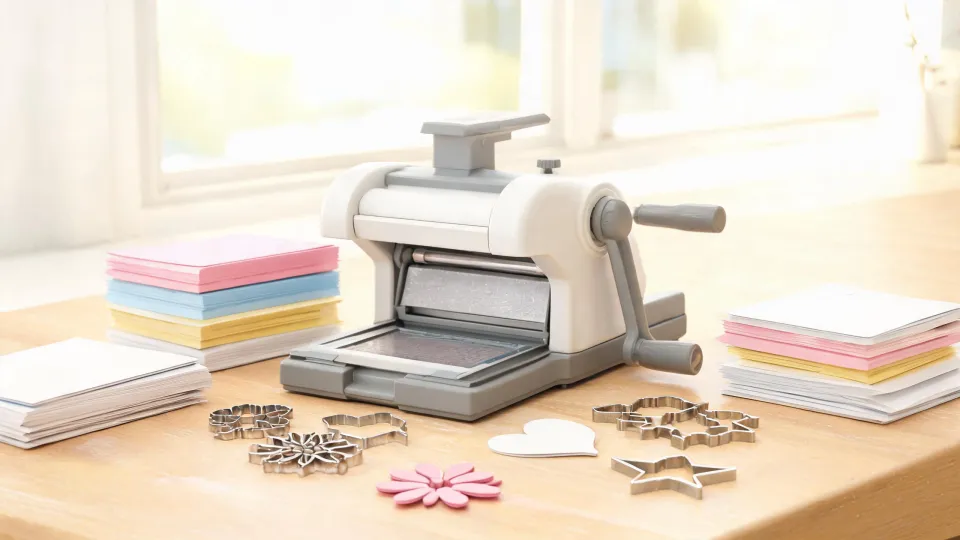
What was best practice in 2020—outsourcing every custom shape to a specialty printer—may not apply in 2025. The industry has evolved. The machinery has evolved. A brand like Sizzix has democratized the process. Their Manual Die Cutting Machines (like the Big Shot Pro or the Sidekick) and Electric machines put a high-quality, precision-die-cutting capability into a workshop environment. This isn't a hobbyist tool anymore for scrapbooking (note to self: the scrapbooking stigma is real, but dead).
Why does this matter for a procurement manager?
Because you stop buying a service and start buying a capability.
When you outsource a die-cut job, you pay for the die, the setup, the overhead, the margin, and the shipping. When you have a machine like a Sizzix in your shop—with access to their massive library of standard dies, or the ability to commission custom dies—your cost structure changes. You buy the die once. You buy the machine once. Then the marginal cost of producing that 51st corporate gift is essentially just raw material.
Let me break this down. A custom Sizzix die might cost you $50-$100, depending on complexity. That's a one-time capital expense. Compare that to paying a $175 setup fee plus a per-piece premium for a vendor. If you have ten different clients needing custom shapes over a year, you amortize that die cost over multiple jobs. The vendor's setup fee is a tax on every single project.
The 'Cheap' Option That Cost Us $1,200
I'm a fan of avoiding disasters, not managing them. We once went with the "cheap" vendor for a rush order of 200 die-cut greeting cards for a Christmas client. The vendor quoted $2.10 per card—significantly lower than the $3.50 we were used to paying. The quality was actually pretty good for the price.
But the delivery was late. Three days late. The client had a holiday party scheduled. We had to overnight the cards at a cost of $680. We also had to send a branded gift basket as an apology ($450).
The 'cheap' option resulted in a $1,200 redo when quality (timeliness, in this case) failed. Seriously. The total cost on the project ballooned to $1,820 from a projected $420. That's a 433% overrun. And it was completely avoidable.
The Die Maker's Perspective
This gets into die manufacturing territory, which isn't my expertise. I'm not a tooling engineer. What I can tell you from a procurement perspective is how to evaluate the capability.
The Sizzix ecosystem is interesting because it's a trusted brand in the crafting community—their collaboration with Tim Holtz is massive for Christmas dies—but they've also built a robust B2B offering. They sell Custom Sizzix Dies directly. You send them your artwork, and they make the steel-rule die. This is the same service a commercial specialty printer offers, but you own the die. And you can use it on your Sizzix machine in-house.
The question isn't "Is the machine expensive?" It's "How many times will I pay the die-setup penalty before I buy the machine?"
The Real Cost of 'Forgetting' a Core Asset
I built a cost calculator after getting burned on hidden fees twice. I ran it based on our 2023 data. We did 17 projects that required custom die-cutting. The total outsourced die and setup fees were $4,275. The shipping costs for those bespoke parts were another $890. The rush fees for three projects added $1,100.
That's $6,265 in pure process waste—money that didn't go toward the product itself.
A top-tier die-cutting machine is a capital investment. But the amortization over three years makes it a no-brainer for any company spending over $5,000 a year on custom die-cutting. And the indirect benefits—control over timeline, zero rush fees, ability to produce last-minute samples—are real but hard to quantify.
People think the machine is the cost. Actually, the outsourcing overhead is the cost. The machine is the cure.
A Balanced View: When Outsourcing Still Works
I'm not saying in-house die-cutting is always the answer. Look, there are legitimate use cases for outsourcing:
- Volume spikes: If you have a 10,000-unit order, running that through a single machine is slower and increases labor costs.
- Specialized materials: Some industrial materials (thick acrylic, metals) require hydraulic presses that a machine like the Big Shot Express can't handle.
- Total creative freedom: A commercial die-maker can cut almost anything. Your in-house machine has size and pressure limits.
But for 85% of corporate gifts—paper goods, thin plastics, cardstock, felt, fabric—a machine like a Sizzix Big Shot Pro or the Sizzix Sidekick is workable. It's fast. It's consistent. And it gives you the ability to prototype a custom design for a client request in 30 minutes instead of 7 days.
The Bottom Line (From a Cost Controller)
Honestly, I wasn't expecting to be a Sizzix evangelist when I started this analysis. I'm a spreadsheet guy. I track every cent.
But the numbers don't lie.
If you're spending more than $3,000 a year on custom die-cut corporate gifts, promotional items, or branded merchandise, you need to look at a machine like the Sizzix Big Shot Pro or the Sizzix Electric Die Cutting Machine. Visit the sizzix official website (sizzix.co.uk for the range) and look at their custom die service.
The cost of the machine is an investment that pays for itself in reduced vendor fees, eliminated rush charges, and faster turnaround times. It turns a variable cost into a fixed cost. Simple. Done.
(note to self: update the cost calculator for 2025 machine prices—the Sidekick is surprisingly affordable for low-volume shops)

Elise Laurent is a crystal and decorative glass quality analyst covering crystal figurines, vases, ornaments, suncatchers, and gift glassware. She examines ISO 6486-1 where food-contact glass dinnerware applies, then uses polarized strain inspection, dimensional checks, surface-defect grading, and refractive clarity to compare decorative pieces outside that scope. Her work helps sourcing teams choose materials, finishing routes, and protective packaging without confusing visual brilliance with verified durability.