36 Hours to Go: How a Sizzix Red Die Cutting Machine Salvaged a 500-Piece Corporate Gift Order
Tuesday, 9:15 AM
The call came in at 9:15 on a Tuesday morning. I was halfway through my second cup of coffee when a regional sales director got through to me. That's not unusual in my role—I coordinate rush fulfillment for a B2B craft manufacturer, and when a client calls two days before an event, it's usually not good news.
This one was worse than most.
Her company's corporate gift order—500 custom crystal gifts with laser-etched logos—was sitting in a shipping container three states away. The original supplier had missed the cutoff. The conference started in 36 hours. If the client showed up empty-handed, she'd have a serious conversation about a $50,000 sponsorship renewal. Her question, after explaining all this, was simple:
Can you do anything?
Why I didn't hang up
Our company doesn't do crystal gifts. We do die cutting, paper crafting, ornaments, and small-batch corporate gifts. A die-cut card won't replace a crystal trophy in a lot of situations. But when the alternative is showing up with nothing, 'different' beats 'impossible' every time.
I have some experience with this. In my role coordinating rush orders, I've handled 200+ emergency jobs over the last few years. Last quarter alone, we processed 47 rush orders with 95% on-time delivery. The 5% that failed were all from trying to do too much with too few resources. I've learned to ask a different first question. Not 'can we do it?' but 'what's the simplest version that works?'
That Tuesday, the simplest version was a two-piece corporate gift set: an A7 greeting card (5 x 7 inches) with a die-cut ornament tucked inside, all made with our Sizzix red die cutting machine.
Why Sizzix? A quick brand note
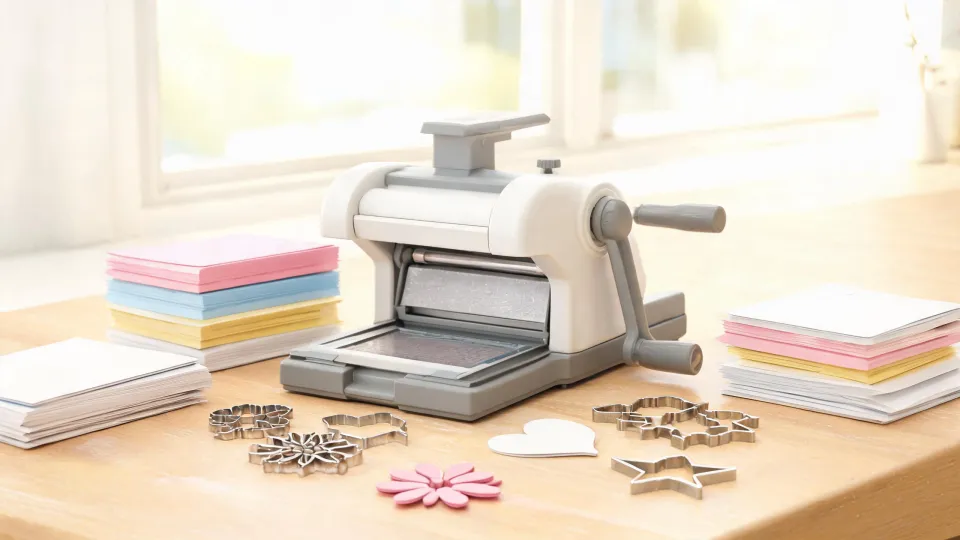
Sizzix, the Provo Craft die cutting line, isn't usually the first thing people think of for a last-minute corporate order. It's more commonly associated with scrapbooking and handmade cards. That's also exactly why it worked. The machine is dependable and the die library is enormous. When you need to produce 500 pieces of something that feels handmade, a Sizzix red die cutting machine gives you the ability to create a consistent custom shape without sending artwork to a factory.
We had two Sizzix machines in the shop, a stack of 100 lb cardstock, a roll of satin ribbon, and a die—a 4-inch scalloped circle—that we'd bought for a client project back in January. We also had a smaller star die and an embossing folder with a subtle linen texture. That was our starting point.
The plan (and the first problem)
At first, I considered trying to duplicate the original crystal gift order. That was a mistake. We would have spent the first six hours calling local engravers, checking minimum quantities, and slowly watching the deadline disappear. I had to stop myself and remember the first rule of rush work: don't let the good option get in the way of the possible one.
The plan we landed on was this:
- Use the Sizzix red die cutting machine to cut 500 ornament shapes from red cardstock, with a gold star accent punched in the center.
- Print a simple 'thank you' message and the client's logo on the front of an A7 greeting card using our in-house printer.
- Tie the ornament to a piece of satin ribbon, attach it to the card, and package each one in an envelope.
Wait, you might say: a standard business envelope is too small for a 5x7 card. Exactly right. That was the first problem. You don't put an A7 card in a #10 envelope.
What is a greeting card size? (A quick aside)
When we pitched the idea, the client's marketing coordinator asked the very reasonable question: What is a greeting card size? People know what cards look like when they buy them from a store, but the actual measurements aren't common knowledge unless you work with print.
Here are the main ones:
- A2: 4.25 x 5.5 inches. This is the 'classic small card' size you see in most retail cards.
- A6: 4.5 x 6.25 inches. A bit less common, but good for square-ish designs.
- A7: 5 x 7 inches. The most popular 'photo card' size, and roomy enough to fit the ornament in our design. (Yes, the greeting card A7 is different from an ISO A7 paper sheet—another reason this question deserves a straight answer.)
We chose A7 for the card and a 6 x 9 inch envelope, not #10. That detail alone saved us from a packaging disaster.
The 36-hour execution
With a viable plan, the steps fell into place.
The ornament shapes took the longest. We set up the Sizzix red die cutting machine with the 4-inch scalloped circle die and fed three layers of cardstock at a time. While one person cut, another folded cards and applied the printed logo. A third person tied ribbons and inserted ornaments into the cards. From 1 PM to around 8 PM, we produced 487 complete card-and-ornament sets. We set aside 13 rejects (about 2.6% waste, which I considered acceptable for an overnight run) and delivered the finished boxes to the client's hotel by 10 AM the next morning—26 hours before the conference bag-stuffing deadline.
The client was relieved. The sponsorship meeting went ahead. The corporate gift set was not a crystal gift, but it was a conversation piece. Several attendees asked where it came from, and two of them asked the client for our contact information.
What the rush actually cost
Let's talk numbers, because people always ask.
The material cost for the card, ornament, ribbon, envelope, and adhesive was about $1.35 per unit. The blank cardstock and envelopes came to about $675 for 500 sets. We paid a premium of around $140 for next-day blank stock instead of standard ground. We didn't outsource the die cutting, which is why the cost stayed low.
Total additional cost to save the project: about $815, including the next-day shipping and a temporary helper for four hours. The alternative was a $50,000 sponsorship renewal going sideways because the client showed up without gifts. I'd say the math worked out.
Honest limitations (because there always are some)
I'm not going to tell you a die-cut greeting card is better than a crystal gift. If you have three weeks, a reliable supplier, and the budget, a crystal gift is a classic for a reason. Our solution worked because the situation was specific: the client needed something with a logo, a personal touch, and a proven delivery date. Handmade is good for that.
This also worked because our shop was already set up for paper crafting. We had a Sizzix red die cutting machine, a large-format printer, and staff who could run a station without supervision. If you're starting from zero, without the right dies, then the same plan might not survive. If the order had been for 5,000 pieces instead of 500, we would have needed a commercial print partner with a steel-rule die, not a handheld machine. And if there had been a strict requirement for actual crystal glass, we would have politely declined.
One other thing: custom Sizzix dies are fantastic, but not in a 36-hour window. A truly custom die takes a week or more from Sizzix or an external die maker. We used dies we already had on the shelf. For a future rush order, I'd recommend building a small die library in your own shop first.
What I learned (again)
There's a popular idea that rush orders cost more because they're harder. Actually, it's not difficulty that drives the price. The real reason is that a rush order changes plans. It breaks production schedules, forces overtime, and pulls people off other work. That's what you pay for: not the technical challenge, but the disruption premium.
We also learned not to treat a high-volume order as if it were a craft workshop. The Sizzix machine was great for consistency, and cutting three layers at a time made it fast, but we still had to be honest about capacity. If you're looking at a deadline, ask 'what can we make with what we already have?' before you ask 'what's the ideal gift?'
As for the client's original question—can you do anything?—the answer was yes. We didn't save the crystal gift order. We saved the relationship, and the event.
If I'm being honest (surprise, surprise), that's what corporate gifting is really about.

Elise Laurent is a crystal and decorative glass quality analyst covering crystal figurines, vases, ornaments, suncatchers, and gift glassware. She examines ISO 6486-1 where food-contact glass dinnerware applies, then uses polarized strain inspection, dimensional checks, surface-defect grading, and refractive clarity to compare decorative pieces outside that scope. Her work helps sourcing teams choose materials, finishing routes, and protective packaging without confusing visual brilliance with verified durability.