Why Sizzix Die Cutting Machines Are My Go-To for Corporate Gifts and Crafts
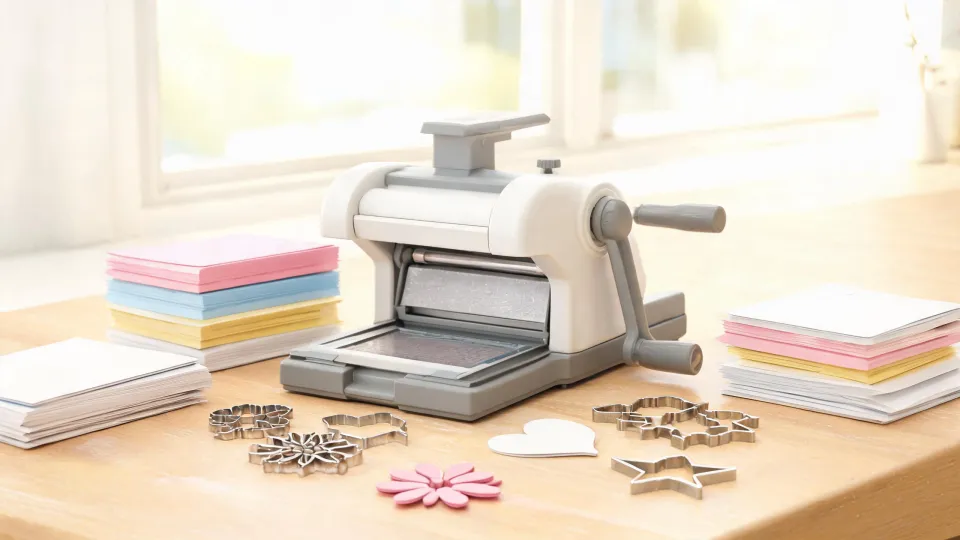
If you're sourcing corporate gifts or crafting kits for employees or clients, the Sizzix Foldaway Die Cutting Machine is the smartest investment for small-to-mid-sized orders. Not because it's the fanciest—but because it's the most practical for the kind of batch production we do.
I manage all gift and promotional ordering for a 200-person company—roughly $50,000 annually across 8 vendors. When I took over purchasing in 2020, I was making mistakes that cost us time and money. Now, I stick with Sizzix for most of our custom die-cut projects: greeting cards, ornaments, candle holders, embroidery kits, and crystal gifts. Here's why.
What I've Learned About Die Cutting Machines for Business
The Sizzix Foldaway: A Real Space-Saver
Our office doesn't have a dedicated crafting room. The Sizzix Foldaway Die Cutting Machine collapses flat—that's its killer feature. When it's not in use, it stores under a desk or in a cabinet. No bulky machine taking up floor space. I've tried other brands that required permanent counter space, and that alone made them non-starters for our needs.
Look, I'm not saying the Foldaway is the most powerful machine on the market. It won't cut through steel. But for cardstock, felt, thin acrylic, and most fabrics used in embroidery kits? It's more than enough. And the manual operation means no software updates, no power cords, no troubleshooting when IT isn't around. Just crank and cut.
Custom Dies: The Real Value
Here's the thing: the machine itself is just the tool. The real magic is in the dies. Sizzix offers both standard and custom die design and production. For corporate gifts, custom dies let us create consistent, branded shapes—company logos, event-specific motifs, or seasonal ornaments—that look professional and uniform across hundreds of units.
We ordered custom Sizzix dies for a holiday promotion: 400 ornament blanks with our logo. The dies arrived in 10 business days, and the entire production took two afternoons with a team of four. Total die cost: about $200. Compare that to ordering 400 pre-made ornaments from a vendor at $5 each—that's $2,000. We saved $1,800 and had complete control over the design. But I'll admit, I was nervous during the wait for the dies. What if they weren't sharp enough? What if the alignment was off? That week of uncertainty was stressful, but the results were worth it.
Embroidery Kits and Candle Holders: What Works
Embroidery Kits
One of our most successful initiatives was a DIY embroidery kit for employee appreciation month. We partnered with Sizzix to create custom die-cut felt shapes for embroidery projects. The kits included pre-cut felt pieces, embroidery floss, and instructions—I needed a machine that could handle multiple layers of felt without jamming. The Sizzix Big Shot Pro handled it effortlessly.
But I almost went with a cheaper machine from an unknown brand that promised the same capabilities. Saved $150 on the initial purchase. That 'budget vendor' choice looked smart until the first batch of felt sheets shredded halfway through. We ended up spending $400 on rush reorders with Sizzix and had to toss 60 ruined felt pieces. Net loss: $250. That was my penny wise, pound foolish moment—and I still kick myself for not researching better before ordering.
Candle Holders and Crystal Gifts
Candle holders and crystal gifts require precision—especially when cutting stencil film for etching or creating packaging inserts. Sizzix's electric machines (like the Big Shot Express) handle thicker materials comfortably. For our employee milestone awards, we die-cut acrylic holders that fit standard tea lights. The consistency was impressive: every piece identical, no manual cutting errors. That saved our accounting department from dealing with complaints about quality variations.
What About Fabric Cutting Machines?
If you're shopping for fabric cutting machines, you've probably seen the question: "What is the best fabric cutting machine for bulk production?" It's a reasonable concern. Most die cutting machines struggle with fabric because of fraying and stretch. Sizzix machines, especially the manual ones, handle fabric well because the pressure is consistent and you can layer materials. For straight cuts of quilting cotton or felt, they're excellent.
But here's the nuance: Sizzix machines are not designed for high-volume textile manufacturing. If you're cutting 10,000 pieces of denim a day, you want a computerized industrial cutter. For batches of 50-500 fabric pieces, Sizzix is ideal. I'd recommend testing your specific material before committing to a large run. We had success with felt and cotton, but silk and jersey were tricky—the fabric slipped in the die unless we used a stabilizer.
My rule of thumb: if you're a small business or corporate buyer doing seasonal or event-based projects, Sizzix machines are the right fit. They don't require a dedicated operator, they have low maintenance (no blades to replace), and the dies are reusable for years. That said, if you need to cut 5,000 identical polyester patches weekly, you're better off with a dedicated fabric cutter.
Small Orders, Same Service
I'll be honest: when I started, I worried Sizzix might not take small orders seriously. I was wrong. Our first order was $200 in custom dies, and they treated me like I was placing a $20,000 order. That matters. The vendors who treated my $200 orders seriously are the ones I still use for $20,000 orders. Sizzix earned that loyalty through consistent quality and communication.
They also accept smaller quantities for standard dies, which is rare in this industry. Many die making shops require minimum orders of 100+ dies. Sizzix? They'll sell you a single die for $25-40. For a small test run before committing to a large order, that's invaluable.
What I Wish I Knew When Starting
Three things I learned the hard way:
- Spend on quality dies, not the machine. A $60 manual machine with premium dies outperforms a $200 electric machine with cheap dies every time.
- Test your material before mass production. We cut a batch of candle holder stencils where the adhesive backing didn't stick to the acrylic. Wasted 200 pieces. A test run of 5 would have caught the issue.
- Custom dies take time (and may need revisions). Our first custom die had a 0.5mm alignment error—barely visible on paper, but glaring on acrylic. Sizzix fixed it quickly, but the turnaround was 5 extra days.
So glad I invested in the Sizzix foldaway machine for our office. Almost bought a cheaper knockoff, which would have meant constant troubleshooting and wasted materials. Now, our gift production runs smoothly, our accounting team saves 6 hours monthly on procurement administration, and our employees actually enjoy the DIY kits we send. That's a win.
Are there situations where Sizzix isn't the best choice? Yes. If you need ultra-high volume production (thousands of identical cuts daily) or you're cutting exotic materials (multi-layer leather, thick acrylic sheets over 3mm), look elsewhere. But for most corporate gifting, event merch, and craft kits, Sizzix is the right call.

Elise Laurent is a crystal and decorative glass quality analyst covering crystal figurines, vases, ornaments, suncatchers, and gift glassware. She examines ISO 6486-1 where food-contact glass dinnerware applies, then uses polarized strain inspection, dimensional checks, surface-defect grading, and refractive clarity to compare decorative pieces outside that scope. Her work helps sourcing teams choose materials, finishing routes, and protective packaging without confusing visual brilliance with verified durability.