Standard Dies vs. Custom Sizzix Dies: Which One Actually Saves Your Rush Order?
-
What We're Comparing: Standard Stock Dies vs. Custom Sizzix Dies
-
Dimension 1: Flexibility & Customization – The Custom Die Wins, But With a Catch
-
Dimension 2: Cost-Effectiveness for Small Batches – The Surprise Winner
-
Dimension 3: Quality Consistency & Turnaround Reliability – The Deciding Factor in a Rush
- When to Use Which: A Practical Scenario Guide
-
Final Word: There's No One Right Answer—There's the Right Answer for Your Deadline
Look, I've been in the trenches of B2B gift and promo production for years. When a client's corporate event is 48 hours away and the greeting card design just got rejected, you don't have time for theory. You need a solution that works. Now.
That's where the die-cutting decision hits you. Do you grab a standard Sizzix die off the shelf, or do you call in for a custom Sizzix die? From the outside, it looks like a simple choice: standard is faster and cheaper, custom is slower and more expensive. The reality? In a rush, that assumption can cost you the contract.
Let me break down the real trade-offs. I've managed over 200 rush orders in the last three years alone—ranging from emergency greeting card runs for a major tech launch to last-minute candle holder redesigns for a luxury hotel chain. Here's what I've learned about when to use which.
What We're Comparing: Standard Stock Dies vs. Custom Sizzix Dies
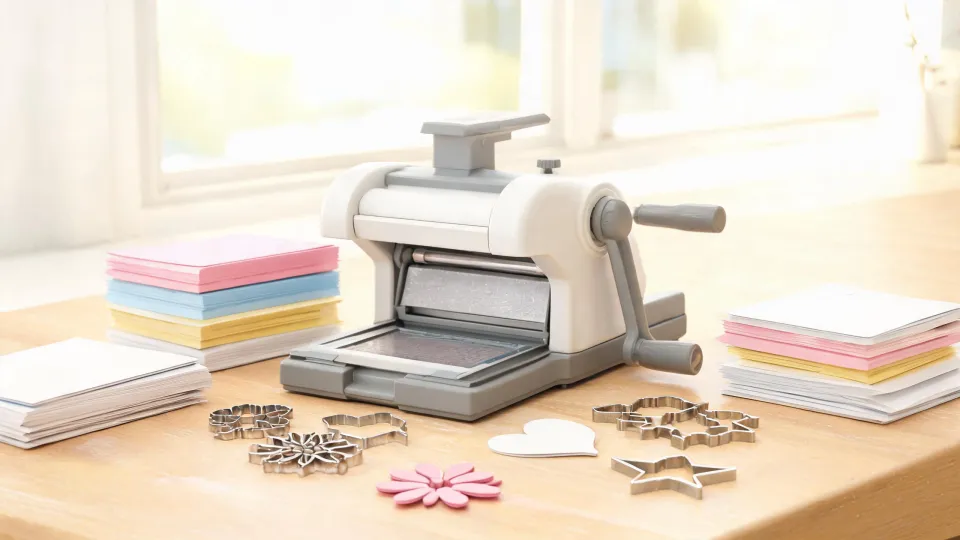
Before we dive into the dimensions, let's set the framework. We're comparing standard stock dies (pre-made shapes you can buy off the shelf) against custom Sizzix dies (made-to-order for your specific design). The comparison criteria are the ones that matter most when the clock is ticking: flexibility, cost-effectiveness at small volumes, and quality consistency.
Dimension 1: Flexibility & Customization – The Custom Die Wins, But With a Catch
Here's the thing: when a client says, 'We need a greeting card in the exact shape of our new logo,' a standard die isn't going to cut it (pun intended). You need a custom Sizzix die that matches that logo precisely. No alternative.
Standard die: You're limited to existing shapes—circles, squares, basic flowers, generic ornaments. Great for volume. Useless for a logo.
Custom Sizzix die: You get exactly what you need. The catch? The production time. A custom die typically takes 3-5 business days to manufacture. In a 48-hour rush, that's a dealbreaker unless you plan ahead or pay for emergency die-making (which we've done—more on that later).
Conclusion: If your design is unique and you have at least a week's lead time, custom wins hands down. If you're scrambling for a 24-hour turnaround, you're stuck with what's on the shelf.
Dimension 2: Cost-Effectiveness for Small Batches – The Surprise Winner
People assume custom dies are only for big budgets and big runs. That's a surface illusion. (What most people don't realize is that the cost of a custom die gets amortized over the number of cuts. For small batches of 50-200 units, the per-unit die cost can actually be higher than a standard die. But here's the twist: for very small, high-value runs—like a corporate gift for a board of directors—the custom die's impact justifies the premium.)
Standard die: No upfront die cost. You buy the die once, use it forever. Perfect for recurring standard shapes. Per-unit cost is minimal.
Custom Sizzix die: Die cost is usually $150-$400 depending on complexity. For a one-off run of 100 greeting cards, that adds $1.50-$4.00 per card. That sounds expensive. But if that card is part of a $15,000 corporate gift package? It's negligible.
Here's the insider knowledge: for small orders (under 500 units), the custom die often isn't the expensive option compared to hand-cutting or laser-cutting each piece individually. The labor savings are real. I've seen a $12,000 project saved by paying $350 for a custom die instead of $2,000 for hand-cutting 300 ornaments.
Conclusion: For very small, high-value runs, custom dies can be surprisingly cost-effective. For medium-volume standard shapes, standard dies are cheaper. For high volume (1000+), the per-unit cost of custom dies plummets and they become the obvious choice for branded work.
Dimension 3: Quality Consistency & Turnaround Reliability – The Deciding Factor in a Rush
In my first year, I made the classic specification error: assumed 'standard' meant the same thing to every vendor. Not with dies. A standard Sizzix die from a trusted brand like Sizzix (especially the Tim Holtz collaboration lines) cuts consistently every time. A cheap generic die from an unknown manufacturer? Not so much.
Standard Sizzix die: Known quality. The machine alignment is precise. You know exactly what shape you'll get. The risk is low. For rush orders, this predictability is gold.
Custom Sizzix die: The quality depends entirely on the manufacturer. Sizzix's custom die service is good (they use the same standards as their stock dies), but you're adding a variable. I learned this the hard way when a custom die from a discount vendor produced a slightly off logo—the 'S' in the logo looked stretched. Cost us a $600 redo and a 3-day delay (ugh).
For rush orders, the reliability question is critical. I'd rather use a standard Sizzix Big Shot Plus die that I know works than risk a custom die that might need tweaking. Unless the design is so specific that standard won't do—then you have no choice.
Conclusion: For reliability in a rush, standard dies win. For brand-critical custom shapes, invest in a reputable custom die maker (like Sizzix) and build in a buffer for testing.
When to Use Which: A Practical Scenario Guide
Based on my experience, here's how I make the call:
Go with Standard Sizzix Dies When:
- You're in a true emergency (24-48 hour turnaround).
- The design is a common shape (circle, square, simple ornament).
- You're doing a large volume (500+ units) and the shape is standard.
- You need to test a product concept before committing to a custom die.
Go with Custom Sizzix Dies When:
- The design includes a logo, unique shape, or specific branding.
- You have at least 5-7 business days for production.
- The order is for a high-value corporate gift where the die cost is a small fraction.
- You plan to reuse the custom die for future orders (the die cost gets cheaper per run).
For Small Businesses & First-Timers (The 'Small Customer' Perspective)
I get it—small orders feel like a hassle. But here's my take: good suppliers treat every order with respect. I built my current business on the vendors who took my $200 greeting card orders seriously. They're the ones I still call for $20,000 projects. Small doesn't mean unimportant—it means potential. Sizzix's standard dies are perfect for testing the waters on a new product line without a big upfront investment. Start small, prove the concept, then invest in a custom die for volume.
Final Word: There's No One Right Answer—There's the Right Answer for Your Deadline
If I could sum up 200 rush orders worth of experience into one piece of advice: know your timeline before you choose your die. Standard dies are your safety net. Custom dies are your precision tool. Both have their place. The mistake is assuming one is always better than the other.
And when in doubt? Call the supplier. Ask about their custom die turnaround. Ask if they have rush die-making options. Some vendors (like Sizzix) can expedite custom dies for an extra fee. That $100 rush fee might save you the $15,000 contract.
I should add: always keep a few standard Sizzix Big Shot Plus dies in your drawer—the classic shapes. You never know when you'll need them at 4 PM on a Friday.

Elise Laurent is a crystal and decorative glass quality analyst covering crystal figurines, vases, ornaments, suncatchers, and gift glassware. She examines ISO 6486-1 where food-contact glass dinnerware applies, then uses polarized strain inspection, dimensional checks, surface-defect grading, and refractive clarity to compare decorative pieces outside that scope. Her work helps sourcing teams choose materials, finishing routes, and protective packaging without confusing visual brilliance with verified durability.