Sizzix Die Cutting Machines & Dies for Promotional Products: A B2B Buyer's Guide
-
What's the difference between Sizzix die cutting machines & dies for B2B use?
-
How do custom Sizzix dies work for promotional products?
-
How does the Sizzix gift card holder die actually work?
-
How do you estimate the true cost of a die-cut project?
-
What cardstock should you use for a die-cut greeting card or gift card holder?
-
Where to buy scrapbooking supplies online for bulk Sizzix projects?
-
Why does die-cut consistency matter for corporate gifts?
-
Should you buy a Sizzix machine for in-house production or outsource?
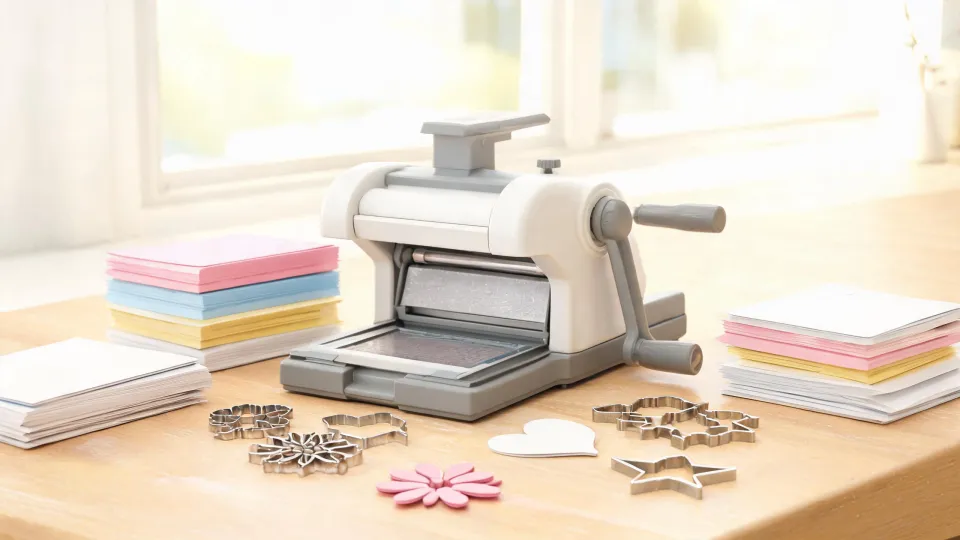
I'm a procurement manager at a 40-person promotional products distributor, and I've logged every order in our cost tracking system for the past six years. This guide isn't a craft tutorial. It's the buyer's checklist I wish I had before investing in Sizzix die cutting machines & dies for corporate gifts, greeting cards, and custom packaging.
What's the difference between Sizzix die cutting machines & dies for B2B use?
Short answer: it depends on the size of the products you're making and how many you need to produce.
If you're making small items like tags, gift card holders, and ornaments, a compact manual machine like the Sizzix Sidekick or Big Shot Express is enough for samples and short runs. If you're cutting larger pieces, say 8.5 x 11 inches greeting cards or multiple shapes at once, you want a wider platform like the Big Shot Pro. The rule I've learned from comparing quotes is simple: buy the machine that matches your most common finished size, not the one that looks most impressive in a catalog.
From a total cost standpoint, the machine is rarely the biggest line item. Dies, cardstock, labor, and waste will dwarf the hardware cost quickly. In 2021, I approved a larger machine than we actually needed because I assumed it would give us more flexibility. It didn't. It just took up more space.
How do custom Sizzix dies work for promotional products?
Custom dies are steel-rule dies made to fit Sizzix machines. You send vector artwork to a die maker, they build the cutting and scoring tool, and then the machine presses it through cardstock or thin materials. It's how you turn an ordinary greeting card into a branded pop-up or gift card holder.
The one-time die cost is the hidden line item most buyers miss. A custom branded die for a holiday campaign might run $150-$400, depending on size and detail. That sounds painful until you spread it over 2,000 greeting cards. We've reused the same custom die for three consecutive corporate holiday campaigns, so the per-unit cost drops a lot.
I'm not a structural packaging engineer, so I won't pretend to design a complex dieline. What I can tell you as a buyer: get a physical sample of the die cut before you commit to a full run. A digital proof won't show you how the cardstock tears, folds, or has burrs around the edges.
How does the Sizzix gift card holder die actually work?
The Sizzix gift card holder die cuts and scores a folder meant to hold a gift card. You run it through the machine with cardstock, fold along the scored lines, and a standard gift card slides into the pocket.
It sounds simple, but the tolerance is tight. If the pocket is too loose, the card falls out. Too tight, and the recipient has to wrestle with it. In my first year as a buyer, I approved a gift card holder based on the design proof and didn't test it with an actual gift card. The first production batch was useless: the card kept sliding out. We had to re-run 2,000 units with a different die. That's exactly the kind of mistake that doesn't show up in a cost spreadsheet until it's too late.
My rule now: order a sample, put a real gift card in it, and give it to someone who isn't being careful. If it survives that test, it can go into production.
How do you estimate the true cost of a die-cut project?
Use a total cost formula, not a per-piece quote. The line item you see on a supplier's website is only the beginning.
- Machine cost or rental, if in-house
- Custom die setup ($50-$200 for standard die cutting, more for complex custom dies)
- Cardstock, envelopes, and packaging
- Labor for cutting, folding, and inserting
- Waste and redo risk
- Shipping and any rush fees
Color is another hidden cost. Industry standard color tolerance is Delta E less than 2 for brand-critical colors, which means the printed version should match your Pantone spec closely. But that level of matching costs money. I've compared quotes where one vendor looked 30% cheaper until I found the color matching and setup fees on the second page.
Bottom line: always ask for a full breakdown before comparing.
What cardstock should you use for a die-cut greeting card or gift card holder?
For a standard fold-and-mail greeting card, 100 lb text (about 150 gsm) is a common choice. For gift card holders and anything that needs to stand on a desk, use 80 lb cover (about 216 gsm) or heavier. That's roughly business-card weight, so it holds up.
The important part is to test with your exact stock. The same cardstock can cut differently depending on the die condition, machine pressure, and whether it's printed before cutting. A score that works on one paper fiber direction might crack on another. That's not a marketing issue; it's a mechanical one.
There's something satisfying about opening a box of 5,000 die-cut cards and seeing the first one come out perfectly. Don't let that happen by luck. Ask for a mock-up that uses the same cardstock, same printing process, and same die.
Where to buy scrapbooking supplies online for bulk Sizzix projects?
If you're looking for a single die or a few packs of cardstock, online scrapbooking retailers like Scrapbook.com, Amazon, and craft stores are fine. But for a B2B project, retail prices are not your benchmark.
For bulk dies and materials, work with an authorized Sizzix distributor or a promotional products supplier that carries custom Sizzix dies. They can give you wholesale pricing, set up business accounts, and coordinate custom die production. That's not the same as buying 50 gift card holder dies from a consumer website.
The phrase 'where to buy scrapbooking supplies online' will bring up a lot of consumer options. My advice: use those for prototyping and small samples, and switch to a distributor when you need consistent quality, volume pricing, and a paper trail.
Why does die-cut consistency matter for corporate gifts?
Because a branded gift is a representation of your company. If one card has a bent fold and another has rough edges, recipients notice. They don't think 'handmade charm' when a corporate logo is on the card. They think 'this company sends out sloppy work.'
Die cutting is consistent by nature, but only when the tooling is maintained and the machine is set up correctly. A worn die tears cardstock after thousands of cuts. If you're reusing a custom die from last year, ask the supplier to inspect it before you run a large order.
Also, be honest with yourself: die cutting isn't always the right finishing step. For simple rectangular greeting cards, a standard digital print might do the job at half the cost. Die cutting makes sense when the shape or functionality, like a gift card holder, adds real value.
Should you buy a Sizzix machine for in-house production or outsource?
For most corporate marketing teams, outsourcing is cheaper. If you only do holiday cards once a year, you don't want to buy a machine, store it, maintain it, and pay someone to run it.
For promotional products distributors doing short-run custom work, an in-house Sizzix machine can pay for itself quickly. We use ours for small batches of 50 to 200 units for client events and internal campaigns. But when a project passes 1,000 units, we send it to a commercial die cutter. The math flips because labor and waste become bigger than the per-unit savings.
I'm not a manufacturing engineer, so I can't tell you the exact breakeven for your operation. What I know from procurement is that you should run the numbers with your own labor cost, not guess. That's the honest answer.

Elise Laurent is a crystal and decorative glass quality analyst covering crystal figurines, vases, ornaments, suncatchers, and gift glassware. She examines ISO 6486-1 where food-contact glass dinnerware applies, then uses polarized strain inspection, dimensional checks, surface-defect grading, and refractive clarity to compare decorative pieces outside that scope. Her work helps sourcing teams choose materials, finishing routes, and protective packaging without confusing visual brilliance with verified durability.