How to Order Custom Sizzix Dies for Corporate Gifts When You're Already Behind Schedule
-
When This Checklist Helps (and When It Doesn't)
-
The 6-Step Rush Checklist for Custom Sizzix Orders
-
Step 1: Confirm your material before you choose a machine
-
Step 2: Check custom die lead times before you fall in love with a design
-
Step 3: Order a physical sample before the full run
-
Step 4: Treat the packaging as part of the gift, not an afterthought
-
Step 5: Factor in assembly time separately
-
Step 6: Get final approval in writing, including Pantone references
-
Step 1: Confirm your material before you choose a machine
-
Common Mistakes I Still See
-
The Honest Bottom Line
I'm the person who gets called when a corporate gift order is falling apart. For the last two years, I've coordinated custom die-cut projects at a branded merchandise company. I've handled 214 rush orders—including one where a client called at 7 a.m. on a Tuesday needing 300 custom ornaments for a Friday morning sales kickoff. Normal lead time on custom Sizzix dies is 10–15 business days. We got them made in 72 hours, but it cost more and required a lot of honesty from every vendor involved.
This checklist is for other B2B buyers, promotional distributors, and gift box assemblers who need Sizzix products on a deadline. It's not a list of every possible step. It's the one I wish someone had given me before I learned some of these lessons the expensive way.
When This Checklist Helps (and When It Doesn't)
Use this if you need custom Sizzix dies for a corporate event, a client gift, a promotional insert, or a product launch. If your drop-dead date is inside the usual 10–15 business day lead time, this will help you prioritize. If you have three months, you don't need half of these steps. If you need 5,000 identical pieces delivered tomorrow, a custom die is not where you should start—you'd be better off with a stock die and an overnight print shop.
I'll say it plainly: custom dies are not for every project. A custom Sizzix die is a tool, not a miracle. But when it's right, it makes a corporate gift feel personal in a way a printed logo alone can't.
The 6-Step Rush Checklist for Custom Sizzix Orders
Step 1: Confirm your material before you choose a machine
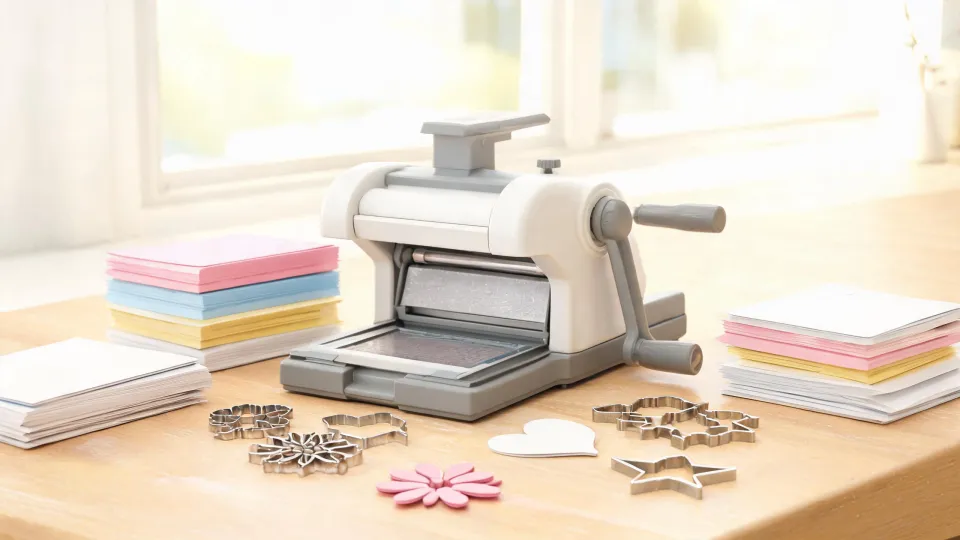
The Sizzix Big Shot Pro die cutting machine is our workhorse for larger corporate gifts. It handles wider formats and thicker materials than the standard manual machine. We use it to cut 6-inch by 12-inch greeting cards, layered ornaments, and padded fabric pieces for embroidery kits. But here's the catch: if your project is mostly cardstock and thin felt, a standard Big Shot is probably enough. Don't buy the Pro just because it sounds more impressive. The material dictates the machine, not the size of the order.
For small die-cut shapes like gift tags, even a Sizzix Sidekick can be the right call. The point is to match the machine to the material. For crystal gift items, you're not going to cut crystal with any Sizzix machine. We use Sizzix dies for the printable packaging, the card insert, and the backing board that goes with crystal gifts. Know the difference before you pitch a solution to your client.
Step 2: Check custom die lead times before you fall in love with a design
Custom Sizzix dies typically take 7–15 business days, plus shipping. As of Q1 2025, our standard custom die has been coming in around 10 business days. That changes with the season, so verify the current timing before locking in a promise to your client. In my experience, the lead time between the first quote and the final invoice is where scope creep happens.
The Sizzix app is genuinely useful here. You can upload vector art, select the die size, and see early warnings about scale or complexity. I also use it to show clients a rough mock-up before we commit to tooling. It's not perfect—I've had files that looked fine in the app but still needed manual tweaks. But using the app prevents a lot of "what did you mean by this?" emails.
If you're already at day six, you need to call a vendor and ask about expediting. We paid $180 extra for a 72-hour custom die in June 2024. That was on top of the $240 base cost. It felt painful at the time, but it saved a $15,000 contract. That's the math that matters.
Step 3: Order a physical sample before the full run
I cannot overstate this. In October 2024, we skipped a sample for a 1,200-piece order because the client was in a hurry. The design looked clean on screen. On the actual textured cardstock, the score lines didn't crack on the crease—they tore. We replaced the stock and reordered the die with a slight depth adjustment. The wasted material cost $650, but the bigger loss was two days we didn't have.
A sample is not a full prototype, but it tells you whether the die and the material are compatible. If a vendor says you don't need a sample, that's a red flag. After three failed rush orders with discount vendors, we now only use die manufacturers who will produce a sample before a production run. It's a deal-breaker for me.
Step 4: Treat the packaging as part of the gift, not an afterthought
In the corporate gift world, unboxing matters. A custom die-cut greeting card or an ornament can be the hero piece, but it needs a box, a bag, or at least a belly band to make it feel like a gift. We often combine a Sizzix die-cut ornament with a candle or a reed diffuser to round out the box.
And if you've just searched "where can i find a reed diffuser on sale" because a client asked for one at the last minute—yeah, I've been there. We source reed diffusers separately from our die-cut vendor. Their lead times have nothing to do with the Sizzix order. Don't let the diffuser decision delay the piece that actually has the longest production time.
The numbers sometimes say to share more, but my gut says keep the die-cut piece central. I've seen gift boxes get too crowded. One hero item, a scent, and a small practical insert—that's usually enough. If a client asks for a single engraved crystal gift, a die cutting machine isn't the tool. But if you're producing 200 crystal gifts and need the inserts and cards to match, Sizzix is a solid choice.
Step 5: Factor in assembly time separately
Dies and machines are only half the equation. A 500-piece order of layered ornaments—three paper layers, a ribbon, and a header card—will take a small team about a full day to assemble. People underestimate assembly time by 30% at least. We learned this the hard way in December 2024. We had 800 gift boxes due on a Monday. The numbers on the schedule said cutting would be the bottleneck. My gut said assembly was going to be the problem. We ignored my gut because the cutting line was already running ahead. Turns out assembly was exactly what slowed us down. We had to pull two people off another project to make the deadline.
The surprise wasn't that the dies arrived on time. It was that the cutting ran ahead of schedule and still didn't matter. Since that experience, our company policy now requires a 48-hour buffer between die delivery and the final ship date. It's annoying some days, but it has saved us more than once.
Bottom line: create a separate assembly schedule with its own buffer. Don't assume the die cutter will be the slowest step.
Step 6: Get final approval in writing, including Pantone references
For branded corporate gifts, color consistency is where projects fall apart. If you're matching a logo color, specify a Pantone number. Industry standard tolerance is Delta E < 2 for brand-critical colors. Delta E of 2–4 is noticeable to trained observers; above 4 is visible to most people. And keep in mind that Pantone colors may not have exact CMYK equivalents. A deep corporate blue that looks right on a screen can print surprisingly purple if no one checked the reference. Reference: Pantone Color Matching System guidelines.
This isn't just a print issue. The Pantone reference matters for the paper, cardstock, or ribbon you're pairing with the die-cut piece. We once approved a "festive red" ornament without a Pantone number. The die was fine. The color was a Christmas-coral. Not ideal.
Common Mistakes I Still See
The most frustrating part of vendor management for rush orders is seeing the same issue recur despite clear communication. You'd think written specs would prevent misunderstandings, but interpretation varies wildly. So I've learned to put even the obvious things in writing.
- Assuming the custom die cost includes a sample. It usually doesn't. Ask separately.
- Choosing a standard die when a custom one is actually unnecessary. Standard Sizzix dies are cheaper and often ship next day. If a stock shape works, use it. Custom is for when the shape doesn't exist.
- Mixing Pro and standard platforms. The Sizzix Big Shot Pro uses different-sized platforms for oversized dies. Check compatibility before you place an order. We've done this wrong and it's a frustrating way to lose a day.
- Believing a die cutting machine can handle any material. If someone tells you that, run the other way. There are always limitations, and knowing them is what makes a custom die project successful.
The Honest Bottom Line
This pricing and lead-time information was accurate as of Q1 2025. The market changes fast, so verify current custom die lead times and shipping costs before you budget. I don't have hard data on industry-wide custom die failure rates—I wish I had tracked that more carefully. Based on our own orders, I'd guess that about 10% of first-run custom die projects need a modification. That's why samples aren't optional.
If you're on the fence about whether Sizzix is right for a corporate gift, ask yourself three questions: Do you need more than 100 pieces? Does the design benefit from a unique shape? Do you have 10 business days of lead time? If yes to all three, it's likely a no-brainer. If no, there may be a better route.
Take it from someone who has pulled off more rush orders than I can count: the checklist above won't make a deadline magical. It just keeps you from making the same mistakes twice. And in this industry, that's a win.

Elise Laurent is a crystal and decorative glass quality analyst covering crystal figurines, vases, ornaments, suncatchers, and gift glassware. She examines ISO 6486-1 where food-contact glass dinnerware applies, then uses polarized strain inspection, dimensional checks, surface-defect grading, and refractive clarity to compare decorative pieces outside that scope. Her work helps sourcing teams choose materials, finishing routes, and protective packaging without confusing visual brilliance with verified durability.