How a Sizzix Die-Cutting Machine Fixed Our Corporate Gift Disaster (A Buyer's Honest Review)
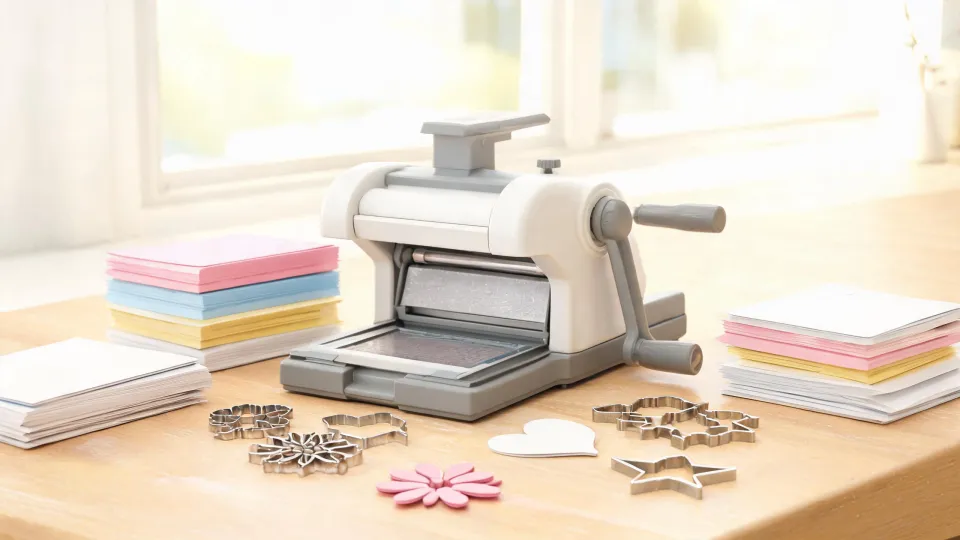
Last November, our VP of Marketing walked into my office holding a box of greeting cards that looked... almost right. The die-cut snowflake was there. The logo was there. But the fold was crooked, and every single card had a scratch across the middle. We'd ordered 300.
Can we fix these? she asked. Fix them, no. Reorder, maybe—if we had two weeks and another $500. Which is how I ended up researching die-cutting machines instead of wrapping up the holiday budget.
First, a little context. I'm an office administrator for a 200-person company. I manage all corporate gift ordering—roughly $40,000 annually across eight vendors. I've been doing this since 2020, when I took over from someone who retired. It took me about six months to realize where the real costs were hiding.
The problem with "cheap" printed greeting cards
For years, we ordered holiday cards and promotional products from a large online printer. Business cards, letterhead, welcome packets. The per-unit pricing looked great on the quote (which, honestly, meant nothing when the final invoice arrived). But every time we needed a custom die-cut greeting card or a branded giveaway, the numbers went sideways.
Most buyers focus on per-unit pricing and completely miss setup fees, minimum quantities, and proof revisions that can add 30 to 50 percent to the total. The question everyone asks is, What's your best price? The question they should ask is, What's included in that price?
Last year, our die-cut holiday card quote seemed reasonable: $1.15 per card for 300 cards. But then came a $350 setup fee for the custom die, a $95 shipping charge, and a $180 reprint because the die was misaligned on the first run. That put us at over $3.80 per card. It was not a cheap card by the time it showed up.
The accidental Sizzix solution
Our junior marketing coordinator had used a Sizzix die-cutting machine at a previous job. She asked why we didn't make the cards ourselves. I laughed. In-house? We're not a craft shop.
But she kept pushing. So I checked the Sizzix official website. I wanted to see what we'd actually need to produce a simple branded greeting card. The full product listing calls it the Provo Craft Sizzix die-cutting machine line. There are manual and electric options. I settled on a Big Shot Express and a Sidekick, and ordered custom Sizzix dies with our company logo and a snowflake outline.
One thing I learned quickly: start with the die, not the machine. The die determines what you can produce. The machine is just how you apply it. On the Sizzix official website, the custom die section is where you design the actual cut shape. We sketched our idea, uploaded the file, and received a die about two weeks later. (This was back in October 2024, so the custom die process may have changed—but it was straightforward then.)
The first disaster, and the fix
The first batch was a mess. I ordered a logo die that was too small for the card front. We didn't have a formal process for cutting, stacking, or checking quality—cost us an entire stack of cardstock. The third time we ruined a batch, I finally created a one-page checklist: card size, die size, plate order, pressure setting, and a sample test before the full run. Should have done that after the first failure.
Once we fixed the process, something clicked. We made 75 greeting cards with a custom die-cut front in about two hours. Not commercial speed, but enough for our top clients and referral partners. Every cut lined up. We controlled the quality from start to finish.
There's something satisfying about watching plain cardstock turn into a perfectly cut stack of cards. After the reprint fiasco the year before, seeing the VP smile at a finished product made the whole experiment worth it.
Where to buy a photo book for the bigger gift
Around the same time, we wanted a more substantial thank-you for our 15 biggest clients. I spent an embarrassing amount of time trying to figure out where to buy a photo book in bulk. For a one-off, any online photo service works. For a small batch, you need volume pricing and fast delivery. We ordered a custom photo book showing our company's year in photos, and it was a nice gesture. But it needed a branded wrapper. Rather than pay $2.50 per custom mailer from a specialty packaging vendor, we cut a simple cardstock band with the Sizzix machine. The band held the book closed, showed our logo, and doubled as a return address label. It looked like an expensive branding agency did it.
What it actually cost
Here's the honest math from our first Sizzix holiday season:
- Big Shot Express machine: around $200 (Sizzix official website, early 2025; verify current pricing)
- Custom company-logo Sizzix die: around $45
- Cardstock, envelopes, and photo book supplies: roughly $150
The year before, we paid over $1,150 for 300 printed die-cut greeting cards and still ended up with cards we were embarrassed to send. This year, our materials for 75 custom cards and 15 branded photo book wraps came to about $150. The machine cost extra, but it's already more than paid for itself. Next year, the cards cost just the cardstock and the time.
The lesson: total cost, not sticker price
In my experience managing vendor relationships for this company over the last five years, the lowest quote has cost us more in at least half the cases. That $200 savings turned into a $1,500 problem when a rush fee and a reprint got added to an invoice. With Sizzix, we don't avoid every surprise—we just control more of them ourselves.
What I mean is that the "cheapest" option isn't just about the sticker price—it's about the total cost, including your time spent managing issues, the risk of delays, and the potential need for redos. A die-cutting machine shifts that balance for short-run corporate work.
Maybe the old "in-house isn't scalable" thinking was true twenty years ago, when in-house meant scissors and glue. Today, a die-cutting machine changes the math. We're not replacing a commercial print shop for a 10,000-unit order. But for 50 to 300 pieces, the Sizzix route is faster and more flexible than outsourcing.
Should you do this? My honest answer
Is a Sizzix die-cutting machine right for every corporate gift program? No. If you need 50,000 identical die-cut cards by Friday, find a reliable commercial printer. But for custom greeting cards, small-batch promotional products, and branded gift packaging, it's worth considering.
Since that first holiday season, we've used the machine for more than cards. We make custom die-cut gift tags for every promotional product we hand out—water bottles, notebooks, tote bags. A $5 notebook with a branded die-cut tag feels like a $15 gift. That's value that doesn't show up on a per-unit comparison.
If you ask me now, the question isn't whether in-house die-cutting is cheaper. The question is whether you want to be at the mercy of a print vendor's schedule and minimums. For us, Sizzix became part of the toolkit. It didn't replace every vendor—but it replaced the most expensive one.

Elise Laurent is a crystal and decorative glass quality analyst covering crystal figurines, vases, ornaments, suncatchers, and gift glassware. She examines ISO 6486-1 where food-contact glass dinnerware applies, then uses polarized strain inspection, dimensional checks, surface-defect grading, and refractive clarity to compare decorative pieces outside that scope. Her work helps sourcing teams choose materials, finishing routes, and protective packaging without confusing visual brilliance with verified durability.